English Русский
Български
Беларускі
Український
Српски
Hrvatski
Română
Polski
Slovenský
Magyar
Articles Bookmark Contacts Sitemap   
Company Audi Company Ford Company Hyundai Company Kia Company Mazda Company Mercedes-Benz Company Nissan
MitsubishiMan.ru


Home Colt Lancer Galant L200 Outlander Pajero Others
L200 4 (2005-2014, diesel)

History of generations of the Mitsubishi L200 car

  • Home
  • L200
L200, 4-door, 2016 year 
L200, 4-door, 2016 year
Mitsubishi L200 — is a pickup truck with a body, produced by the Japanese automaker Mitsubishi Motors Corporation from 1978 to the present. The body was two-door or four-door (appeared in the second generation) with rear or all-wheel drive. It has different names in different countries. In Japan, it was called Forte, and since 1991, Strada. In the United States, Chrysler sold it under the names Dodge Ram 50 and Plymouth Arrow, as well as Mitsubishi Mighty Max. In most other countries, it is called L200, and there were also less common names Triton, Rodeo, Colt, Storm, Magnum, L200 Strakar and others. The fifth generation of this car is currently being produced. The Dodge Dakota pickup truck is based on the Mitsubishi Raider platform and has no relation to the L200.

The main classmates and competitors of the Mitsubishi L200 pickup truck are currently the Chevrolet Colorado, Dodge Dakota, Ford Ranger, Fiat Fullback, Great Wall Wingle, GMC Canyon, Honda Ridgeline, Mazda BT-50, Nissan Navara, Nissan NP300, Suzuki Equator, SsangYong Actyon Sport, Toyota Hilux, Toyota Tacoma, UAZ Patriot Pickup and Volkswagen Amarok.

First generation (1978-1986)
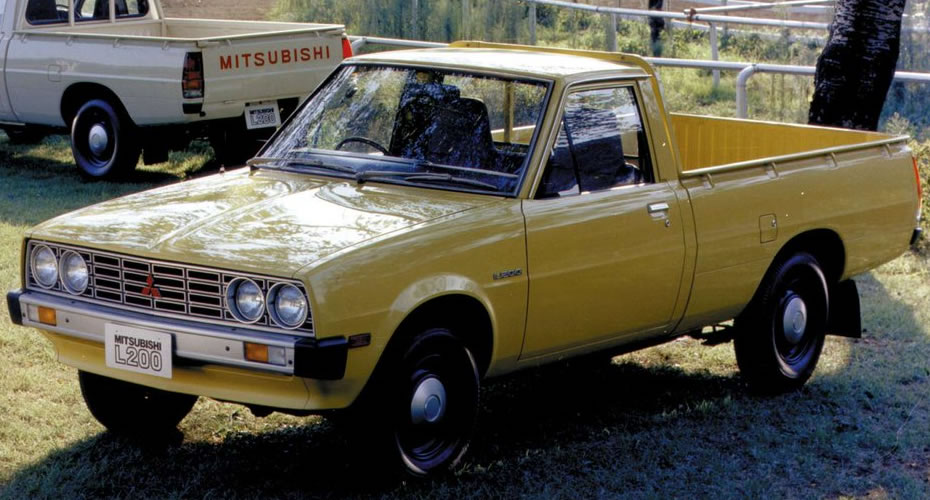


L200, 2-door, 1978 year 
L200, 2-door, 1978 year
The first generation of the pickup appeared in 1978 in Japan under the name "Forte". The body was only two-door with two seats for people in the cabin. The length of the car was 4690 mm, the width was 1650 mm and the height was 1560-1645 mm. Other names under the Mitsubishi brand were "L200", "L200 Express", "L200 Power X", "Mighty Max", under other brands the names were "Chrysler D-50", "Chrysler L200 Express", "Dodge D-50", "Dodge Ram 50" and "Plymouth Arrow Truck". Assembly was carried out only in Japan. The engine was located in the front longitudinally, rear-wheel drive or all-wheel drive, which appeared in 1981. The entire structure and body are assembled on a load-bearing steel frame. In 1979, the car received the "Pickup of the Year" award in the USA.

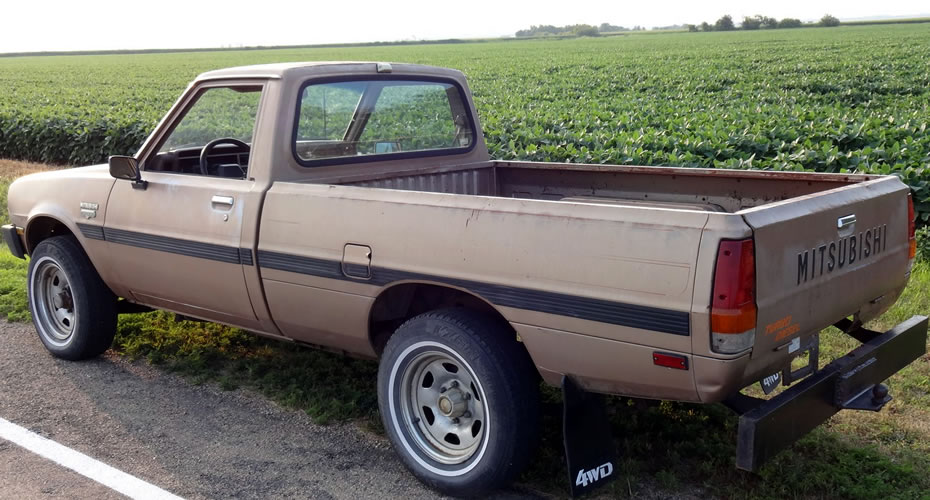
L200, back view, 1983 year 
L200, back view, 1983 year
The petrol engines were all four-cylinder in-line with a capacity of 1.6 litres (1597 cm³, 4G32/G32B, 91 hp), 2.0 litres (1995 cm³, 4G52, 93 hp), 2.0 litres (1997 cm³, 4G63/G63B, 108 hp) and 2.6 litres (2555 cm³, 4G54, 105 hp). There were two models of diesel engines, also four-cylinder with a capacity of 2.3 litres (2346 cm³, 4D55, 67 hp) and 2.5 litres (2476 cm³, 4D56, 73 hp). The gearbox was four- or five-speed manual.

The front wheels had disc brakes, a spring front suspension, and a leaf spring rear suspension with shock absorbers mounted on them. The all-wheel drive system included an additional lever located next to the main speed switch. When shifting, the car moves at half speed for any given engine speed.

Second generation (1986-1996)
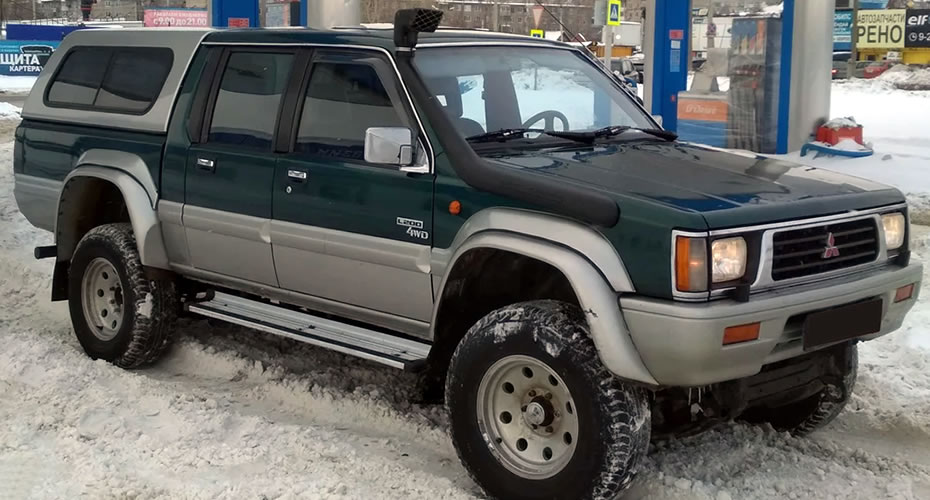


L200, 4-door, 1995 year 
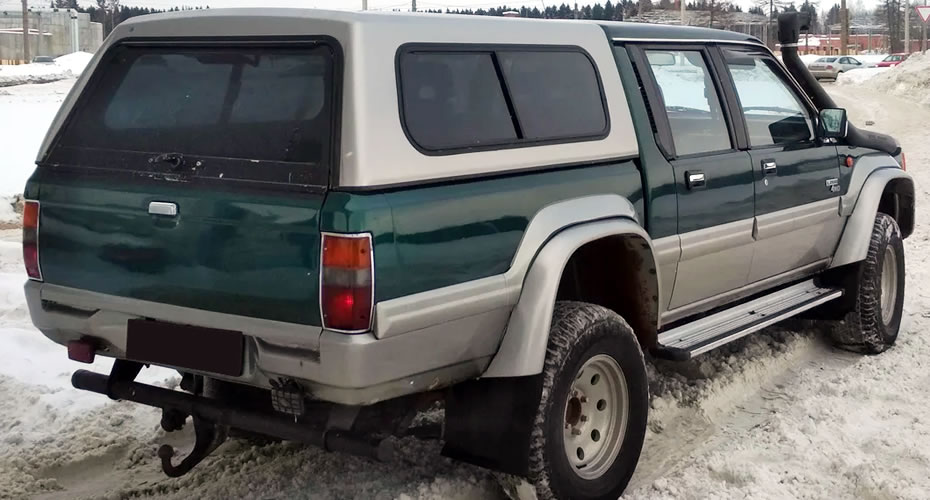
L200, 4-door, 1995 year
In 1986, the second generation of the pickup was introduced. In addition to the two-door body (length 4501 mm, width 1655 mm, height 1486 mm), a four-door model appeared (length 4920 mm, width 1655 mm, height 1506 mm). The curb weight was 1220-1635 mm. Pickups were not sold in Japan for several years, so they returned under the name "Strada" in March 1991. In Australia, the car was called "Triton", in Thailand "Cyclone", in South Africa "Colt", and there were also names "L200" and "Mighty Max". Chrysler sold this pickup under the name "Dodge Ram 50", and in 1987 its successor "Dodge Dakota" appeared.

L200, back view, 1995 year 
L200, back view, 1995 year
There were three models of four-cylinder petrol engines with a volume of 2.0 liters (1997 cm³, 4G63/G63B, 92 hp), 2.4 liters (2351 cm³, 4G64, 145 hp) and 2.6 liters (2555 cm³, 4G54, 131 hp), as well as one V-shaped six-cylinder with a volume of 3.0 liters (2972 cm³, 6G72, 141 hp). There were two models of diesel engines, both with a volume of 2.5 liters (2476 cm³, 4D56), naturally aspirated with a capacity of 74 hp and turbocharged with a capacity of 84 hp. The gearbox was a four-speed automatic or a five-speed manual.

In 1993, the car was updated, which brought a new radiator grille and new plastic bumpers.

Third generation (1996-2006)
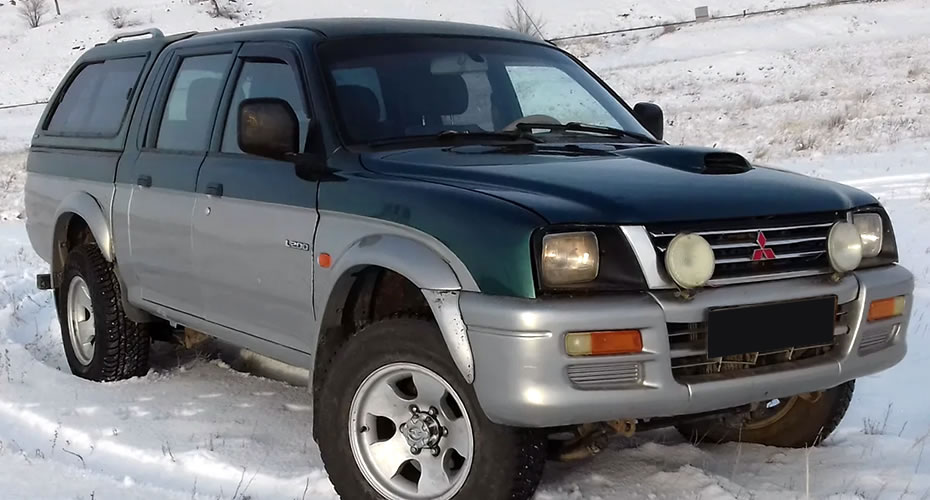


L200, 4-door, 1997 year 
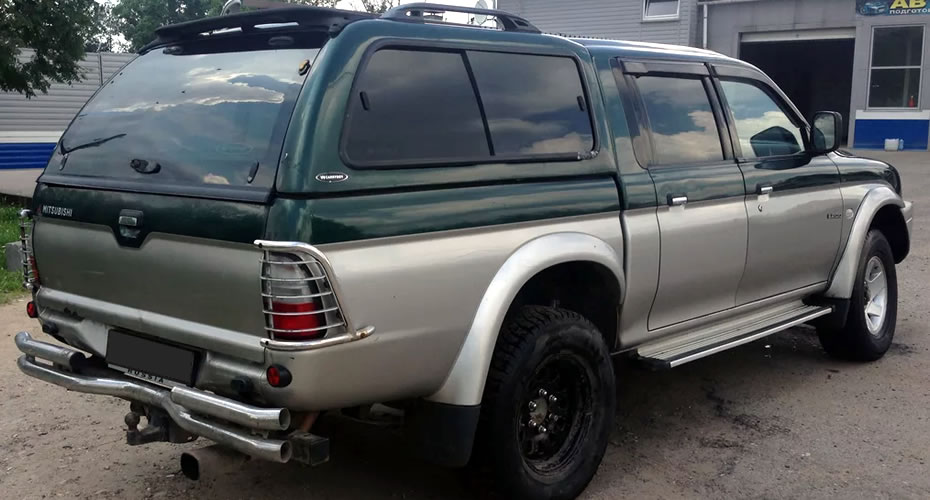
L200, 4-door, 1997 year
In 1996, the third generation was introduced with a two-door pickup body (length 5125 mm, width 1775 mm, height 1800 mm), four-door pickup (length 5010 mm, width 1775 mm, height 1800 mm) and a five-door station wagon. The curb weight of the car was 1380-1795 kg. The names in different countries were also different. On the basis of the L200, the Mitsubishi Challenger SUV was created, which was also called Montero Sport, Pajero Sport, Shogun Sport or Nativa. It has many of the same components and some body elements (for example, the front doors) with the pickup and uses the wheelbase "Pajero" second generation.

L200, back view, 2004 year 
L200, back view, 2004 year
There were two models of four-cylinder petrol engines with a volume of 2.0 liters (1997 cm³, 4G63, 95 hp) and 2.4 liters (2351 cm³, 4G64, 145 hp), as well as one six-cylinder V-shaped with a volume of 3.0 liters (2972 cm³, 6G72, 141 hp). There were four versions of four-cylinder diesel engines with a volume of 2.5 liters (2477 cm³, 4D56/4D56T, naturally aspirated 100 hp, turbocharged 136 hp) and 2.8 liters (2835 cm³, 4M40/4M40T, naturally aspirated 80 hp, turbocharged 123 hp). The transmission is a four-speed automatic or a five-speed manual.

At the end of 2001, the car underwent a facelift, receiving new headlights and other minor changes.

Fourth generation (2005-2014)
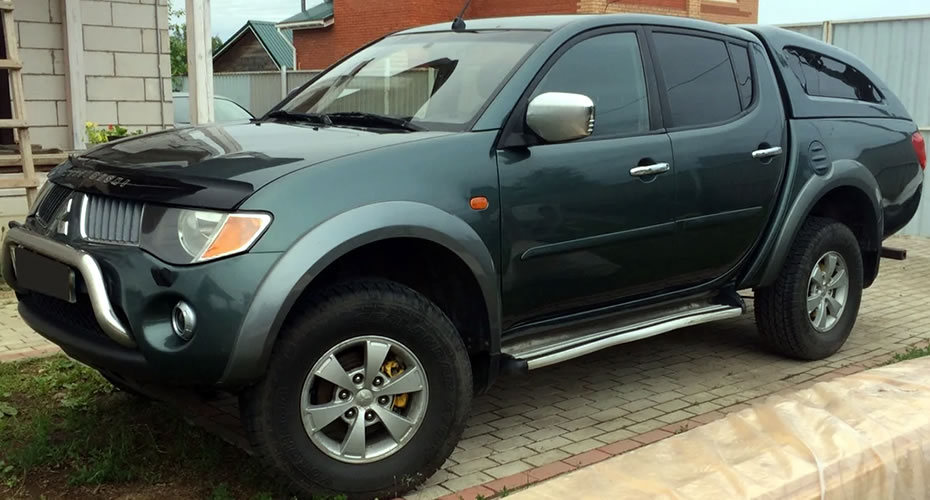


L200, 4-door, 2007 year 
L200, 4-door, 2007 year
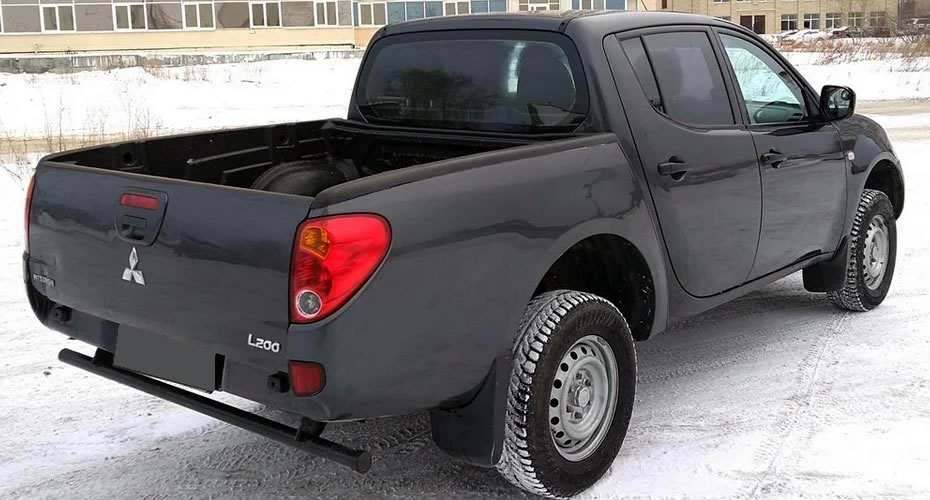
The fourth generation was released in 2005. Production was mainly carried out in Thailand by Mitsubishi Motors subsidiary "Mitsubishi Motors (Thailand)" and from there the car was exported all over the world. The most common name was "Mitsubishi L200", but there were also others, such as "Triton", "Strada", "Sportero", "Hunter" and "Strakar". The body was a two-door pickup (length 5115 mm, width 1750 mm, height 1775 mm) and a four-door pickup (length 5000 mm, width 1800 mm, height 1780 mm). The curb weight was 1880-1935 kg.

There were two models of petrol engines, one four-cylinder with a volume of 2.4 liters (2351 cm³, 4G64, 132 hp) and one six-cylinder 3.5 liters (3497 cm³, 6G74, 186 hp). There were also two models of diesel engines, both four-cylinder with turbocharging with a volume of 2.5 liters (2477 cm³, 4D56, 136 hp) and 3.2 liters (3200 cm³, 4M41, 162 hp). The gearbox was a five-speed manual or four- and five-speed automatic.
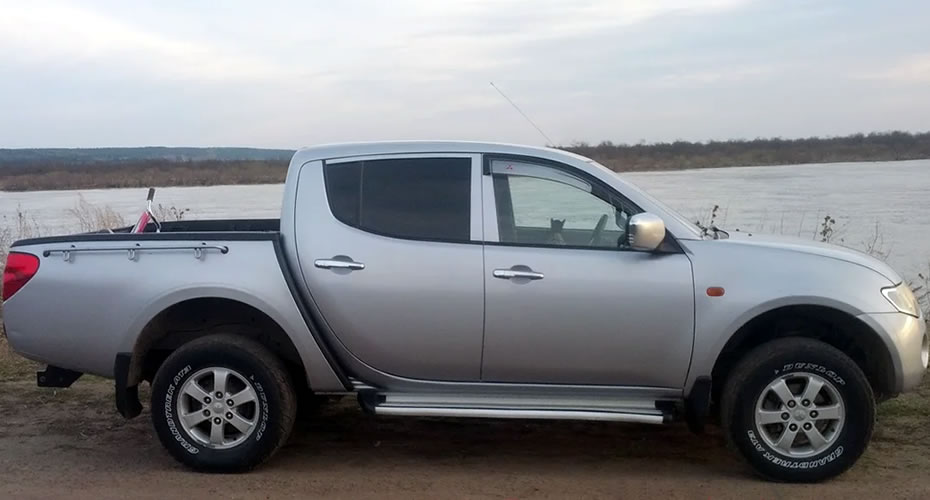
L200, side view, 2008 year 
L200, side view, 2008 year
L200, back view, 2012 year 
L200, back view, 2012 year
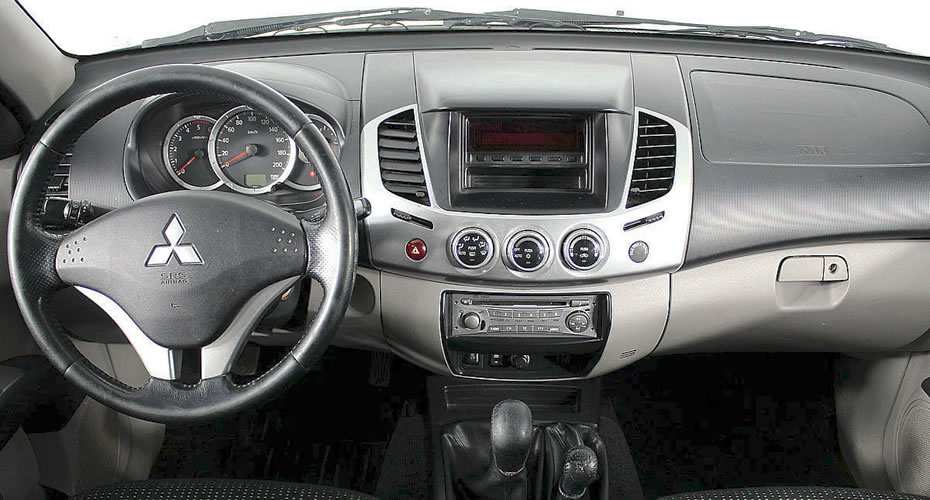
L200, interior, 2012 year 
L200, interior, 2012 year

Fifth generation (2015-present)


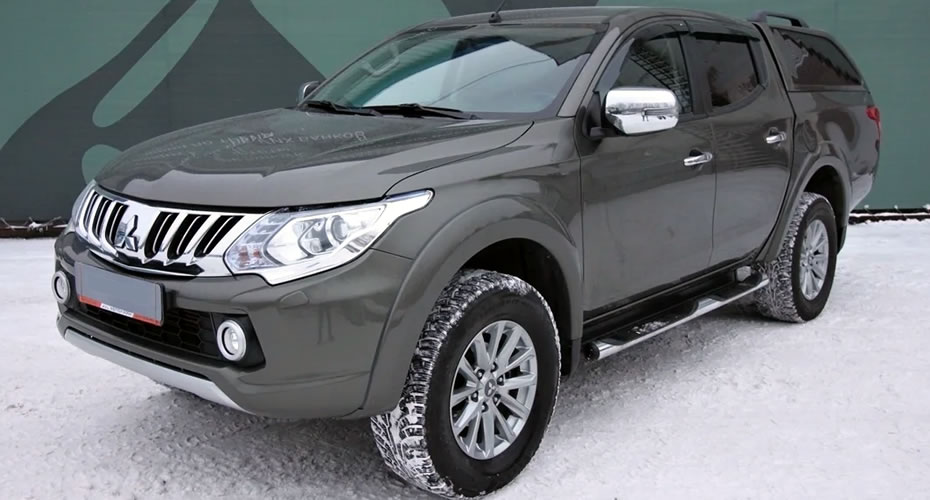
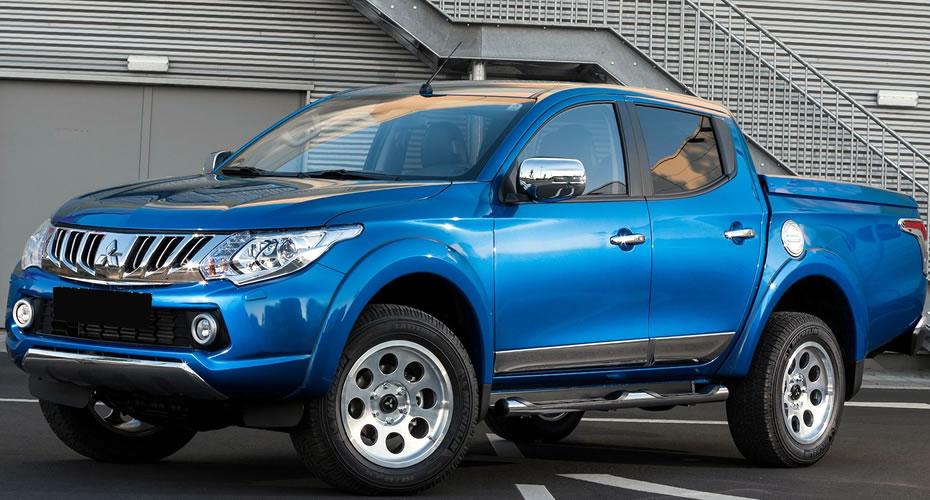
L200, 4-door, 2015 year 
L200, 4-door, 2015 year
In early 2015, the fifth generation of Mitsubishi L200 with a two-door pickup or four-door pickup body began to be exported to some countries. The length of the car is 5210 mm, width 1820 mm, height 1780 mm and the curb weight is 1915 kg. Production is still only in Thailand. In addition to the main name "L200", there were also "Triton", "Ram 1200", "Strada", "Strakar", "Barbarian", and "Fiat Fullback" was produced for Europe and the Middle East.

The petrol engine was only one four-cylinder with a volume of 2.4 liters (2351 cm³, 4G64, 140 hp). There were two models of diesel engines, four-cylinder turbocharged with a volume of 2.4 liters (2442 cm³, 4N15, MIVEC, 154 hp) and 2.5 liters (2476 cm³, 4D56, 175 hp). Gearboxes were five- or six-speed manual or automatic.

In the spring of 2018, the updated L200 2019 model year was shown at the Bangkok International Motor Show in Thailand. The front of the car has changed quite a lot, the rear lights have been changed, and there are some minor changes in the interior.
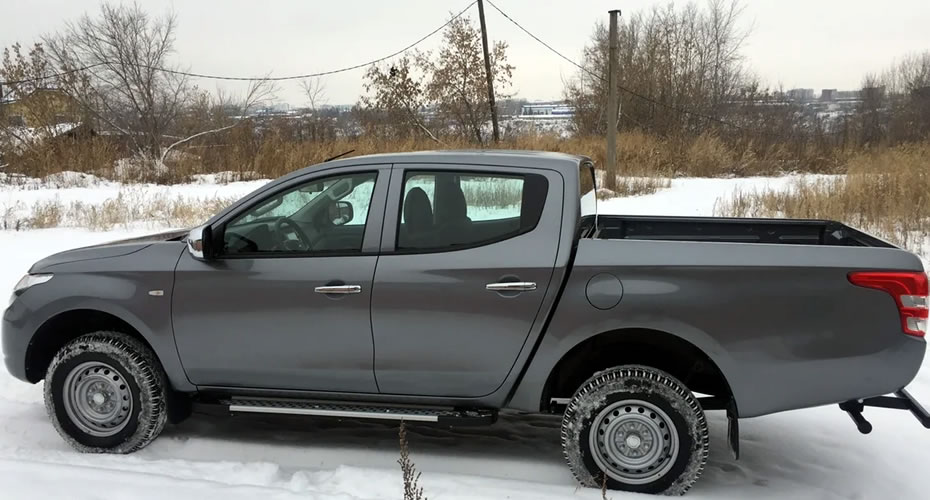
L200, side view, 2017 year 
L200, side view, 2017 year
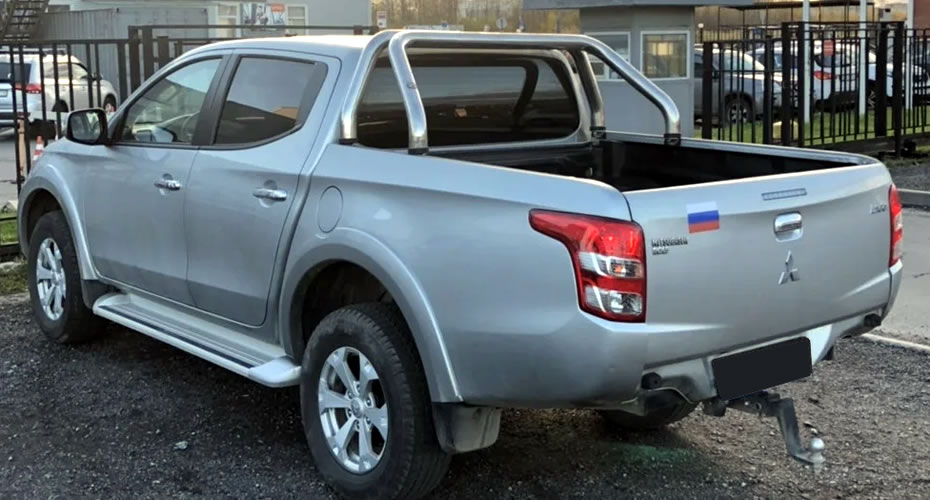
L200, back view, 2017 year 
L200, back view, 2017 year
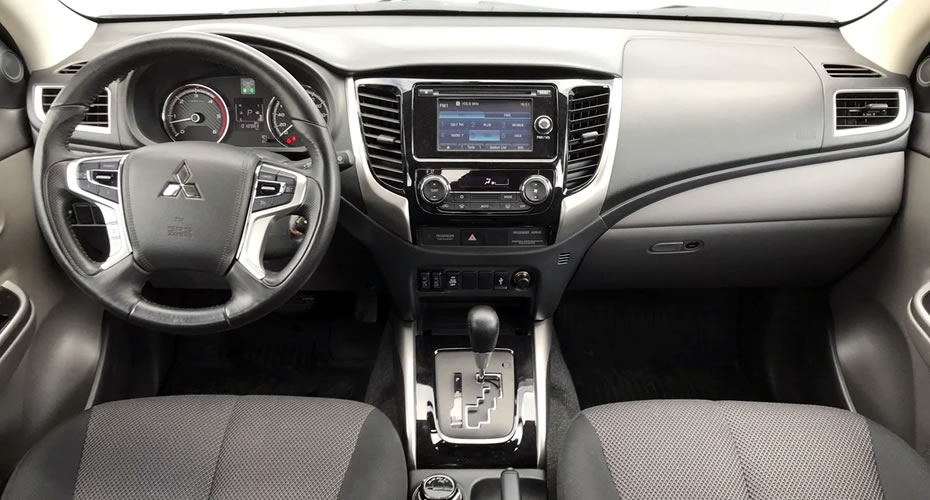
L200, interior, 2017 year 
L200, interior, 2017 year
Share with friends:
Link in different formats to this article
TEXTHTMLBB Code
L200 4 (2005-2014, diesel) 
  • General information
  • User manual
  • Maintenance
  • Power unit
  • Diesel engine
  • Lubrication system
  • Fuel system
  • Control system
  • Transmission
  • Clutch
  • Mechanical gearbox
  • Transfer case
  • Front axle
  • Rear axle
  • Chassis and running gear
  • Car suspension
  • Steering
  • Brake system
  • Body and interior
  • Exterior (external elements)
  • Interior (internal elements)
  • Doors, locks and windows
  • Electrical equipment
  • Equipment and devices
  • Electrical circuits
MitsubishiMan.ru © 2018–2026 • Mobile version • Articles about Mitsubishi • Contacts • Sitemap: EN BG BY UA RS HR RO PL SK HU • Site search • Bookmark
Colt 2 and 3 (1983-1993) · Colt 4 and 5 (1991-2003) · Colt 5 (1995-2003) · Lancer 3 and 5 (1984-1992) · Lancer 9 (2000-2007) · Galant 5 (1983-1989) · Galant 6 and 7 (1987-1998) · L200 4 (2005-2014) · Outlander 1 (2003-2008) · Pajero 1 and 2 (1982-1999) · Pajero 4 (2006-2021) · Carisma (1995-2004) · Space Star (1998-2005) ·
This resource sets cookies 🍪 to avoid bothering you with repeated data entry.