



Contents: Infants and young children ⤓ Child restraint system (child seat)…⤓ Suitability of child restraints for…⤓ Designations used in the table ⤓ Location of fasteners ⤓ Fastening the child seat harness ⤓ Installing a child restraint system…⤓ Child restraint system (child seat)…⤓ Installation ⤓ Removal ⤓ Supplemental Restraint System (SRS)…⤓ Warning signs ⤓
When transporting children in a car, you should always use a child seat of one type or another, depending on the child's build. According to the legislation of most countries, this requirement is mandatory.
Rules regarding transporting children in the front seat of a car vary from country to country.
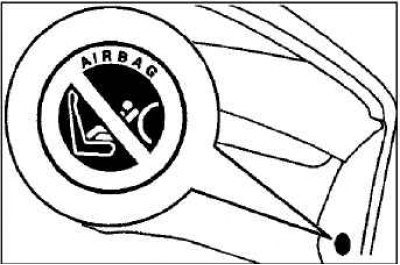
The sticker shown in the figure is attached to vehicles equipped with an airbag for the front passenger.
If the vehicle has such a sticker, then never install a child safety seat in the front passenger seat, in which the child is positioned with his back in the direction of the vehicle.
Infants and young children
When transporting infants and young children, please adhere to the following guidelines:
A baby bassinet should be used to transport infants. A child seat should be used to transport small children of such a height that the shoulder belt is at face or neck level when seated.
The restraint device (child seat) must be appropriate for the height and weight of the child and installed properly. For greater safety for your child, install child seats in the back seat of the car.
Note: Before purchasing a child seat or "bassinet", check that it fits securely in the rear seat. In some cases, the seat belt buckles located on the seat cushion may make it difficult to securely install some child restraints (child seats).
If such a child seat can be easily moved forward on the seat cushion after tightening the belt, then another child seat should be selected. Depending on the type of child seat used and the arrangement of the seats in the vehicle, the child restraint device (child seat) can be secured in one of two ways:
- to the lower anchor of the rear seat, but only if the child seat is equipped with ISOFIX mountings;
- to the seat belt.
Child restraint system (child seat) anchorages
Always install the child seat according to the manufacturer's instructions, using the special anchorages provided in the vehicle (see illustration). Install the child seat, securing it as shown in the illustration. Make sure that the installation of this device and its location in the vehicle do not conflict with existing local regulations for the transportation of children.
Suitability of child restraints for use in different seating positions
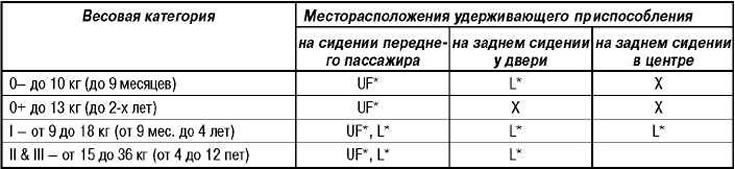
* The seat back must be positioned vertically
Designations used in the table
- U – the seat is suitable for installing "universal" child restraints (child seats) corresponding to the weight category of the child
- UF – the seat is suitable for installing "universal" devices for children (child seats), in which the child is positioned facing the direction of travel of the vehicle and corresponding to the weight category in which the child falls
- L – the seat is suitable for installing special child restraint devices (child seats) (original MITSUBISHI equipment) corresponding to the weight category of the child.
- B – the seat is suitable for installing built-in child restraints (child seats) that correspond to the weight category of the child.
- X – the location is not suitable for installing child restraints (child seats) for this weight category
Location of fasteners
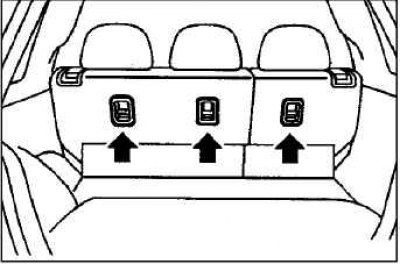
Each of the three rear seat backs has an anchor point at the rear, which can be used to securely attach the child seat belt.
The original article was published on (MitsubishiMan.ru)
Caution: These anchors are only to be used for child seats installed in the rear seats of the vehicle.
Fastening the child seat harness
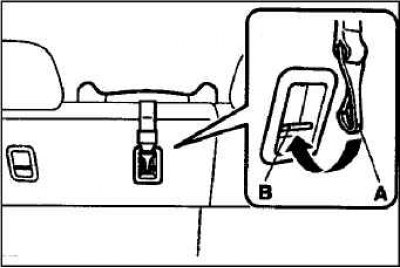
Remove the head restraint from the rear seat where the child seat will be attached.
Hook the child seat anchorage strap hook A into the anchorage bar B and pull the hook upwards until it clicks securely into place.
Warning! Child restraint anchorages are designed only to support the load of a properly installed child seat. Never attach seat belts to them or attach any objects or equipment to them.
Installing a child restraint system (child seat) to the lower anchorages of the rear seats (child seats with ISOFIX mounting system)
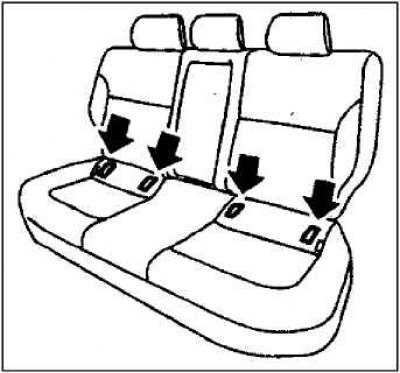
The rear seats of the vehicle are equipped with lower anchorages that are used to install child seats equipped with the ISOFIX mounting system.
Child restraint system (child seat) with ISOFIX mounting system
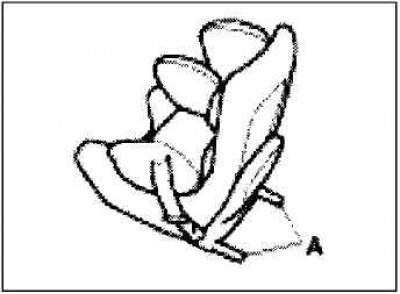
A – child seat connecting rod.
This child seat is designed and may only be installed on seats that have special lower anchors. Secure the child seat using the lower anchors. Child seats equipped with this anchoring system do not need to be secured with the vehicle's seat belt. Only the original MITSUBISHI restraint device may be used.
Installation
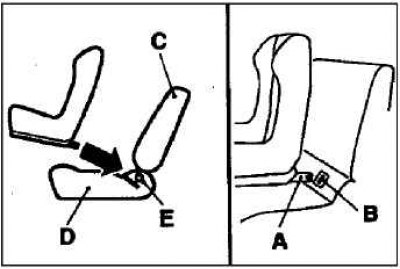
A – connecting rod.
B – slot.
C – back of the car seat.
D – car seat cushion.
E – lower anchor fastening.
Insert the connecting rod A of the child seat into the slot B, following the instructions of the child seat manufacturer.
Remove the head restraint from the rear seat where the child seat will be attached.
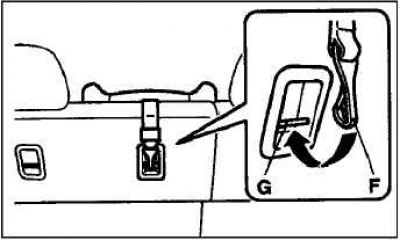
Hook the hook F of the child seat anchorage strap onto the anchor bar G and pull the hook upwards until it clicks securely into place.
Push and rock the child seat in different directions to make sure it is securely fastened.
Warning! Before installing the child seat, make sure there are no foreign objects in the attachment point and remove them if there are any. Also check that the seat belt is retracted and not caught or wrapped around the child seat. If you do not remove foreign objects from the attachment point or do not retract the seat belt, the child seat may not be properly secured and, in the event of sudden braking or a collision, may move forward. This may result in injury to the child or other passengers.
When installing a child seat with the ISOFIX fastening system, be sure to fasten the child seat belt. Failure to do so may result in serious injury to the child in the event of sudden braking or a collision.
Do not adjust the seat to which the child seat is attached while the vehicle is moving.
Removal
Remove the child seat according to the instructions provided in the child seat manufacturer's instructions.
Supplemental Restraint System (SRS) (Air Bag System) Warning Light
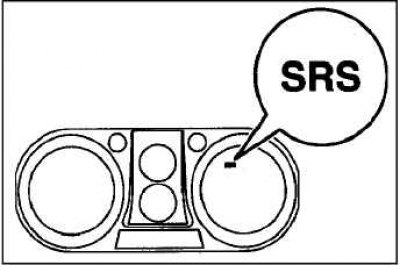
There is a warning light for the additional passive restraint system (SRS) on the instrument panel. The system performs self-diagnosis and, if a malfunction occurs, the SRS warning light comes on. When you turn the ignition key to the "ON" or "START" position, the warning light comes on for a few seconds and then goes out. This means that the system is working.
The SRS control lamp serves:
- front-mounted inflatable driver's airbag;
- front passenger front airbag;
- side airbags;
- pre-tensioning mechanisms (pre-tensioners) of seat belts.
Warning signs
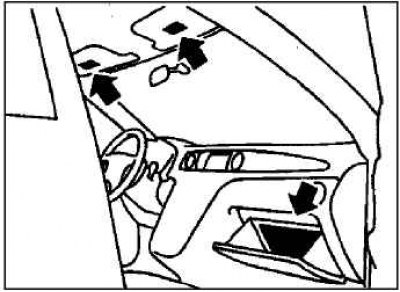
Supplemental Restraint System (SRS) warning labels are located in the locations shown in the illustration.