



Contents: Methodology (tips for balancing) ⤓ Confirmation of correct wheel…⤓ Checking the calibration of the…⤓ Checking static balancing ⤓ Dynamic balancing check ⤓ Checking tire pressure ⤓ Checking tire wear ⤓ Checking tire runout ⤓ Installation operations of parts ⤓
This section contains tips and techniques for performing precise wheel balancing. Vibration of the steering wheel and/or shaking of the body indicate that some operations have not been given sufficient attention.
For proper balancing, the wheel assembly must be properly secured on the stand. One of the important conditions for proper installation is the installation of the wheel in the center of the balancing stand shaft.
Wheel balancing stands for wheels removed from a vehicle must be calibrated periodically to obtain accurate wheel balancing results.
A poorly calibrated wheel balancer can result in unnecessary replacement of tires, shock absorbers, suspension or steering components.
Calibrate the balancing stand every 100 wheel balancings.
The balancer's Operation Manual should describe the calibration procedures for your balancer. If the calibration procedures for your balancer are not available, use the general concepts described in this section for zero, static and dynamic balancing. This flow chart also contains the procedures for checking the balancer's calibration.
Methodology (tips for balancing)
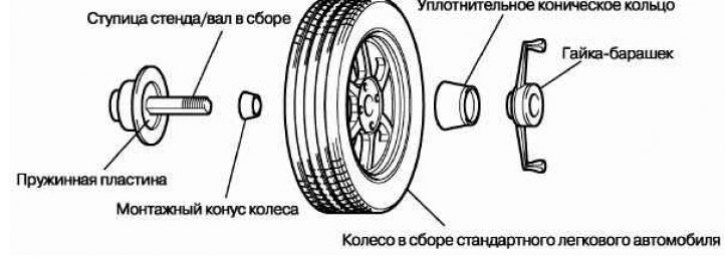
Make sure that the balancing stand cone and wheel mounting cone are free of dirt and rust.
On this vehicle, the center hole of the wheel on the hub side is chamfered.
In this case, it is necessary to use a reverse cone on the balancing stand to center the wheel being tested on the stand shaft.
Install the wheel mounting cone. The acceptable cone diameter for this vehicle's wheel is 67.0 mm.
Before you begin balancing, remove all weights from the wheel (on both sides). Also check the condition of the wheel and tire on both sides.
When installing weights, nail them in place with blows applied at right angles.
Confirmation of correct wheel balancing
After wheel balancing is complete, loosen the wing nut and rotate the wheel 180° relative to the hub of the balancing stand. Tighten the wing nut again and check the wheel balancing again. If necessary, repeat the wheel balancing operations.
Rotate the wheel another 180° relative to the hub of the balancing stand.
If the wheel is unbalanced each time it is subsequently turned relative to the hub of the stand, then most likely the balancing stand requires calibration.
Checking the calibration of the balancing stand
Place the undamaged wheel and tire assembly on the balancing stand. Balance the wheel.
Check the zero calibration. Loosen the stand wing nut, rotate the wheel half a turn (180°), tighten the wing nut again.
Check the wheel balance. If the imbalance is less than 5g, the zero calibration is normal. Rebalance the wheel and proceed to step 4 to check the static balance. If the imbalance is greater than 5g, proceed to the next step.
Loosen the wing nut of the stand, rotate the wheel a quarter of a turn (90°), tighten the wing nut again. Check the wheel balance. If the imbalance does not exceed 5 g, the wheel may not be centered on the stand, or the mounting cones, cup and/or wing nut are damaged or dirty, or do not fit this wheel. It may be necessary to refer to the "Operating Manual" of the balancing stand to clarify the rules for mounting the wheels on the stand. After completing the necessary adjustments, check the wheel balance again. If everything is in order, proceed to the next step.
The article was taken from the website [MITSUBISHIMAN]
If the imbalance exceeds 5g, the wheel balancer needs to be calibrated. Contact the wheel balancer manufacturer regarding the need for wheel balancer calibration by their representatives.
Checking static balancing
Attach a 5g weight to the outer rim flange. Check the wheel balance. The wheel balancer should detect 5±2g imbalance from 170 to 190° from this 5g weight.
If the imbalance is within the normal range, the static balance calibration is OK. Proceed to the next step of checking the dynamic balance.
If the imbalance exceeds the norm, the balancing machine needs calibration. Contact the manufacturer of the balancing machine in connection with the need for calibration of the machine by their representatives.
Dynamic balancing check
Attach a 5g weight to the inner rim flange at an angle of 180° to the 5g weight that was attached in the previous step. Check the imbalance again. The balancer should detect 5 ±2g imbalance from 170 to 190° from both the inner and outer 5g weights. If the imbalance is within the normal range, the dynamic balancing calibration is OK. The balancer calibration check is complete. If the imbalance exceeds the normal range, the balancer needs to be calibrated. Contact the balancer manufacturer to have the balancer calibrated by their representatives.
Checking tire pressure
Please note: The nominal tire pressure is indicated on the label on the driver's side B-pillar.
Checking tire wear
Tyre tread depth: minimum 1.6 mm.
If the tire tread depth is less than the permitted limit, replace the tire.
Attention! When the tire tread depth becomes less than 1.6 mm, the wear indicator appears on the tire.
Checking tire runout
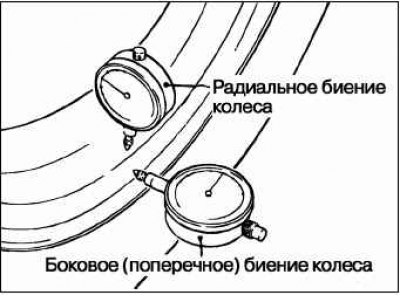
Raise the vehicle so that the wheel is off the floor. Rotate the wheel slowly by hand and measure the wheel runout using a dial indicator.
If the wheel runout exceeds the limit, replace the wheel.
Limit value

Installation operations of parts
Tighten the wheel nuts to the specified torque.
Nominal tightening torque: 98±10 Nm.