



When balancing wheels directly on the vehicle, do not remove the balancing weights installed during the preliminary wheel balancing stage separately from the vehicle. If it is necessary to install a balancing weight of more than 28 g, it must be evenly distributed between the outer and inner sides of the wheel.
The rotation of the drive wheels is provided manually or by the vehicle engine.
Push the wheel with your hand so that it rotates slowly counterclockwise. After the wheel stops, mark the top position of the wheel with chalk.
Push the wheel again, but make it rotate clockwise. After the wheel stops, mark another mark with chalk for the top position of the wheel.
ATTENTION: The upper positions of the wheels (easy section) do not coincide when rotating in different directions.
By dividing the distance between the marks in half, you will determine the lightest section of the wheel. Place one small weight on the rim on either side of this section.
Push the wheel with your hand and spin it again. If after the wheel stops the weights are at the lowest position or stop anywhere, this means that there are enough weights. If the weights are at the top, this means that their weight is insufficient and they need to be replaced with heavier weights, and then make sure that the weights stop at the bottom position.
Move the weights selected in this way along the rim at equal distances on both sides of the middle mark and achieve uniform rotation of the wheel in both directions.
Aluminum Wheel Balancing Weights
To balance aluminum wheels, special weights with nylon-coated clamps are required. The design of these weights is adapted for mounting on thicker edges of the wheel rim. The weights are secured with a plastic hammer.
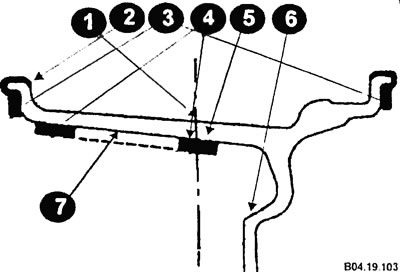
Installation of adhesive balancing weights
1 - plane of symmetry of the wheel; 2 - inner edge of the rim; 3 - balancing weight with clamp; 4 - adhesive balancing weight; 5 - adhesive balancing weight (dynamic balancing); 6 - adhesive balancing weight (static balancing); 7 - wheel mounting plane.
Clean the area where the weight will be installed with sandpaper down to bare metal.
Wipe the mounting area for securing the load with a solution of isopropyl alcohol and water (in a 1:1 ratio). Use a clean cloth or paper towel for wiping.
Dry the prepared area with hot air. The wheel should be warm to the touch.
The adhesive side must be warmed up to room temperature. Remove the protective film from the adhesive side of the load. Do not touch the adhesive.
Place the balancing weight on the prepared place and press it down with your hand
Roll the balancing weight with a roller with a force of 70-110 N.