



Share with friends:
Brake system of the car Mitsubishi Colt 5 (CJ)

General information and characteristics of the brake system
The service brake system is shown in Figure 14.1. The technical characteristics of the service brake system are given in Table 14.1. The technical data of the service...
The service brake system is shown in Figure 14.1. The technical characteristics of the service brake system are given in Table 14.1. The technical data of the service...

Checking and adjusting the brake pedal
1. Fold back the mat under the brake pedal. 2. Measure the height of the brake pedal (Figure 14.2). It should be: left-hand drive vehicles: 163.5-166.5 mm, right-hand...
1. Fold back the mat under the brake pedal. 2. Measure the height of the brake pedal (Figure 14.2). It should be: left-hand drive vehicles: 163.5-166.5 mm, right-hand...

Checking the brake light switch
Connect an ohmmeter to the brake light switch wiring connector and check the switch for continuity with the contact pin in the pressed and released states (Figure 14.7)....
Connect an ohmmeter to the brake light switch wiring connector and check the switch for continuity with the contact pin in the pressed and released states (Figure 14.7)....

Functional check of the brake booster valve
1. Connect a pressure gauge to the inlet and outlet side of the brake booster valve (Figure 14.8) Figure 14.8. Connect a pressure gauge to the inlet and outlet side of...
1. Connect a pressure gauge to the inlet and outlet side of the brake booster valve (Figure 14.8) Figure 14.8. Connect a pressure gauge to the inlet and outlet side of...

Checking and replacing the front brake pads
The left brake pad (inner) has a wear indicator. If the pad thickness is less than 2 mm, a squealing sound is heard as a warning while driving (Figure 14.10). Figure...
The left brake pad (inner) has a wear indicator. If the pad thickness is less than 2 mm, a squealing sound is heard as a warning while driving (Figure 14.10). Figure...

Checking the front brake disc
Checking the thickness of the front brake disc 1. Measure the thickness of the disc with a micrometer at eight points offset by 45 degrees and 10 mm from the edge of the...
Checking the thickness of the front brake disc 1. Measure the thickness of the disc with a micrometer at eight points offset by 45 degrees and 10 mm from the edge of the...

Checking the rear wheel brakes
Checking the brake lining thickness 1. Remove the brake drum. 2. Measure the thickness of the brake lining at the most worn area (Figure 14.16). Nominal value: 4.3 mm....
Checking the brake lining thickness 1. Remove the brake drum. 2. Measure the thickness of the brake lining at the most worn area (Figure 14.16). Nominal value: 4.3 mm....

Brake pedal — design description
The brake pedal of left-hand drive vehicles is shown in Figure 14.18, the brake pedal of right-hand drive vehicles is shown in Figure 14.19. Figure 14.18. Brake pedal...
The brake pedal of left-hand drive vehicles is shown in Figure 14.18, the brake pedal of right-hand drive vehicles is shown in Figure 14.19. Figure 14.18. Brake pedal...

Brake master cylinder and vacuum booster
The master brake cylinder and vacuum booster are shown in Figure 14.20a. The disassembled master brake cylinder is shown in Figure 14.20b. Figure 14.20a. Master brake...
The master brake cylinder and vacuum booster are shown in Figure 14.20a. The disassembled master brake cylinder is shown in Figure 14.20b. Figure 14.20a. Master brake...
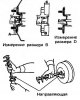
Checking and adjusting the clearance between the primary piston and the push rod
1. Gap A is calculated based on dimensions B, C and D (Figure 14.21): A = B - C - D. Nominal value: 0.65-0.85 mm. Figure 14.21. Checking the clearance between the...
1. Gap A is calculated based on dimensions B, C and D (Figure 14.21): A = B - C - D. Nominal value: 0.65-0.85 mm. Figure 14.21. Checking the clearance between the...

Front wheel disc brake mechanism
The front wheel disc brake mechanism is shown in Figure 14.23. The disc brake mechanism support is shown in Figure 14.24. Figure 14.23. Front wheel disc brake mechanism:...
The front wheel disc brake mechanism is shown in Figure 14.23. The disc brake mechanism support is shown in Figure 14.24. Figure 14.23. Front wheel disc brake mechanism:...

Rear wheel drum brake mechanism
The drum brake mechanism of the rear wheel is shown in Figure 14.25a,b. The brake cylinder of the rear wheel is shown in Figure 14.26. Figure 14.25a. Rear wheel drum...
The drum brake mechanism of the rear wheel is shown in Figure 14.25a,b. The brake cylinder of the rear wheel is shown in Figure 14.26. Figure 14.25a. Rear wheel drum...

Brake booster valve
The brake booster valve is shown in Figure 14.27. The connection of the brake pipes to the brake booster valve is shown in Figure 14.28. Figure 14.27. Brake booster...
The brake booster valve is shown in Figure 14.27. The connection of the brake pipes to the brake booster valve is shown in Figure 14.28. Figure 14.27. Brake booster...

Parking brake system diagram
The diagram of the parking brake system is shown in Figure 14.29. Figure 14.29. Parking brake system diagram
The diagram of the parking brake system is shown in Figure 14.29. Figure 14.29. Parking brake system diagram

Checking the travel of the parking brake lever
1. Tighten the parking brake lever with a force of 196 N and count the number of clicks. It should be 5-7 clicks. 2. If the stroke length of the lever is not as...
1. Tighten the parking brake lever with a force of 196 N and count the number of clicks. It should be 5-7 clicks. 2. If the stroke length of the lever is not as...

Checking the Parking Brake Drive Indicator Light Switch
1. Remove the center console. 2. Check the electrical continuity between the switch terminals and the switch mounting bolt (Figure 14.31). When the parking brake system...
1. Remove the center console. 2. Check the electrical continuity between the switch terminals and the switch mounting bolt (Figure 14.31). When the parking brake system...

Parking brake system actuator lever
The parking brake system drive lever is shown in Figure 14.32. Figure 14.32. Parking brake system drive lever: 1 - Adjusting nut; 2 - Bracket; 3 - Parking brake system...
The parking brake system drive lever is shown in Figure 14.32. Figure 14.32. Parking brake system drive lever: 1 - Adjusting nut; 2 - Bracket; 3 - Parking brake system...

Parking brake system drive cables
The parking brake system drive cables are shown in Figure 14.33. Figure 14.33. Parking brake system drive cables: 1 - Rear brake drum; 2, 5 - Springs; 3 - Spring lock; 4...
The parking brake system drive cables are shown in Figure 14.33. Figure 14.33. Parking brake system drive cables: 1 - Rear brake drum; 2, 5 - Springs; 3 - Spring lock; 4...

Anti-lock braking system ABS — general description
The anti-lock braking system ABS consists of wheel speed sensors, a brake light switch, a hydraulic unit and an electronic control unit (ABS-ECU). If the system...
The anti-lock braking system ABS consists of wheel speed sensors, a brake light switch, a hydraulic unit and an electronic control unit (ABS-ECU). If the system...

Checking the voltage at the terminals of the ABS control unit connector
1. Measure the voltage between each terminal and terminals 15, 25 or between each terminal and terminal 42 (ground connection) (Figure 14.35). The voltage values at the...
1. Measure the voltage between each terminal and terminals 15, 25 or between each terminal and terminal 42 (ground connection) (Figure 14.35). The voltage values at the...

Checking the resistance between the terminals of the wiring harness connector
2. Resistance measurement and continuity testing must be performed with the ignition switched off ("OFF") and the wiring connector disconnected from the ABS control...
2. Resistance measurement and continuity testing must be performed with the ignition switched off ("OFF") and the wiring connector disconnected from the ABS control...

Checking the output voltage of the wheel speed sensor
4. Raise the vehicle and release the parking brake lever. 5. Disconnect the wiring connector from the control unit and measure the output voltage between the connector...
4. Raise the vehicle and release the parking brake lever. 5. Disconnect the wiring connector from the control unit and measure the output voltage between the connector...

Checking ABS Solenoid Valves
Measure the resistance between the terminals (Figure 14.37 and Table 14.8). Figure 14.37. Checking the electromagnetic valves Table 14.8. Resistance of electromagnetic...
Measure the resistance between the terminals (Figure 14.37 and Table 14.8). Figure 14.37. Checking the electromagnetic valves Table 14.8. Resistance of electromagnetic...

ABS hydraulic control unit
The hydraulic control unit is shown in Figure 14.38. Figure 14.38. Hydraulic control unit: 1 - Brake pipes; 2 - Wiring connector mounting bracket; 3 - Hydraulic control...
The hydraulic control unit is shown in Figure 14.38. Figure 14.38. Hydraulic control unit: 1 - Brake pipes; 2 - Wiring connector mounting bracket; 3 - Hydraulic control...

Electronic control unit ABS
The ABS electronic control unit is shown in Figure 14.40. Figure 14.40. ABS electronic control unit: 1 - ABS control unit mounting bracket; 2 - ABS control unit
The ABS electronic control unit is shown in Figure 14.40. Figure 14.40. ABS electronic control unit: 1 - ABS control unit mounting bracket; 2 - ABS control unit
This section is available on: russian, bulgarian, belarusian, ukrainian, serbian, croatian, romanian, polish, slovak, hungarian
Similar materials for other Mitsubishi models
➤ Chassis and running gear: Brake system Mitsubishi Lancer 3 and 5 (1984-1992)
➤ Chassis and running gear: Brake system Mitsubishi Galant 6 and 7 (1987-1998)
➤ Chassis and running gear: Brake system Mitsubishi L200 4 (2005-2014, diesel)
➤ Chassis and running gear: Brake system Mitsubishi Outlander 1 (2003-2008)
➤ Chassis and running gear: Brake system Mitsubishi Pajero 4 (2006-2021)
➤ Chassis and running gear: Brake system Mitsubishi Carisma (1995-2004)
Link in different formats to this section
TEXTHTMLBB Code
- General information
- User manual
- Specifications
- Gasoline engines
- 4G1 engines until 1995
- 4G1 engines since 1995
- Repair of 4G9 engines
- Cooling system
- Reduced exhaust gas toxicity
- Engine electrical equipment
- Injection system MPI
- Carburetors
- Transmission
- Clutch and drive shafts
- Manual gearbox F4M21/F5M21
- Manual gearbox F4M41
- Automatic gearbox F4A21
- Automatic gearbox F4A41
- Chassis and running gear
- Car suspension
- Steering
- Brake system
- Body
- Exterior (external elements)
- Electrical equipment
- Equipment and devices
- Electrical circuits
- General information
- Maintenance
- Power unit
- Engine in a car
- Engine repair (gasoline)
- Engine repair (diesel)
- Lubrication system
- Cooling system
- Carburetor
- Fuel injection MPI
- Fuel injection GDI
- Emission reduction
- Fuel system (diesel)
- Ignition system
- Exhaust system
- Transmission
- Clutch
- Manual gearbox
- Automatic gearbox
- Drive shafts
- Chassis and running gear
- Chassis malfunctions
- Front suspension
- Rear suspension
- Steering
- Wheels and tires
- Brake system
- Body and interior
- Body elements
- Electrical equipment
- Equipment and devices
- Power devices
- Heating and air conditioning
- Electrical circuits
- General information
- User manual
- Daily care
- Maintenance
- Power unit
- Engine in a car
- Engine overhaul
- Cooling system
- Heater and air conditioner
- Power and exhaust system
- Engine electrical equipment
- Emission reduction
- Transmission
- Mechanical gearbox
- Automatic gearbox
- Clutch and axles
- Chassis and running gear
- Brake system
- Car suspension
- Steering
- Body and interior
- Body and elements repair
- Electrical equipment
- Equipment and devices
- Electrical circuits