



Contents: Tire marking ⤓ Markings on the sidewall of the tire ⤓ Disks - marking ⤓ TRX type tires and wheels ⤓ TD type tires and wheels ⤓
Tire marking
Depending on the year of manufacture, tires have different markings:
- In the old markings - for example, 185/70HR14 - the letter designation of the maximum speed H is in the middle.
- In the new marking - for example, 185/70R1484H - the letter designation of the maximum speed (H) is at the end. A number indicating the mileage of the tires (in this case 84) has been added to the marking.
- Tires with the TD code designation retain their running properties when punctured, and tires with the TRX code designation have a metric inner diameter. It is indicated by the number 390 in the tire brand 195 /60VR390TD or 195/60R390 91 H M+S (TRS).
For the rest of the tires, the inner diameter is measured in inches.
Markings on the sidewall of the tire
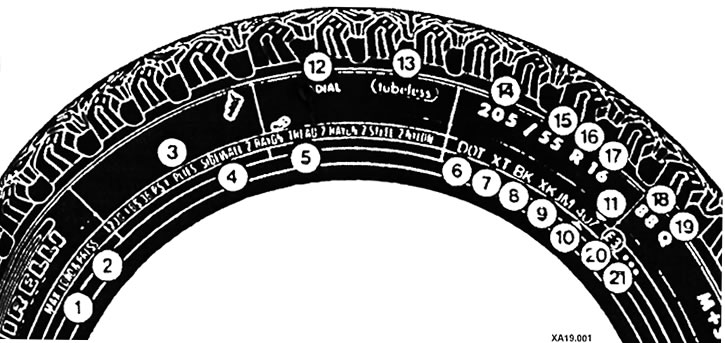
1 - maximum load; 2 - tire air pressure; 3 - cord material: 4 - sidewall material; 5 - protector material; 6 - DOT (US Department of Transportation) compliance marking; 7 - manufacturer code; 8 - tire size code; 9 - brand designation of the tire type; 10 - production week; 11 - year of manufacture; 12 - radial; 13 - tubeless; 14 - nominal width; 15 - height to width ratio; 16 - radial; 17 - disc diameter; 18 - index or conditional number of load; 19 - maximum speed index; 20 - ECE (Economic Commission for Europe) sign; 21 - standard number.
The numbers and letters in the tire markings mean the following:
- 185, 195U 200, 205 - tire width without load in millimeters;
- 55, 60, 65, 70 - the ratio of the tire's height to its width - for example, 65.100. Accordingly, this value is lower for tires marked with numbers 60, 55;
- R - tire type designation: radial.
- 15, 390 - inner diameter of the tire in inches or millimeters;
- Q - maximum speed of 160 km/h - speed class for regular tires marked M+S;
- S - up to 180 km/h;
- T - up to 190 km/h - high-speed tires M+S;
- H - up to 210 km/h;
- VR - over 210 km/h (old, but still used marking). Replaced by V and ZR designations;
- V - up to 240 km/h;
- ZR - over 240 km/h;
- TD - a class of tires that maintains traction when punctured.
Disks - marking
The numbers and letters on the disc markings mean the following:
- 6, 6.5, 7, 167, 180, 195 - rim width in inches or millimeters (for TRX and TD modifications);
- J - symbol for side height;
- X - deep rim designation;
- 15, 390, 415 - maximum disc diameter in inches or millimeters (from bead to bead);
- ET 19, ET 20, 6T 22 - rim seating depth. This size specifies the code designation below;
- TR - code designation of the TRX type wheel;
- TD is a code designation for wheels that retain driving performance when the tire is punctured.
As you can see from the previous section, three different types of wheel rims can be installed on cars: regular deep-dip rims, TR and D-type rims. It should be noted that not all tires are suitable for all rims, and vice versa. A regular radial tire should be mounted on a deep-dip rim, a TRX tire on an R-type rim, and a TD tire on a D-type rim.
Most car models are now fitted with all-season radial steel-belt tyres as standard equipment. These tyres have an average of 37% higher snow traction than the regular road tyres that were fitted to cars previously. At the same time, such properties as wet traction, rolling resistance, service life and the ability to retain air pressure have also been improved. These improvements have been achieved through changes in the tread design and the use of special rubber compounds.
TRX type tires and wheels
The ride will be comfortable if the sidewalls of the tires are high and elastic, and the grip on the road is improved if the sidewalls are low and rigid. To achieve a compromise between these conditions, the TRX tire carcass was developed, which works equally in tension and compression. Hence the name of the tire "TR" - "tension repartie" (load distribution. Therefore, the shape of the sidewalls of this tire had to be changed, and this led to the need to create a new disk.
TD type tires and wheels
These tires have a highly developed additional bead on the flange that fits into a deep groove on the edge of the rim. This significantly improves the tire's grip on the disk, so that when punctured, the tire does not slip off the rim.
The original was published on the website (www.mitsubishiman.ru)
Even with a punctured tire, the car can be safely driven out of the danger zone. A punctured TD tire is retained on the front wheel for up to 30 km, on the rear wheel - up to 9 km (if it is the driving wheel). However, the speed on turns should not exceed 30 km / h, and when driving straight - 60 km / h. However, even if a tire is unexpectedly punctured at a higher speed, it does not come off the rim - even on turns. The car remains controllable, and it can be stopped smoothly.