



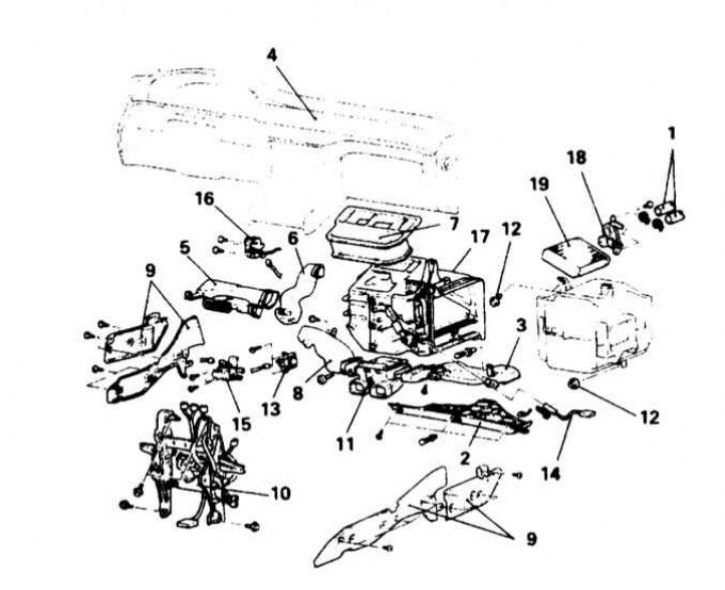
Installation details of the heater heat exchanger on Diamante models produced in 1992÷1996.
1 - Heating hose connection pipes; 2 - Right section of the lower trim of the instrument panel; 3 - Air supply hose to the passenger footwell; 4 - Instrument panel; 5 - Foot level air duct deflector; 6 - Sleeve A of the knee cooler; 7 - Assembling the central air duct; 8 - Air supply hose to the driver's footwell; 9 - Front and rear central amplifiers; 10 - Assembling the central mounting post; 11 - Assembling the air flow distribution sleeve; 12 - Cooling block fastener; 13 - Power transistor; 14 - Coolant temperature sensor; 15 - Assembly of the damper motor for forming the temperature composition of the air; 16 - Damper motor for outside air supply selector; 17 - Assembling the heater; 18 - Overlay; 19 - Heat exchanger (radiator) of the heater
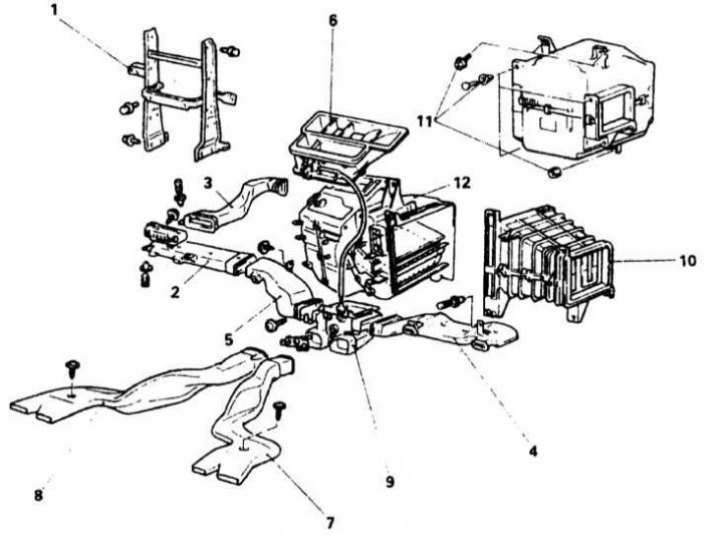
Installation details of the heater heat exchanger on Galant models produced in 1990÷1993.
1 - Instrument cluster central mounting post; 2 - Foot level air duct deflector; 3 - Knee level air duct; 4 - Air supply hose to the passenger footwell; 5 - Air supply hose to the driver's footwell; 6 - Central air duct; 7 - Rear heater air duct B; 8 - Rear heater air duct C; 9 - Lower level air distributor; 10 - Air duct (models without air handling unit); 11 - Evaporator fastener (models with A/C); 12 - Assembling the heater
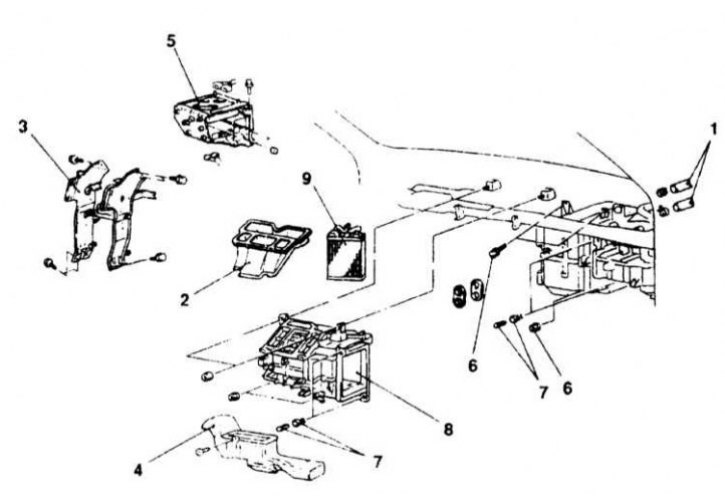
Installation details of the heater heat exchanger on Galant models produced in 1994÷1998.
1 - Heating hose connection pipes; 2 - Central ventilation sleeve; 3 - Central amplifier; 4 - Lower level air distributor; 5 - ECM support bracket; 6 - Evaporator fastener; 7 - Fixators; 8 - Assembling the heater; 9 - Heat exchanger (radiator) of the heater
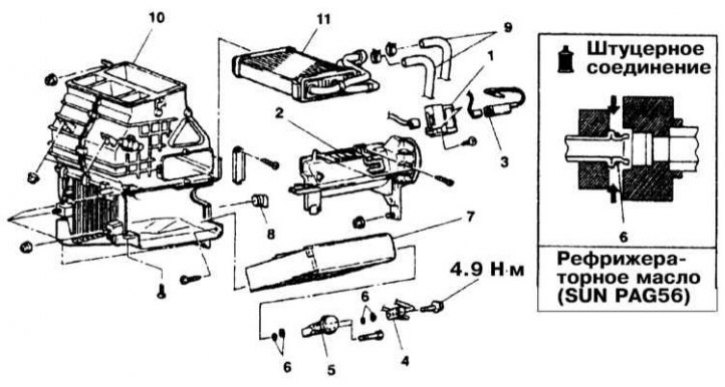
Heater heat exchanger installation details for Galant models 1999 and 2000.
1 - Belt Lock Controller (3.0L Models); 2 - Lid; 3 - Automatic compressor controller (models with A/C); Charging and discharging refrigerant (models with A/C); 4 - Refrigeration line pipe (models with K/V); 5 - Expansion valve; 6 - Sealing rings (models with K/V); 7 - Evaporator; 8 - Drain hose (models with K/V); Draining and adding coolant; 9 - Heating hoses; 10 - Heater/cooler assembly; 11 - Heat exchanger heater
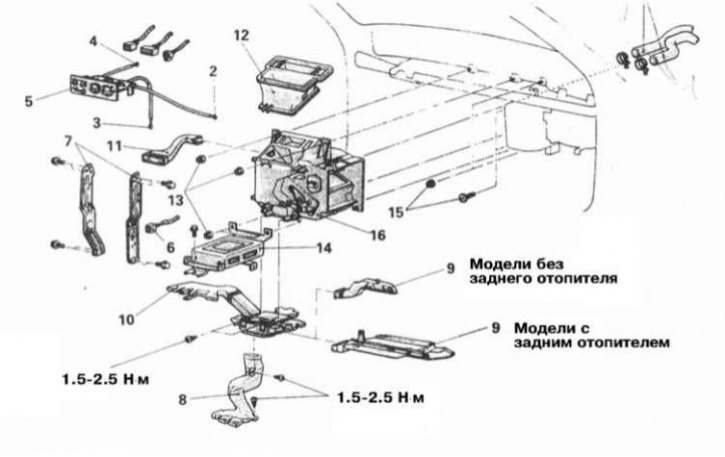
Heater heat exchanger installation details for Mirage models 1990÷1992.
1 - Heating hoses; 2 - Drive cable selection of air distribution direction; 3 - Temperature mode selection drive cable; 4 - Air circulation mode selection drive cable; 5 - Assembly of heater control; 6 - ECI Control Relay Wiring Connector; 7 - Instrument cluster central mounting post; 8 - Rear heater hose A; 9 - Knee level air duct (models without rear heater)/transit air duct (models with rear heater); 10 - Air supply hose to the foot wells; 11 - Knee level air duct; 12 - Central air duct; 13 - Heater assembly fasteners; 14 - ELC-AT control unit; 15 - Evaporator assembly fasteners; 16 - Assembling the heater
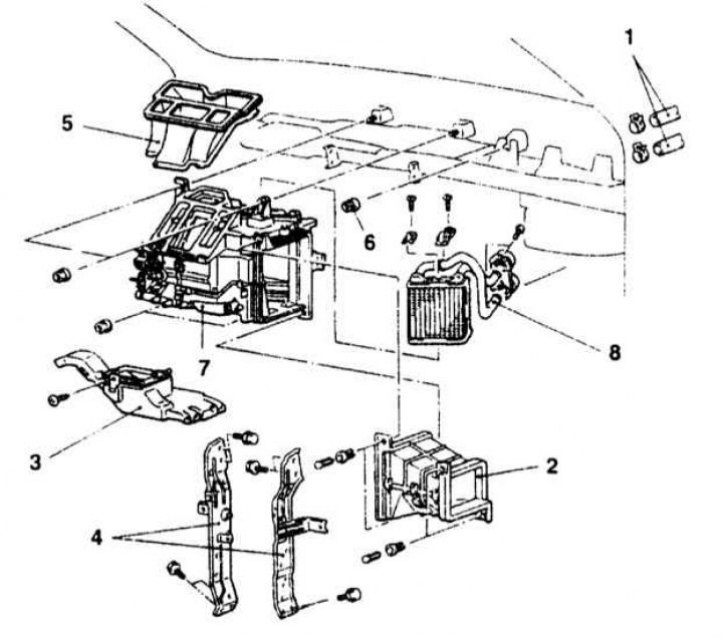
Heater heat exchanger installation details for Mirage models produced in 1993÷1996.
1 - Heating hoses; 2 - Connecting sleeve (models without K/V); 3 - Front air duct; 4 - Central amplifier; 5 - Central air duct; 6 - Evaporator assembly fasteners (models with A/C); 7 - Assembling the heater; 8 - Heat exchanger (radiator) of the heater
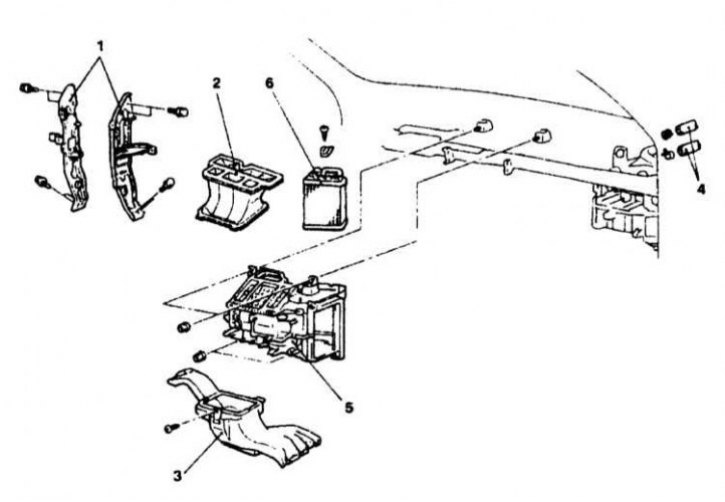
Heater heat exchanger installation details for Mirage models produced in 1997÷2000.
1 - Central amplifier; 2 - Central air duct; 3 - Air distributor sleeve; 4 - Heating hoses; 5 - Assembling the heater; 6 - Heat exchanger (radiator) of the heater
Warning! The vehicles covered in this manual are equipped with the Supplemental Restraint System (SRS), better known as the airbag. Before performing any work near the airbag assembly or steering column, always disable the system to avoid injury from accidental deployment (see Chapter On-board electrical equipment). The insulation and connectors of the SRS circuit wiring are painted bright yellow. Do not connect any diagnostic equipment to this circuit!
The air conditioning system is under constant high pressure. Never disconnect refrigeration lines or remove any system components without first discharging the system. Discharging the air conditioning system must be done by an experienced technician in a car service workshop. Always wear safety glasses when disconnecting refrigeration lines!
Do not allow antifreeze to come into contact with exposed areas of the body or painted surfaces of the vehicle. If it accidentally splashes, immediately wash it off with plenty of water. Remember that antifreeze is a highly toxic liquid and its ingestion, even in small quantities, can have the most serious consequences (even fatal). Never leave antifreeze stored in a loosely closed container and immediately collect any coolant spilled on the floor. Remember that the sweet smell of antifreeze can attract the attention of children and animals. Consult any car service station about how to dispose of used coolant. In many regions of the world, special collection points for various types of waste have been set up. Never pour old coolant down the drain or onto the ground! Recently, non-toxic types of antifreeze have been developed, but they are also subject to disposal in an organized manner.
Wait until the engine has cooled down completely before starting the procedure.
Diamante Models
Removal
1. Installation details of the heater heat exchanger on Diamante models are shown in the illustrations.
2. Disconnect the negative cable from the battery.
Warning! If the car stereo system is equipped with a security code, make sure you have the correct combination to activate the audio system before disconnecting the battery! Disable the SRS (see Chapter On-board electrical equipment).
3. Drain the cooling system and disconnect the rubber hoses of the water circuit from the heater heat exchanger (immediately seal the open ends of the hoses to prevent the risk of internal contamination of the cooling system).
4. Remove the right section of the lower instrument panel trim.
5. Remove the air supply hose to the passenger footwell.
6. To remove the console assembly, remove the ashtray and unscrew the exposed screw. Unscrew the remaining four front screws located on the sides of the assembly and remove the console.
7. Remove the decorative caps, unscrew the exposed screws and remove the driver's knee support assembly with the support bracket.
8. Remove the steering column covers.
9. Remove the glove box lid lock striker, the glove box assembly itself and its outer casing. Unscrew the exposed screw.
10. Remove the radio trim panel and stereo system
11. Remove the heating and air conditioning control assembly.
12. Remove the cup holder.
13. Remove the speakers located on top of the instrument panel.
14. Remove the instrument panel trim and instrument cluster.
15. Disconnect the speedometer drive cable from the transmission. Disconnect the adapter from the instrument cluster assembly, slightly pull the cable inward and remove the adapter.
16. Disconnect all electrical wiring connected to the steering column. Unscrew the mounting bolts and lower the column down, laying it on the driver's seat.
Caution: Use extreme caution to avoid any contact with the airbag module.
17. Remove the glove compartment light bulb.
18. Remove the remaining mounting screws and remove the instrument panel.
19. Remove the driver's footwell air supply hose, knee level cooling hose and center air duct.
20. Remove the front and center struts and the center mounting post.
21. Remove the air distribution hose assembly.
22. Disconnect all electrical wiring connected to the heater assembly.
(The original article was published on: MitsubishiMan.ru)
23. Remove the mounting screws, loosen the nuts and remove the heater assembly from the vehicle.
24. Transfer the assembly to a workbench and remove the heat exchanger radiator from the casing.
Installation
1. Thoroughly clean and dry the inside of the heater housing and install the heat exchanger and related components into it.
2. Install the heat exchanger assembly on the vehicle, tighten the fasteners. Ensure that the heater and evaporator assembly casings are correctly positioned relative to each other. Connect the electrical wiring to the components attached to the heater assembly.
3. Install the air distribution sleeve assembly. Install the front and rear reinforcements and the center mounting post.
4. Install the center air duct, knee cooler hose and air supply hose to the driver's footwell.
5. Install the instrument panel, screw in and tighten the mounting screws.
6. Install the glove compartment light.
7. Move the steering column into working position and secure it, connect the appropriate electrical wiring to it.
8. Connect the speedometer drive cable adapter to the instrument panel.
9. Install the instrument cluster and its trim panel.
10. Install the overhead speakers on the instrument panel.
11. Install the cup holder.
12. Install the air conditioning system control assembly.
13. Install the stereo and radio trim panel.
14. Replace the screw located under the glove box assembly.
15. Install the glove box assembly.
16. Install the steering column cover covers.
17. Install the knee support bracket and the knee support itself. Screw in the mounting screws and seal them with decorative plugs.
18. Install the console assembly and ashtray.
19. Install the air supply hose into the passenger footwell.
20. Install the right section of the lower instrument panel trim.
21. Connect the rubber hoses to the heater heat exchanger.
22. Fill the cooling system with coolant.
23. Connect the negative cable to the battery.
24. Check the correct operation of the automatic air conditioning system.
25. Check the heating system components for signs of developing coolant leaks.
Galant Models
Removal
1. The heater heat exchanger installation details on Galant models are shown in the illustrations.
2. Disconnect the negative cable from the battery.
Warning! If the car stereo system is equipped with a security code, make sure you have the correct combination to activate the audio system before disconnecting the battery! Disable the SRS (see Chapter On-board electrical equipment).
3. When the engine is cold, move the temperature selection lever to the FULL HOT position. Drain the cooling system.
4. Disconnect the rubber water line hoses connected to the heater heat exchanger pipes on the rear bulkhead of the engine compartment.
5. Remove the center console (see Chapter Body).
6. Remove the heater cover.
7. Remove the steering wheel.
8. Remove the small cover from the steering column cover.
9. Remove the lower instrument panel trim section.
10. Remove both sections of the steering column cover. Disconnect the electrical wiring connected to the column.
11. Remove the instrument panel trim.
12. Remove the instrument cluster mounting screws.
13. Release the instrument cluster from its mounting socket and disconnect the speedometer drive cable attachment from its rear side. Remove the instrument cluster.
14. Remove the floor console with the subframe.
15. Disconnect and remove the air supply hoses to all vertical levels of the passenger compartment.
16. Remove the glove box.
17. Remove the ashtray with the support bracket (remember to disconnect the wiring from the cigarette lighter).
18. Remove the heater control panel trim.
19. Remove the heater control assembly and disconnect the electrical wiring from it.
20. Remove the right section of the lower instrument panel trim with the subframe.
21. Remove the cover of the fuse box, installed on the left under the instrument panel. Unbolt and remove the fuse box.
22. Remove the front pillar trim panels.
23. Remove the front door sill trims from both front doors.
24. Release the windshield deflector trim, disconnect the electrical wiring from the photocell and remove the trim and deflector grille.
25. Remove the central air duct deflector grille.
26. Remove the bolts securing the steering column bracket to the instrument panel.
27. Remove the central reinforcement frame assembly. Unscrew the right subframe mounting bolts (try to remember their installation positions).
28. Remove the remaining mounting bolts and remove the instrument panel, after marking and disconnecting the corresponding electrical wiring.
29. On models with automatic air conditioning, remove the power distribution control unit installed before the heater assembly (bottom).
30. Remove the hose connecting the heater unit to the evaporator housing (models with A/C)/heater fan assembly (models without A/C).
31. Carefully disconnect the vacuum hoses.
32. Remove the heater assembly from the vehicle and transfer it to the workbench.
33. Remove the cover from the water tap, disconnect the rods and remove the vacuum activator.
34. Release the clamps and remove the heat exchanger from the heater casing.
35. After removing the water tap, the heat exchanger can be replaced. Remove the plastic cover, loosen the fastening clamps, disconnect the hose and remove the tap.
Installation
1. Thoroughly clean and dry the inside of the heater housing and install the heat exchanger and water hose assembly into it (replace the hose with the mounting clamps).
2. Install the vacuum activator and connecting rod. Install the cover on the tap assembly.
3. Install the heat exchanger assembly on the vehicle, tighten the fasteners.
4. Carefully connect the connector to the vacuum hose harness. Make sure the hoses are connected correctly and are securely fastened to their fittings.
5. Install the heating assembly cover and center console.
6. Install the hose connecting the heater and evaporator assemblies/heater fan assembly.
7. Install the power distribution unit, carefully connect the rods and stems.
8. Connect the cooling system hoses to the heat exchanger.
9. Install the instrument panel (proceed in the reverse order of component removal).
10. Install the center console.
11. Install the steering column covers. Restore the original wiring connections.
12. Install the center section of the lower trim.
13. Install the small cover onto the steering column cover.
14. Install the steering wheel.
15. Fill the cooling system.
16. Connect the negative cable to the battery.
17. Check the proper functioning of the automatic air conditioning system.
18. Check the heating system components for signs of developing coolant leaks.
19. Connect the negative cable to the battery.
20. Check the proper functioning of the automatic air conditioning system.
21. Check the heating system components for signs of developing coolant leaks.
Mirage Models
Removal
1. The heater heat exchanger installation details on Mirage models are shown in the illustrations.
2. Disconnect the negative cable from the battery.
Warning! If the car stereo system is equipped with a security code, make sure you have the correct combination to activate the audio system before disconnecting the battery!
3. Drain the cooling system. Disconnect the heating hoses. Remove the decorative caps from the anchor bolts, the tray installed under the seats and the seat belt guide rings, release the fasteners, disconnect the wiring from the seat belt switch sensors, then remove the seats.
4. Remove the coin box and glove box from the floor console assembly. Remove the power mirror switch assembly/plug.
Note: To release all of the above components, use only a plastic tool!
5. Remove the rear half of the console.
6. On models with manual transmission, remove the gear shift knob.
7. Remove the front section of the console.
8. Plastic pin-type fasteners are used to secure the instrument panel. To release such a fastener, use a blunt punch to push in the central pin of the assembly, then remove the latter from its seat.
Note: Do not press the pin with excessive force as this may cause it to be pushed out of the opposite side of the retainer.
9. Remove the front door sill trims from both doors.
10. Remove the ashtray.
11. Remove the central trim section of the instrument panel (radio trim).
12. Remove the sunglasses case attached to the upper left corner of the instrument panel, as well as the side panel into which this case is mounted.
13. Remove the driver's knee support and the hood release handle.
14. Remove the upper and lower sections of the steering column cover.
15. Remove the radio.
16. Remove the glove box and its lid lock striker.
17. Remove the lower instrument panel cover and the two small trim pieces in the center of the panel (pull them toward you).
18. Remove the screw securing the heater control assembly.
19. Remove the instrument panel trim and pull out the instrument cluster.
20. Remove the adapter fitting connecting the speedometer drive cable to the instrument cluster (the cable should first be disconnected from the transmission). Pull the cable assembly slightly toward you and turn the fitting slightly to release it.
21. Using a flat-blade screwdriver, release the locking tabs and disconnect the connectors of the electrical wiring connected to the instrument cluster.
22. Using a plastic tool, remove the right speaker cover. Remove the speaker and remove the side deflectors of the upper air ducts. Remove the clock. Now you should have access to the instrument panel mounting bolts.
23. Loosen the mounting nut, remove the bolt and lower the steering column.
24. Remove the mounting bolts and remove the instrument panel assembly.
25. Disconnect the heater control cables from the heater assembly, then remove the control panel.
26. Disconnect the MFI control relay wiring.
27. Remove the two stamped steel instrument panel stops.
28. Remove the air duct sleeves.
29. Remove the heater assembly mounting nuts.
30. Remove the automatic transmission ELC control unit.
31. Loosen the nuts and release the evaporator assembly fastening clips.
32. Pull the evaporator into the passenger compartment, then remove the heater unit.
Note: Be careful not to damage the connecting tubes.
33. Remove the cover installed on the heating pipes, then release the heat exchanger fastening clamps. Remove the heat exchanger from the heater casing - try not to damage the radiator fins or cut your fingers on them.
Installation
1. Thoroughly clean and dry the inside of the heater casing and install the heat exchanger in it. Make sure the fasteners and cover are securely snapped into place.
2. Install the evaporator and the ELC AT mounting block.
3. Install the heater assembly in its regular place and connect the air duct hoses.
4. Restore the original wiring and control cable connections.
5. Install the instrument panel assembly and console () in the reverse order of component removal.
6. Install the front seats.
7. Connect the negative cable to the battery.
8. Check the proper functioning of the automatic air conditioning system.
9. Check the heating system components for signs of developing coolant leaks.