



Warning! Proceed with the procedure only after the engine has completely cooled down! See also warnings at the beginning of the Section Antifreeze - general information. Remember that when the ignition is on, the cooling system fan may operate even when the engine is off.
Checking the meter
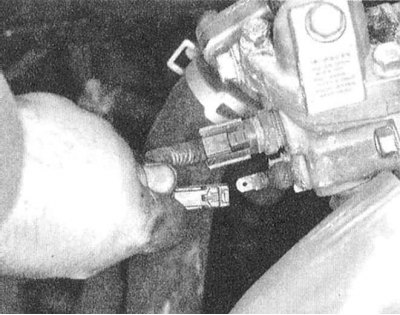
1. Disconnect the electrical wiring from the meter sensor unit.
2. Connect a suitable test lamp (12V/3.4W) between the sensor connector on the wiring harness side and ground.
3. Turn on the ignition.
4. If all components are functioning properly, the test lamp should light and the temperature gauge needle should move. If the lamp works properly but the needle does not move, replace the gauge (see Chapter On-board electrical equipment), having previously checked the condition of the corresponding fuse and electrical wiring. If neither the lamp nor the meter responds to the ignition, check the condition of the corresponding electrical wiring, perform the necessary repairs, replace the failed components.
Checking the sensor
1. Drain the coolant from the engine block, lowering its level below the sensor location.
2. Disconnect the wiring and remove the sensor unit.
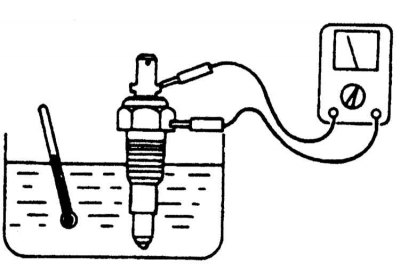
3. Place the working tip of the sensor in a container with hot water, recording the temperature of the latter using a thermometer.
4. Using an ohmmeter, measure the resistance between the terminals of the connector of the sensor lowered into the water.
5. Compare the measurement result with the requirements of the Specifications (the nominal value should not exceed the range of 2.21÷2.69 kOhm for a temperature of 20°C, 264÷328 Ohm for a temperature of 70°C and 90.5÷117.5 Ohm for a temperature of 80°C).
6. The faulty sensor must be replaced.
Replacement
1. Disconnect the negative cable from the battery.
Warning! If the car stereo system is equipped with a security code, make sure you have the correct combination to activate the audio system before disconnecting the battery!
2. Place a drain container of suitable volume under the cooling system radiator.
3. Drain the coolant until its level drops below the sensor level.
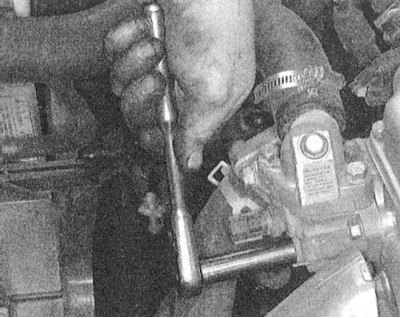
4. Disconnect the wiring from the sensor and unscrew it from the thermostat housing using a deep socket head.
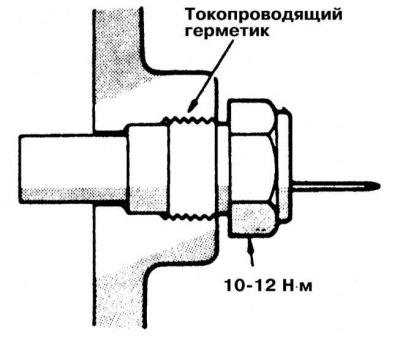
5. Screw a new sensor in place of the removed one, having previously lubricated the threads with conductive sealant (not Teflon tape or FUM tape). Tighten the sensor with the required force (10÷12 N·m).
6. Connect the electrical wiring.
7. Fill the cooling system and check that the temperature gauge is functioning properly (see above).