



2. Perform all work with the battery disconnected (first of all, disconnect the battery ground wire terminal). When performing welding work with the battery, both terminals must be removed.
3. When disassembling units and components, place the removed elements in the appropriate order to facilitate subsequent assembly.
4. Parts that must be replaced with new ones are marked in the figures with the letter "N".
These parts include: seals, gaskets and washers, cotter pins, lock washers, self-locking nuts, etc.
5. When assembling units and assemblies, follow the recommendations for applying the appropriate lubricant or sealant to the parts. Tighten the fasteners in the order shown in the figure, strictly adhering to the recommended torques and tightening angles.
6. When replacing a blown fuse, it must be replaced with a fuse of the same rating (after first establishing and eliminating the reason why the fuse burned out). It is prohibited to install homemade fuses ("bugs") or a fuse of a higher rating in place of a blown fuse.
Installation points for a jack, stops or lift supports for lifting a vehicle during repair or maintenance work
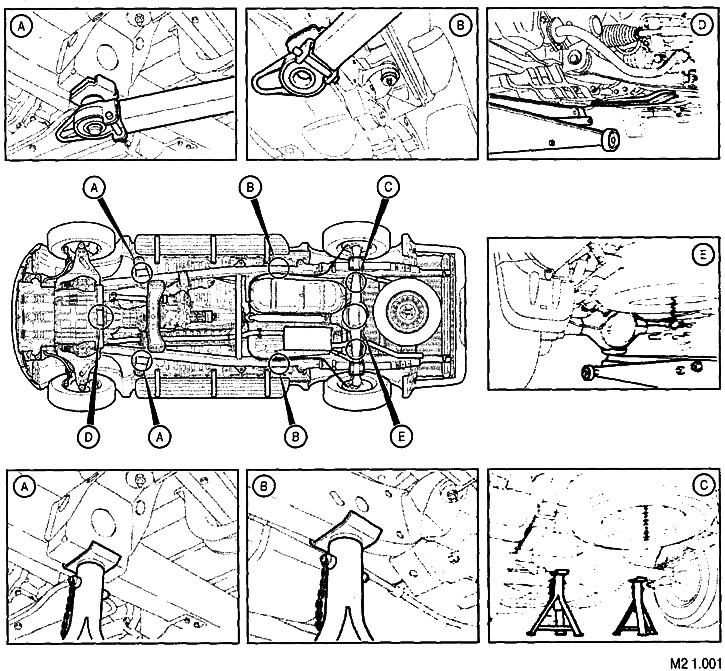
Note: Immediately after jacking up, the vehicle must be placed on supports. It is dangerous to perform any work on a vehicle supported only by a jack. If it is necessary to lift only the front or rear of the vehicle with a jack, it is necessary to place chocks under the corresponding wheels to prevent the vehicle from shifting. To avoid damage to the paintwork and subsequent corrosion, place a piece of rag and a wooden pad where the jack and support stands are installed.
Do not install the jack or supports at points other than those shown in the illustration.
When working on a vehicle installed on a lift (removing the spare wheel, rear suspension or bumper), place additional weight in the body or take measures to secure the vehicle to the lift legs.