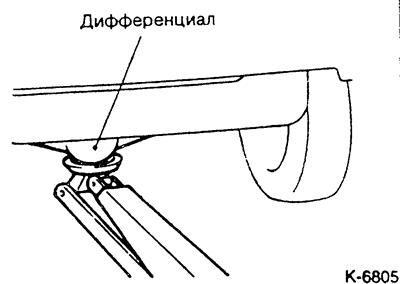
When working under a vehicle, unless it is a lifting ramp, it must be supported on four stable supports. Never work under a vehicle unless it is securely secured.
- Only lift the vehicle when it is unloaded.
- To prevent damage to the body during lifting, use suitable rubber and wooden pads.
- Wheels that remain on the ground when the vehicle is lifted must be supported with wedges at the front and rear. Do not rely on the handbrake; it must be released during some repair work.
- Raise the vehicle only on a level, solid surface.
Caution: When raising the vehicle on soft ground, place wide boards under the jack and stands to distribute the weight over a larger area.
- Place the car on stands so that one leg on each side is facing outward.
Caution: Never use engine and gearbox parts or front and rear suspension components to lift or support the vehicle. Do not start the engine or engage gears on a raised vehicle.
- If the vehicle is raised and the rear suspension, fuel tank, spare tire or rear shock absorber need to be removed, the vehicle must be supported at the rear or jacked up at the front to prevent the center of gravity from shifting.
Support points for jack stands, side jack or lifting ramp.
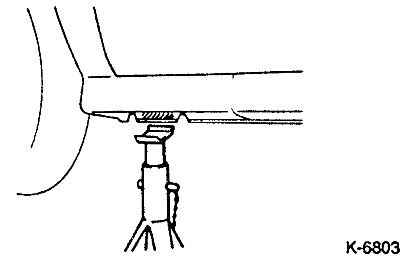
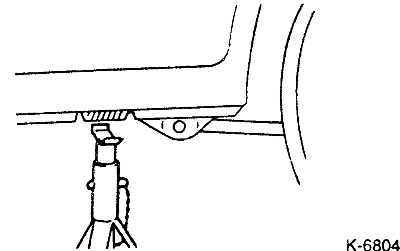
The support points on the lower crossbar are marked with notches. Place the jack under the notches, while the channel groove should lie in the jack's grip.
Support points for industrial jack and for lifting ramp (issues 1 84 to 8 88).
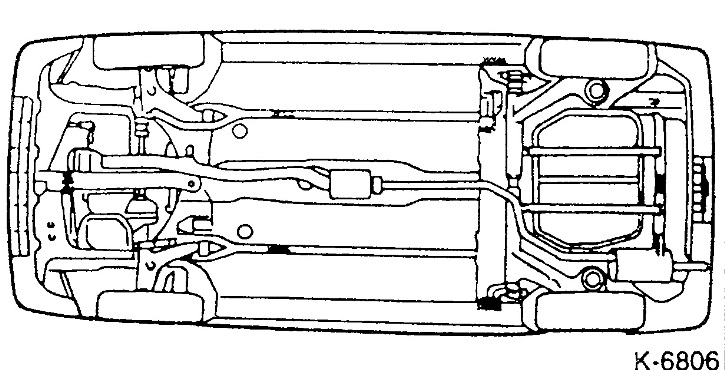
Support points for industrial jack and for lifting ramp (from 9.88 to 3.92)
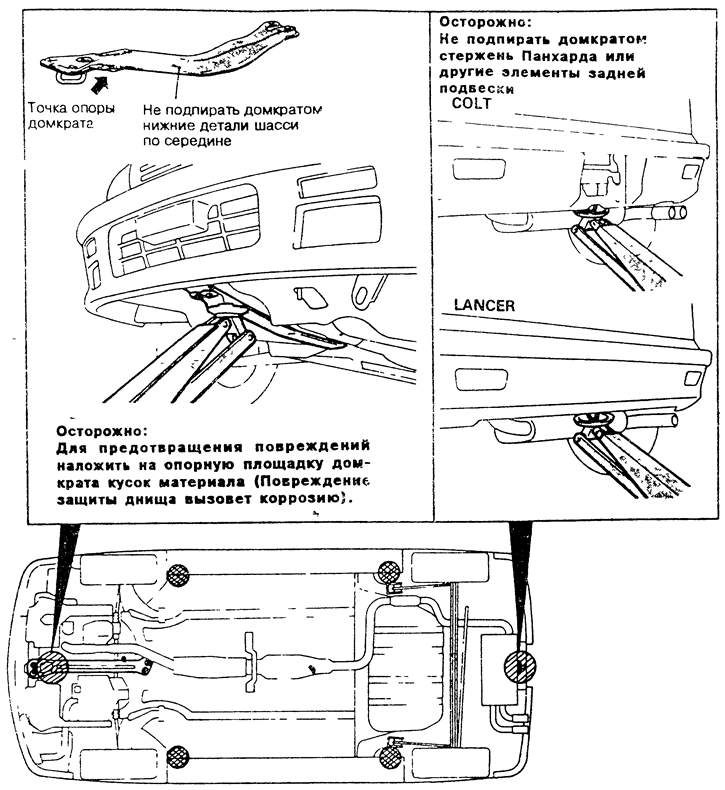
Raise the vehicle at one of the specified points. At the front, the support point is on the lower engine crossmember, at the rear - above the towing hook. However, as a precaution, always use stands at the side support points (for the side jack and lifting ramp).
- Fig. K-6802 shows the support points for front-wheel drive vehicles. On all-wheel drive vehicles, the rear support point is located directly under the differential.