



Contents: General information ⤓ Turn on/adjust sound volume ⤓ Adjusting the tone quality…⤓ Balancing (BAL/FADE) ⤓ Setting up the radio ⤓ Radio Data System RDS ⤓ Automatic reconfiguration to the…⤓ Program Identification (PI) ⤓ Selecting the type of programs…⤓ Information for road users ⤓ Reception of emergency messages ⤓ Listening to audio cassettes ⤓ Selecting the direction of listening…⤓ Fast rewinding of magnetic tape ⤓ Repeat playback of the selected…⤓ Using the Automatic Music Search…⤓ Stopping playback and ejecting the…⤓ Caring for your radio ⤓ Listening to CDs ⤓ Listening to CD recordings ⤓ Fast movement on the disk ⤓ Find the beginning of the desired…⤓ Repeat playback of the selected…⤓ Turning on/off the random playback…⤓ Car radio security system ⤓
General information
As a rule, the audio system is not included in the standard vehicle equipment and is installed as additional equipment.
The proprietary audio system provides clear sound in all frequency ranges, is distinguished by the simplicity of turning off your favorite radio stations using the preset keys, allows you to listen to audio cassettes and provides the ability to control listening to recordings from compact discs loaded into the CD changer cartridge.
The cassette deck features Dolby noise reduction, automatic chrome dioxide tape detection and an auto-reverse function that allows continuous playback of recordings from both tracks of the tape without reinstalling the audio cassette.
Note: The Dolby system used is manufactured under license from Dolby Laboratories Licensing Corporation. "Dolby" and the stylized double-D icon are registered trademarks of Dolby Laboratories Licensing Corporation.
The appearance of the control panel of the stereo radio that comes standard in Mitsubishi vehicles is shown in the illustration.
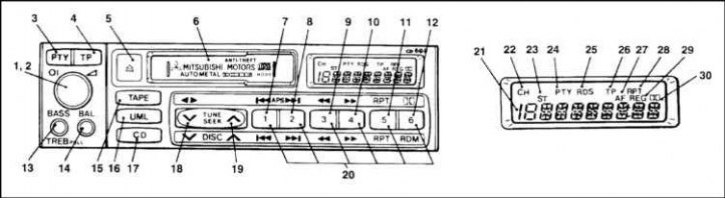
Stereo radio control panel
1, 2 - PWR/VOL - Power button/volume control; 3 - PTY - Program type detection mode activation button; 4 - TP - Button to turn on the broadcast of traffic news services; 5 - Audio cassette eject button; 6 - Cassette receiver; 7, 8 - APS - Automatic recording search buttons with tape rewind 33/forward 44; 9, 10 - Film rewind buttons 33/44; 11 - RPT - Repeat button; 12 - Dolby Noise Reduction System On Button; 13 - BASS/TREB - Button for adjusting the tone in the low/high frequency range; 14 - BAL/FADE - Button for adjusting the stereo balance between left and right/front and rear speakers; 15 - TAPE - Button for turning on the audio cassette listening mode; 16 - UML - Radio frequency range selection button (USW/MW-LW); 17 - CD - Button for turning on the CD listening mode; 18, 19 - TUNE SEEK/DISC / - Keys for directional step-by-step search tuning/disc selection to the side; 20 - Buttons for selecting radio programs stored in the tuner memory; 21 - Tape counter/playback frequency indicator; 22 - Memory number indicator; 23 - ST - Stereo playback indicator; 24 - PTY - Program Type Indicator; 25 - RDS - Radio Data System Indicator; 26 - TP - Traffic News Service Indicator; 27 - AF - Automatic return function indicator; 28 - RPT - Repeat mode indicator; 29 - REG - Regional Radio Services Program Indicator; 30 - Dolby Noise Reduction System Indicator
Turn on/adjust sound volume
With a standard connection, the audio system operates when the ignition key is in the ACC (I) or ON (II) position. In the first position of the key, the power supply of auxiliary power consumers is turned on, in the second position, the ignition and power supply of all power consumers are turned on. The audio system is turned on by pressing the PWR/VOL push-button handle. Rotating the same handle allows you to adjust the playback volume.
Adjusting the tone quality (BASS/TREB)
To adjust the sound tone in the low frequency range (BASS) mode, press the button (13) so that it extends from the panel - turning the button clockwise increases the intensity of low frequency reproduction, counterclockwise - decreases it.
To switch to tone control in HF mode (TREB), the button should be pulled out from the panel even further. The adjustment is made in the same manner as described above.
Once you have finished adjusting, do not forget to press the button back into the panel.
Balancing (BAL/FADE)
The sound level is balanced between the right and left (BAL)/front and rear (FADE) speakers using the button (14). Press the button so that it moves out of the panel - turning the button clockwise shifts the level balance to the right, counterclockwise - to the left.
To switch between front and rear speakers, pull the button out of the panel even further. Adjustment is made in the same manner as described above.
Once you have finished adjusting, do not forget to press the button back into the panel.
Setting up the radio
In any of the three ranges (USW1/USW2/MW-LW) the radio receiver allows tuning in three possible ways: manually (TUNE), semi-automatically (SEEK), and tuning to pre-selected radio stations, the frequencies of which are stored in the radio receiver's memory. Selection of the AM (MW-LW) and FM (USW1 and USW2) frequency search range.
Manual tuning (TUNE function) is performed using the TUNE/SEEK key (18/19), - to change the tuner reception frequency downwards or upwards, press the left (>) or right (<) part of the key, respectively.
In the semi-automatic tuning mode (SEEK function), the radio receiver searches for a radio station with a strong signal in the current range and tunes to it automatically. To turn the radio receiver into the search mode, press the left (>) or right (<) part of the TUNE/SEEK key and hold it down for approximately 0.5 seconds. The search for a radio station with a sufficiently strong signal will occur in the lower or upper sub-range relative to the current tuning frequency of the radio receiver, depending on which part of the key is pressed. The search stops as soon as the receiver finds the first radio station with a sufficiently strong signal.
Tuning the radio to pre-selected stations. Using six buttons (20), marked with numbers from 1 to 6, you can enter the frequencies of your favorite radio stations into the radio receiver"s memory. Each button allows you to program one frequency in the AM radio range (MW-LW) and two frequencies in the FM range (one in each of the USW1 and USW2 ranges). To program the radio receiver"s memory, perform the following operations:
- a) Using the UML button (16), select the required radio frequency range (USW1/USW2 or MW-LW);
- b) Use the TUNE/SEEK key to tune the radio to the desired radio station;
- c) Select one of the six memory programming buttons for this radio station, press and hold it until you hear a short beep;
- d) Repeat steps 1 through 3 to store the frequencies of six radio stations in the radio receiver's memory;
- e) Now it is enough to press any of the six buttons of the radio receiver memory programming so that it automatically tunes to the pre-selected station, the signal frequency of which is entered into the corresponding memory cell.
The radio's preset frequencies are erased from memory when the battery fails (is heavily discharged) or is disconnected, or when the audio system fuse is removed.
Radio Data System RDS
The design of the car radio tuner makes it possible to use the RDS radio data system service functions that are particularly well developed abroad. The RDS system uses a program identification signal (PI) and a list of alternative frequencies (AF) transmitted by some radio stations broadcasting in the ultra-short frequency range (FM). When the RDS function is activated, the radio tuner, using the other set amplification method (EON), identifies stations transmitting the same program (by PI code) and automatically retunes to frequencies from the AF list with the strongest signal. This function allows you to listen to one and the same program on long journeys without switching frequencies when leaving the range of the next repeater. In addition, RDS provides such services as selecting the desired type of information to be received (PTY), interrupting the current broadcast to voice emergency messages and traffic information (TP), and limiting the list of regional radio stations to be received.
Automatic reconfiguration to the selected program
This function allows reception of the selected program of the radio station supporting the RDS standard with automatic selection of the strongest signal from the alternative frequency (AF) range without switching the receiver when passing significant distances. To activate the mode, press and hold the UML button (16) in the depressed position for at least 2 seconds - the "AF" mark (27) will appear on the display of the radio control panel (21). The tuner returns to the normal reception mode by pressing and holding the UML button again.
Program Identification (PI)
When playing frequencies programmed using the buttons (20), it is possible to listen to broadcasts with the same identification code (PI). If the signal level on the programmed frequency drops to an unacceptable limit, the tuner automatically selects another station of the same network transmitting a similar program, - The display screen will show the "REG" label (23).
Selecting the type of programs received (PTY)
In the RDS system, all radio broadcasts are sorted according to the type of programs transmitted (by topic). The selection mode is activated by pressing the PTY button (3). The type of programs received is selected using the TUNE/SEEK button (18/19) from the following list:
- 1 SPEECH Speech
- 2 NEWS News
- 3 AFFAIRS Business
- 4 INFO Information programs
- 5 SPORT Sports programs
- 6 EDUCATE Educational programs
- 7 DRAMA Theatre productions
- 8 CULTURE Culture
- 9 SCIENCE Science
- 10 VARIED Miscellaneous
- 11 MUSIC Music programs
- 12 POP M Pop music
- 13 ROCK M Rock music
- 14 MOR.M. Road Music
- 15 LIGHT M Easy listening
- 16 CLASSIC Classical music
- 17 OTHER M Other music
Note: When selecting positions 1 and 11 (), the search is conducted within a wide range of the concepts "Speech" and "Music"
Original material on the website (mitsubishiman.ru)
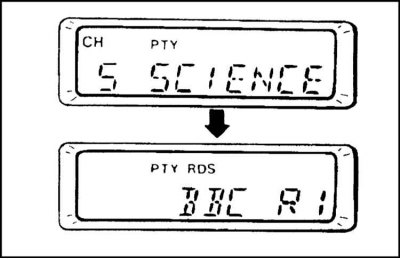
To activate the mode for selecting the theme of the received programs, press the PTY button (3), then select a theme from the list by briefly pressing the corresponding side of the TUNE/SEEK button (18) - the corresponding name will appear on the display screen. Two seconds after the selection is made, the search for programs that meet the specified parameters will begin - during the search, the "PTY" mark will flash on the screen. After the required radio station has been found, its name will appear on the display.
Attention! If you hold the TUNE/SEEK button pressed for more than 0.5 seconds, the system will try to continue searching for the next station that meets the requirements of the selected subject range. If no station transmitting the required type of program is found, the display screen will show "EMPTY" for approximately 5 seconds, then the receiver will return to playing the previously transmitted program.
It is possible to enter up to 6 program types into the tuner memory. The program type is selected using the TUNE/SEEK key (18/19). After the selection is made, press one of the six buttons (20) and hold it down for at least 2 seconds. During the time of entering the data into the system memory, the program playback will be interrupted, the display will show the button number and the selected program type. The program type previously entered into the memory is called up by holding the corresponding button down for at least 2 seconds.
Attention! Disconnecting the battery/removing the radio fuse will erase the data stored in the system memory!
Information for road users
While listening to FM radio/audio cassette or compact disc recordings, the radio tuner can automatically tune in to receive traffic announcements.
To activate the function, press the TP button (4) - the "TP" mark (26) will appear on the display screen. If information for road users is being transmitted, the message "NO RDS" will appear on the display screen for approximately 5 seconds.
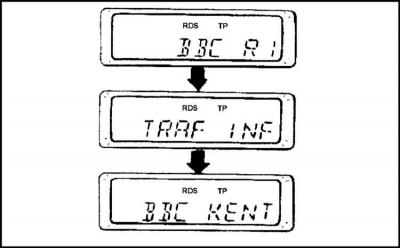
If traffic information is being transmitted by the station already selected or by another station, the message "TRAF INF" will be displayed on the screen for approximately 5 seconds, then the radio frequency will be displayed for 2 seconds, then the name of the radio station transmitting traffic news. If the volume level of the transmission is not high enough, the system will automatically optimize it. After the transmission is finished, the receiver will return to playing the previously selected program.
To return to the previous mode, press the TP button again.
Reception of emergency messages
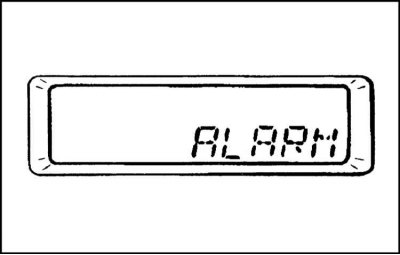
When listening to FM/audio cassette or CD programs, the radio tuner can automatically tune in to receive emergency messages, with the warning message "ALARM" displayed on the display screen and the volume level automatically optimized. When the emergency message is finished, the receiver automatically returns to playing the previously listened program.
Listening to audio cassettes
Make sure that the tape is wound tightly on the cassette reels. Insert the cassette into the cassette receiver - the recording will start playing automatically, even if the radio or CD player was previously turned on. In addition, the playback mode of a recording from a magnetic tape already inserted into the cassette receiver can be switched on using the TAPE button (15).
When listening to tapes recorded using the Dolby noise reduction system (marked NR), the noise reduction system can be activated using the button (12) - the corresponding mark (30) will appear on the display screen. The noise reduction system is switched off by pressing the same button again.
Note: The Dolby system used is manufactured under license from Dolby Laboratories Licensing Corporation. "Dolby" and the stylized double-D icon are registered trademarks of Dolby Laboratories Licensing Corporation.
Selecting the direction of listening to magnetic tape
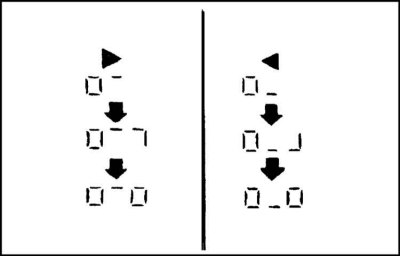
The selection of the listening direction (track) of the magnetic tape is carried out using the button (18). The current direction of tape scrolling is displayed on the display screen.
- 1 Forward
- 2 Back
When the film ends, the scrolling direction will switch automatically (auto-reverse mode).
Fast rewinding of magnetic tape
The film is rewinded in the appropriate direction using the buttons (9 - forward) and (10 - backward) on the car radio control panel.
When you press the button (18)
 during tape rewinding will start playback of the recording from the moment the button was pressed. Pressing buttons (9) or (10) during rewinding will have a similar effect.
Repeat playback of the selected fragment
You can repeat playback of a favorite fragment of a magnetic recording using the RPT button (11) - the corresponding message (28) will appear on the display screen. To cancel the repeat mode, press the RPT button again.
Using the Automatic Music Search (APS) feature
The APS button (7 and 8) allows you to search the magnetic tape with a music recording for the beginning of the next track, skipping up to 7 music recordings in a row.
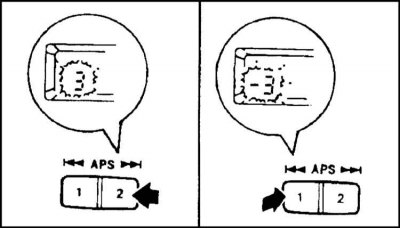
To search with fast forward, press the button (8) as many times as you want to skip songs - the display screen will show the serial number of the selected item from the point where the rewind is turned on, the tape will quickly rewind to the desired position and playback will automatically start. Search with rewind is performed in a similar manner, but using the button (17).
Note: For the APS function to function properly, the pauses between recordings on the tape must be at least 4 seconds long and free of noise.
Stopping playback and ejecting the tape
Press the button (5) on the control panel of the car radio - the playback of the magnetic recording will stop and the cassette will be ejected from the cassette slot.
Caring for your radio
During operation of the car radio, the magnetic head of the cassette deck gradually becomes contaminated with dust deposits and particles of the magnetic layer that have fallen off the film. If the magnetic head is significantly contaminated, the sound quality during playback of recordings deteriorates. In view of the above, it is necessary to regularly, every 30 hours of operation of the deck, clean the magnetic head.
Careless care of the radio and failure to follow the agreed schedule for cleaning the magnetic head can lead to a situation where it will be impossible to remove accumulated deposits using a regular cleaning cassette.
The deck design provides for the possibility of automatic unloading of an audio cassette that for some reason cannot be played back normally. If the cassette is ejected before playback begins, this indicates possible damage to it; do not attempt to reload such a cassette. Sometimes the playback of the audio recording may stop, the deck reverse mechanism may be turned on once or twice, or the cassette may be unloaded. Usually, such phenomena occur due to jamming of the mechanism, or as a result of uneven resistance to rewinding the magnetic tape on the cassette reels. In this case, it is necessary to remove the audio cassette and manually rewind the tape several turns of the reel.
The car radio cassette deck is designed to use audio cassettes with a recording time of up to 100 minutes. Using larger cassettes with thin magnetic film may cause the deck to fail or the film to deform.
Carefully inspect the audio cassette before inserting it into the deck's slot. If the magnetic tape is significantly loose, tighten it by rotating the reel hub in the appropriate direction with a pencil or your fingers.
If the label peels off, glue it back or remove it completely. Otherwise, the peeled label may cause the cassette to jam when you try to remove it from the deck. Do not insert a bent or broken audio cassette into the deck's input window.
Do not leave audio cassettes in places where they are exposed to high temperatures or high humidity, such as on the top shelf of the dashboard or in the cassette deck itself, and do not insert an overheated or overcooled cassette into the radio until its temperature has returned to normal.
Do not insert foreign objects into the cassette deck's input window.
Listening to CDs
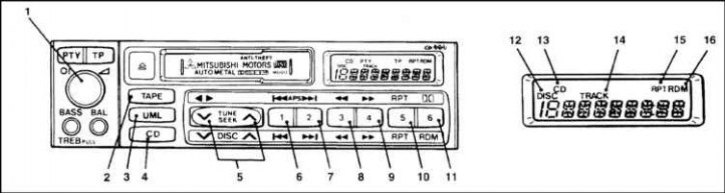
Car radio controls used when listening to CDs
1 - Power button/volume control knob; 2 - TAPE button; 3 - UML Button; 4 - CD listening mode on button; 5 - Disk selection button (DISK); 6 - Skip track back button; 7 - Skip track forward button; 8 - Fast Backward Button; 9 - Fast forward button; 10 - Repeat Button (RPT); 11 - Random Play Mode (RDM) Activation Button; 12 - DISK - disk number indication; 13 - CD - indication of activation of the CD listening mode; 14 - TRACK - track number indication; 15 - RPT - repeat mode on indication; 16 - RDM - indication of random playback mode (RDM) on
The design of the stereo system allows you to listen to compact discs from a CD changer connected to the car radio.
The layout of the changer controls on the radio panel is shown in the illustration.
Listening to CD recordings
Insert the disc into the CD player/changer receiver, making sure that the disc is inserted with the label facing up. After the disc is pulled in, playback will begin automatically, even if the radio or tape recorder was previously turned on. When the disc is inserted into the player/changer, playback is started using button (4) on the car radio panel. The system allows you to control listening to up to 10 compact discs inserted into the CD changer cartridge. The disc number is selected using button (5) (see ibid.). Switching to the radio or tape recording mode is done using buttons UML and TAPE.
Fast movement on the disk
Fast movement around the disc is performed using the buttons (8 - back) and (9 - forward). When the button is released, playback will resume.
Find the beginning of the desired fragment
The search for the beginning of the desired fragment of the recording is carried out using the buttons (6 - back) and (7 - forward). The button is pressed as many times as the fragments need to be skipped - the corresponding number will appear on the display.
Repeat playback of the selected fragment
You can repeat the playback of a favorite fragment using the RPT button (10). The repeat mode can be turned off by pressing the same button again.
Turning on/off the random playback mode for tracks
The random playback mode from a CD is activated using the RDM button (11) - the corresponding message (16) will appear on the display screen (see ibid.). To deactivate the function, press the button again.
Car radio security system
On models equipped with such a system, disconnecting the audio system from the power source for any reason results in its blocking. In order to unlock the system, it is necessary to enter a four-digit code using the radio tuning buttons to pre-selected stations. Since there are hundreds of thousands of such combinations, it is almost impossible to unlock the system without knowing the correct code.
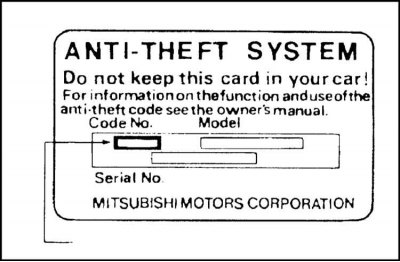
When installing an audio system in a car, the owner receives a special card with the code and serial number of the stereo system. The authors of this Manual strongly recommend that you keep the card in a safe and secure place. Enter the serial number of the audio system in a notebook and keep it with other documents outside the car. A new card to replace the lost one can be obtained at Mitsubishi service stations upon presentation of the serial number.
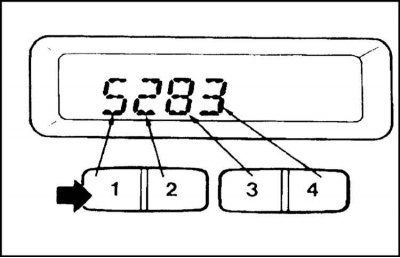
If the battery is discharged or disconnected, the audio system will inevitably be blocked. In this case, when the system is turned on, the display on the front panel of the radio will show the inscription "CODE". Using the setup buttons, enter the required four-digit code - each time you press a button, the corresponding code digit will change its value by one from zero to nine in a closed cycle.
Once you have finished entering the code, press the UML button - if the code is entered correctly and identified by the audio system, it will begin to function in normal mode.
If you enter an incorrect combination, the message "X ERROR" (where X is the error number) will briefly appear on the display screen, which will then be replaced by the prompt "CODE", allowing you to begin re-entering the code combination. The system allows up to three incorrect combinations, after which the message "OFF" will appear on the display and the audio system can only be activated at a Mitsubishi service station.