
English Русский
Български
Беларускі
Український
Српски
Hrvatski
Română
Polski
Slovenský
Magyar
Articles Bookmark Contacts Sitemap   
Company Audi Company Ford Company Hyundai Company Kia Company Mazda Company Mercedes-Benz Company Nissan
MitsubishiMan.ru


Home Colt Lancer Galant L200 Outlander Pajero Others
Outlander 1 (2003-2008)

Checking the operation of the rear brake pressure regulator (Mitsubishi Outlander 1)

  • Home
  • Outlander
  • 1 (2003-2008)
  • Chassis and running gear
  • Brake system
  • Checking the operation of the rear brake pressure regulator
0


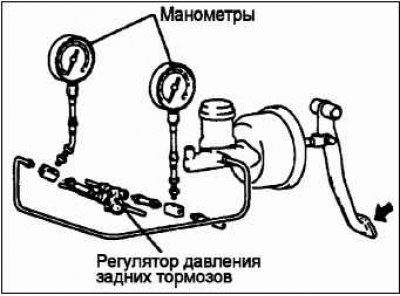
Connect two pressure gauges to the inlet and outlet of the pressure regulator respectively as shown in the figure.

Bleed the brake hydraulic system and pressure gauges.

While gently depressing the brake pedal, take the following measurements and ensure that the results are within the tolerance range.
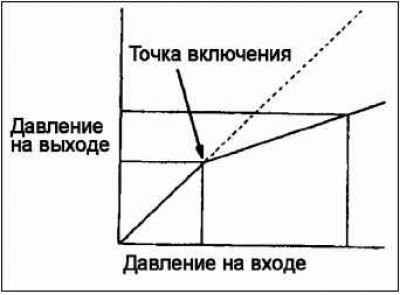


The outlet pressure begins to drop relative to the inlet pressure (turn-on point).

The original material is here mitsubishiman.ru

Nominal value: 2.7–3.19 MPa

Check and ensure that when the brake pedal pressure increases, the fluid pressure at the outlet is within the specified limits, while the pressure at the inlet corresponds to the values given in the table.

Nominal value: 3.68–4.17 MPa.

The difference in pressure at the outlet between the right and left circuits of the hydraulic system.

Maximum allowable value: 0.39 MPa.

If the pressure measurement results do not correspond to the nominal values, replace the pressure regulator.
This article is available at: russian, bulgarian, belarusian, ukrainian, serbian, croatian, romanian, polish, slovak, hungarian
This article was reviewed by: Arseny Pavlov
Share with friends:
◀ Previous
Outlander 1: Brake system
Next ▶

Checking the operation of the check valve
Checking and adjusting the brake pedal
Checking the brake disc
Checking for leaks in brake system pipes and hoses
Checking the play in the front hub bearings
Checking the brake fluid level sensor
Parking brake specifications
Running-in of parking brake linings
Removal and installation the parking brake lever
Removal and installation brake pads and drum mechanism
Similar materials for other Mitsubishi models

➤ Checking tire pressure Mitsubishi Colt 4 and 5 (1991-2003)
➤ Checking the operation of the brake booster Mitsubishi Lancer 9 (2000-2007, petrol)
➤ Checking the proper functioning of the parking brake Mitsubishi Galant 6 and 7 (1987-1998)
➤ Checking and adjusting the rear brake force regulator… Mitsubishi L200 4 (2005-2014, diesel)
➤ Rear Brake Pressure Regulator (1992-98) Mitsubishi Pajero 1 and 2 (1982-1999)
➤ Checking the functionality of the rear brake pressure… Mitsubishi Carisma (1995-2004)
Link in different formats to this article
Comments and feedback from visitors
No comments yet


Add up two numbers 21 + 30


Outlander 1 (2003-2008) 
  • General information
  • User manual
  • Governing bodies
  • Salon equipment
  • Driving and maintenance
  • Power unit
  • Engine repair
  • Cooling and lubrication system
  • Fuel injection system (MPI)
  • Transmission
  • Clutch
  • Mechanical gearbox
  • Automatic gearbox
  • Drive shafts and cardan
  • Chassis and running gear
  • Wheels and tires
  • Front suspension
  • Rear suspension
  • Steering
  • Brake system
  • Body and interior
  • Exterior (external elements)
  • Doors, locks and windows
  • Electrical equipment
  • Equipment and devices
  • Headlights and lighting
  • Power devices
  • Ignition system
  • Electrical circuits
MitsubishiMan.ru © 2018–2026 • Mobile version • Articles about Mitsubishi • Contacts • Sitemap: EN BG BY UA RS HR RO PL SK HU • Site search • Bookmark
Colt 2 and 3 (1983-1993) · Colt 4 and 5 (1991-2003) · Colt 5 (1995-2003) · Lancer 3 and 5 (1984-1992) · Lancer 9 (2000-2007) · Galant 5 (1983-1989) · Galant 6 and 7 (1987-1998) · L200 4 (2005-2014) · Outlander 1 (2003-2008) · Pajero 1 and 2 (1982-1999) · Pajero 4 (2006-2021) · Carisma (1995-2004) · Space Star (1998-2005) ·
This resource sets cookies 🍪 to avoid bothering you with repeated data entry.