



Contents: Checking the degree of wear of brake…⤓ Checking disc runout ⤓ Checking the degree of wear of brake…⤓ Checking the thickness of the brake…⤓ Checking the inner diameter of the…⤓ Checking the fit of the brake drum…⤓ Checking the inner diameter of the…⤓
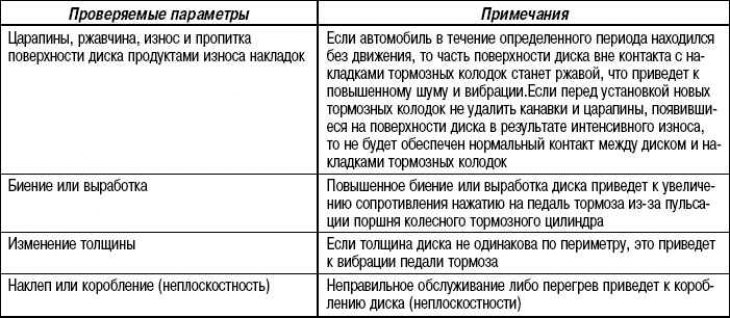
Attention! When servicing disc brakes, special attention must be paid to compliance with the technical requirements imposed on disc brakes, which ensure normal operation of the disc brakes. Before restorative operations on mechanical processing or grinding of the brake disc, the following parameters must be checked.
When servicing brake discs, it is necessary to carefully check that the discs comply with the permissible service values to maintain normal brake operation.
Checking the degree of wear of brake pads and discs
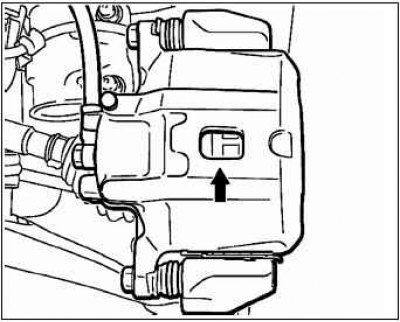
Check the thickness of the brake pads through the inspection window in the brake caliper.
- Nominal value: 10 mm.
- Limit value: 2.0 mm.
If the thickness of the working layer of the pad is less than the limit value, always replace the pads on the entire axle.
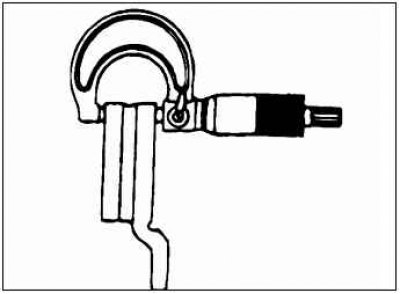
Measure the disc thickness using a micrometer at eight points located approximately 45° around the circumference and 10 mm from the outer edge of the disc.
- Nominal value: 24.0 mm (front), 10.0 (rear).
- Limit value: 22.4 mm (front), 8.4 (rear).
If the disc thickness is less than the maximum, replace it.
Checking disc runout
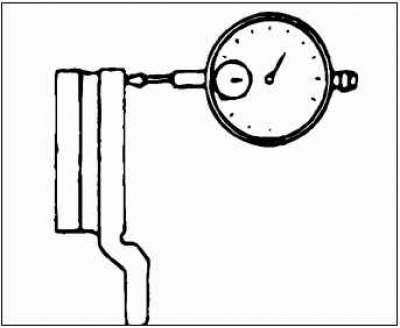
Remove the brake assembly and hang it on a wire.
Temporarily install the disc onto the hub nuts.
Place a dial indicator approximately 5 mm from the outer circumference of the disc and measure its runout.
- Limit value: 0.04 mm (front), 0.05 (rear).
Checking the degree of wear of brake pads and drums
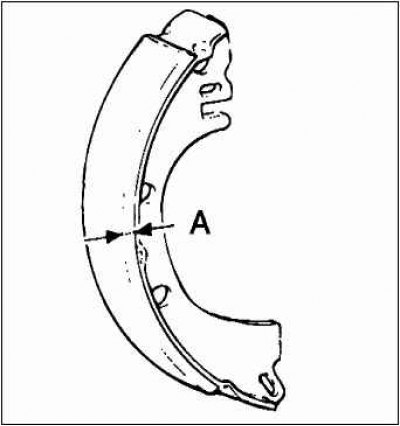
Remove the brake disc.
Measure the thickness of the friction lining.
- Nominal value (A): 2.8 mm.
- Limit value (A): 1.0 mm.
If the brake pad thickness is below the limit, replace the brake pads on both sides of the vehicle. Replacing the brake pads on one side is not allowed.
Checking the thickness of the brake pads
Remove the brake drum.
Measure the thickness of the brake shoe lining at the point of greatest wear.
- Nominal size: 4.4 mm.
- Minimum acceptable value: 1.0 mm.
Replace the pad together with the lining if the lining thickness is less than the maximum permissible value or if it is clearly worn.
Attention! When replacing brake pads, they must be replaced on both the left and right sides of the vehicle in order to prevent uneven braking of the right and left wheels.
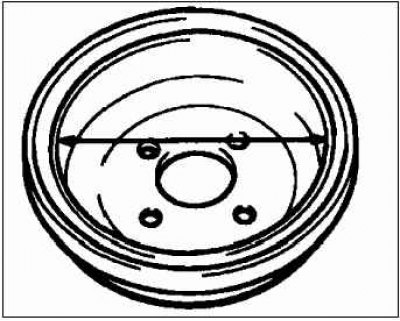
If there is a significant difference in the degree of wear (thickness) of the brake linings on the left and right wheels, then it is necessary to check the operation of the wheel brake cylinder piston.
Checking the inner diameter of the brake drum
Remove the brake drum.
Measure the inside diameter of the brake drum in two or more places.
- Nominal size: 203 mm.
- Maximum allowable value: 205 mm.
(The source of the article is available at: MitsubishiMan.ru)
If the brake drum wear exceeds the limit value or the brake drum has a significant imbalance, then it is necessary to replace the brake drum and brake shoes.
Checking the fit of the brake drum and brake shoes
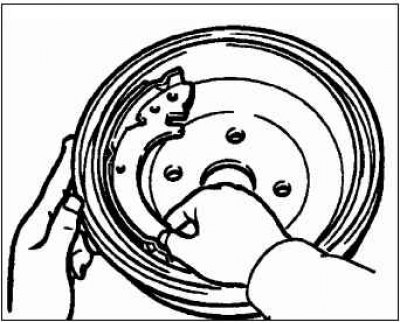
Remove the brake drum.
Remove the brake pads.
Rub the inside of the drum with chalk and run the brake shoe over it.
If the contact patch is uneven, replace the brake drum or brake shoe.
Note: After checking, wipe off the chalk from the surface of the brake drum and lining.
Checking the inner diameter of the brake drum
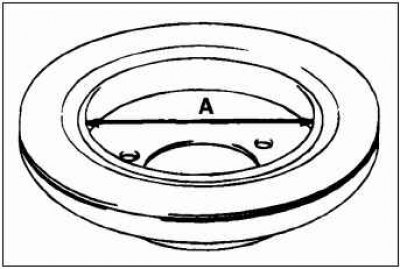
Remove the brake drum.
Measure the inside diameter of the brake drum at least in two places.
- Nominal value (A): 168.0 mm.
- Limit value (A): 169.0 mm.
If the brake pad thickness is below the limit, replace the brake pads on both sides of the vehicle. Replacing the brake pads on one side is not allowed.