



Loosen the wheel nuts of the vehicle while it is parked on the ground.
Raise the vehicle and remove the wheel, having first marked the position of the disc relative to the hub.
Measure the thickness of the brake disc. Service stations use special measuring devices for this, since wear on the disc causes an edge to form. The thickness of the brake disc can also be measured using a caliper. However, in this case, spacers of a known thickness (e.g. 2 coins) must be placed on each side of the disc. To obtain an accurate result, the total thickness of the spacers must be subtracted from the measured value.
ATTENTION: Measure at least 8 points along the disc diameter.
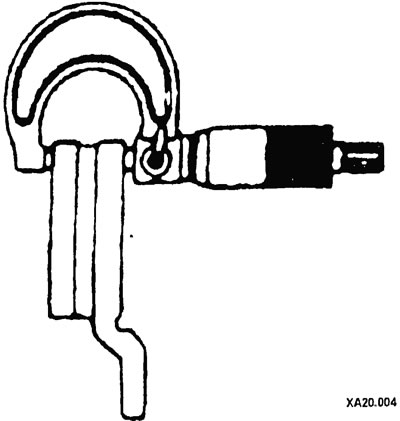
When the wear limit is reached, the brake disc should be replaced.
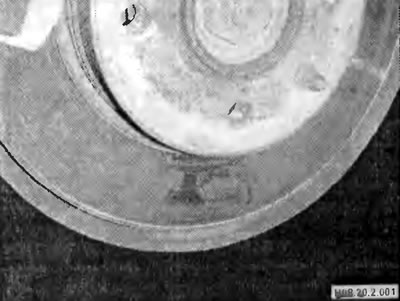
If there are significant cracks or grooves more than 0.5 mm deep, the brake disc must be replaced.
If a dial indicator is available, measure the lateral runout of the disc in the installed state. Position the indicator as close to the outer edge as possible.
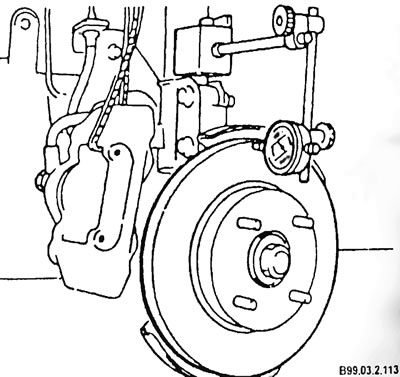
Lateral runout should not exceed 0.15 mm. A large runout may be caused by a worn out front wheel hub bearing.
Install the wheels, observing the marks made during removal. Lower the car and cross-tighten the wheel nuts.