



Contents: Removal ⤓ Installation ⤓
When replacing brake discs, the brake pads must also be replaced.
Removal
Mark the position of the wheel rim on the wheel hub with paint.
Place the front of the car on jack stands.
Remove the wheel.
Release the handbrake completely and disconnect the handbrake cable from the brake caliper.
Remove the brake caliper and hang it with wire on the body with the brake pads installed, avoiding tension or twisting of the brake hose.
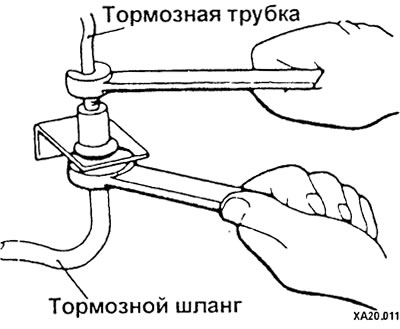
To remove the caliper completely, disconnect the brake hose by unscrewing the union nut and holding the Allen key on the brake hose. Then, by squeezing the clamp of the brake hose holder, remove the brake hose from the holder.
Installation
It is advisable to replace brake discs on one axle at the same time.
Check the bearing breakaway moment by attaching one end of the cord to the hub studs and connecting a spring scale to the other; pull at a 90° angle to the studs until the hub starts to rotate.
Tighten the caliper mounting bolts to 60 Nm.
Insert the brake hose, if removed, into the holder and secure with a clamp. Tighten the union nut of the brake pipe with a force of about 15 Nm.
Bleed the brake system if it has been opened.
Loosen the wheel nuts.
Connect the handbrake cable.
Measure the breakaway torque with the brake pads installed.
After starting the engine, leave it to idle. Set the gearbox to neutral.
Keep the brake pedal depressed for approximately 5 seconds.
Turn off the engine.
Rotate the wheel hub forward 10 revolutions.
Measure the breakaway torque of the wheel hub. If the difference between the measured value and the breakaway torque measured with the brake pads removed exceeds the required value for a ventilated brake disc of 70 N, disassemble and repair the brake caliper.
Place the wheels in accordance with the marks made, screw in the wheel nuts. Lower the car and tighten the nuts crosswise.
Bring the fluid level in the tank up to the MAX mark.
Adjust the handbrake.