
Note. Some models use twin-cylinder disc brake calipers. The refurbishment of such calipers is carried out in the same way as described below for single-cylinder assemblies, with the only difference being that in this case, twice as many cuffs and anthers need to be replaced.
Disassembly
1. Remove the caliper from the brake assembly (see Section Removal and installation of brake calipers) and transfer it to a clean workbench.
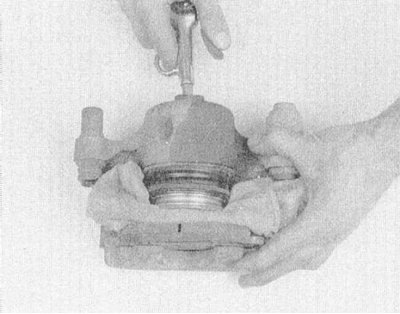
2. Depending on the design of the brake mechanism, the piston is removed from its cylinder in one of two ways. In the first case, you should put a wooden block into the assembly, which will act as a support, then apply compressed air to the caliper inlet, which will push the piston out of the cylinder.
Attention! Be careful - make sure that when pushing the piston, your fingers do not get between its end surface and the thrust surface! In the second case, the piston is removed from the cylinder by turning.
 | 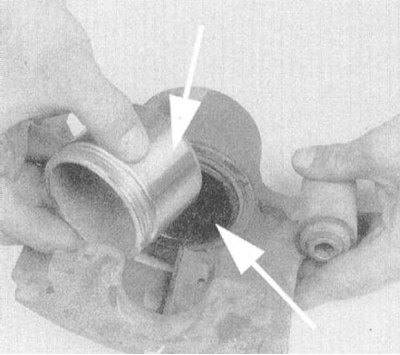 |
3. Carefully inspect the removed piston for scratches, scuffs, corrosion and signs of damage to the chrome plating, replace if necessary.
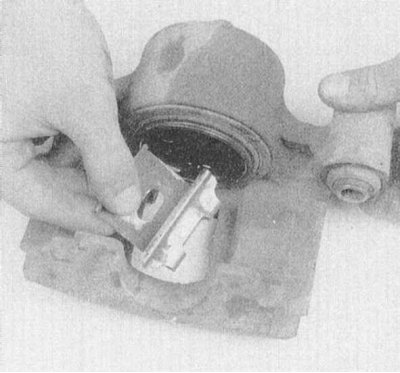
4. If equipped, remove the anti-squeal insert.
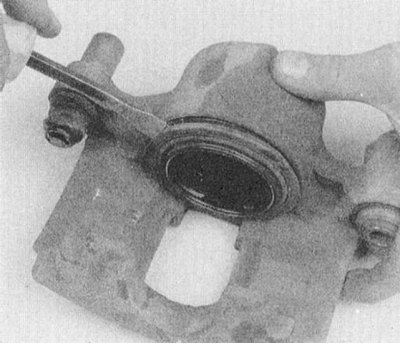
5. Prying with a blunt screwdriver, remove the boot and remove the sealing cuffs from their grooves in the cylinder - try not to damage the cylinder mirror.
 | 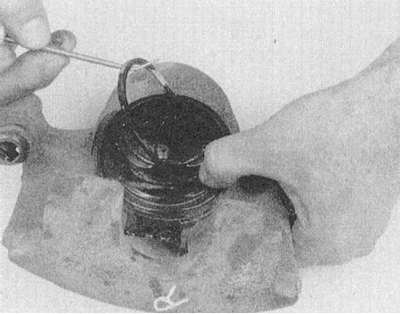 |
6. Remove the protective cap of the bleed valve, then unscrew the latter from the body of the caliper.
7. Carefully inspect the piston face and cylinder bore for scratches, cracks, and signs of excessive wear. Assess the condition of the threaded fasteners.
8. Traces of light corrosion can be removed by polishing the working surfaces of the elements with fine-grained sandpaper.
9. Finally, wipe the surfaces with methanol and dry with compressed air.
Assembly
1. Having previously lubricated, screw the bleed valve into place and install a protective cap on it.
2. Fill in the grooves of the cylinder with new sealing cuffs - make sure that the cuffs are not twisted in the grooves.
3. Lubricate the cylinder mirror.
4. Prime the piston (complete with anther installed on it) into the cylinder and push it in as far as it will go.
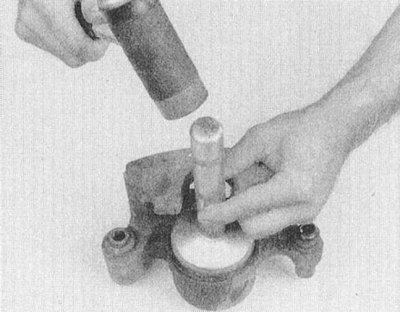
5. Anther is planted in the caliper body using a special mandrel.
6. Install the caliper in its regular place (see Section Removal and installation of brake calipers).
7. Install the wheel and lower the vehicle to the ground.
8. Bleed the brake system (see Section Bleeding the brake system).