



Contents: Towing a car with a tow truck…⤓ Towing with front wheels raised…⤓ Towing with rear wheels raised (type…⤓ Emergency towing ⤓ Towing a car with another car ⤓ Towing another vehicle ⤓
If towing is necessary, we recommend that it be performed by a MITSUBISHI dealer or a professional commercial towing company.
In the following cases, the vehicle can only be towed by a tow truck: the engine is running, but the vehicle does not move, or an abnormal engine sound is heard.
Towing a car with a tow truck (tractor)
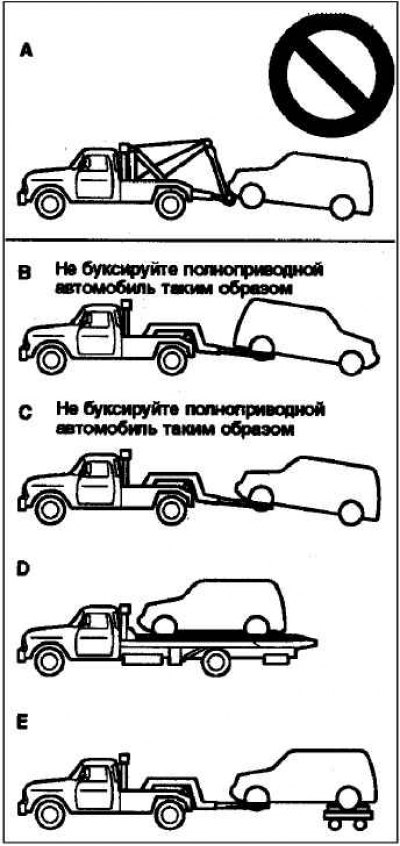
Warning! This vehicle must not be towed by a tow truck with a type A lifting mechanism (see picture). Using this type of lifting mechanism may damage the bumper and the front of the vehicle.
Do not tow a 4WD vehicle with either the front or rear wheels touching the ground (Type B or Type C in the illustration). This may damage the vehicle's control system or cause it to become separated from the tow truck. Use a tow truck with (Type D) or (Type C) equipment to tow a 4WD vehicle.
If the transmission is damaged, transport the vehicle with the drive wheels on a towing device (type C, D or E) as shown in the figure.
Towing with front wheels raised (type C)
Release the parking brake. Set the gearshift lever to neutral position "N" (NEUTRAL).
Towing with rear wheels raised (type B)
Set the gearshift lever to neutral position "N" (NEUTRAL).
Turn the ignition key to the "ACC" position and secure the steering wheel with a belt, rope, etc. in a position where the front wheels are pointing straight ahead (parallel to the longitudinal axis of the vehicle). Never turn the ignition key to the "LOCK" position. This is dangerous, as the steering wheel may lock.
Emergency towing
If towing is necessary, we recommend that it be performed by a MITSUBISHI dealer or a professional commercial towing company.
Only if it is not possible to call a towing service, the vehicle can be temporarily towed using a towing rope or chain.
If your vehicle needs to be towed or if it is towing another vehicle, please ensure that the following rules and recommendations are followed.
Towing a car with another car
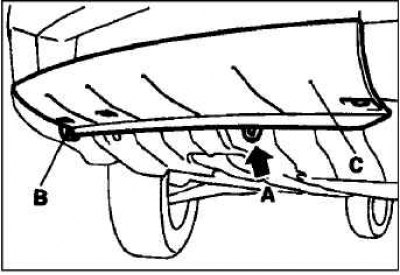
The front towing hook A is located at the location shown in the figure. Attach the towing rope (cable) to the towing hook.
Before towing, remove the lower cover from the bumper.
Note: If the bumper cover is removed, it may be dented or damaged during towing due to contact with the towing rope (cable).
Note: Do not use hook B for towing. It is intended only for securing the vehicle during transportation.
Using any part of the vehicle other than the designated towing hook A for towing may result in damage to the vehicle body.
Try not to use metal cables and ropes for towing, as they can damage the body.
If you are using a metal towing cable, wrap it with a rag where it comes into contact with the vehicle.
Make sure that the towing cable (rope, chain) is positioned as close to horizontal as possible so that it does not damage the body.
Never try to pull a car out of a deep ditch using a rope (cable), since in this case the latter cannot be positioned horizontally.
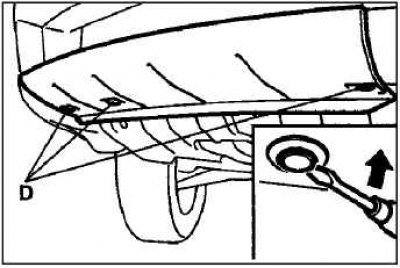
Release all the fasteners D. To do this, insert the tip of a flat-head screwdriver into the slot of the fastener. Carefully pry the fastener and use the screwdriver as a lever to pull out the fastener.
The source of the article is available at MITSUBISHIMAN
Remove the lower bumper cover.
Once the vehicle has been towed, reinstall the bumper cover by performing all operations in reverse order.
Leave the engine running. If the engine is not running, turn the ignition key to the ACC or ON position to unlock the steering wheel.
Caution! Since the engine is not running, the brake booster and power steering pump do not function. This means that more force is required to brake and control the steering wheel. Therefore, driving the car becomes more difficult than under normal (standard) conditions.
Do not leave the ignition key in the "LOCK" position. If the key is removed from the ignition while driving, the steering wheel will be locked and the vehicle will become uncontrollable.
Set the gearshift lever to neutral position "N" ("NEUTRAL").
Turn on the hazard warning lights.
During towing, reliable communication must be ensured between the drivers of both vehicles and the movement must take place at a low speed.
Warning: Avoid sudden acceleration, sudden braking and sharp turns, otherwise the towing hooks and cable may be damaged, which may result in injury to others.
On a long descent, the brakes may overheat and lose their effectiveness. In this case, the car must be transported on a tow truck.
Towing another vehicle
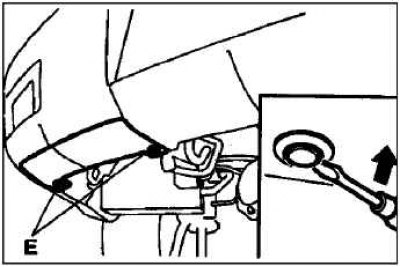
Unfasten all the E fasteners. To do this, insert the tip of a flat-head screwdriver into the fastener groove and carefully pry the fastener out.
Remove the lower bumper cover.
Once the vehicle has been towed, reinstall the bumper cover by performing all operations in reverse order.
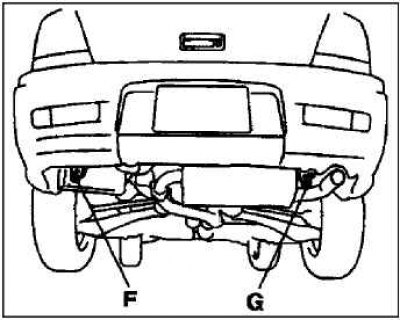
The rear towing hook F is located at the location shown in the illustration. Attach the towing rope (cable) to the towing hook.
Note: Do not use the towing hook (G). It is intended only to secure the vehicle during transport.
Using any part of the vehicle other than the designated towing hook F for towing may result in damage to the vehicle body.
The vehicle may only be used to tow another vehicle of equal or lesser weight.