



Warning! For safety reasons, when jump starting the engine, please follow the jump starting procedure described below. Otherwise, a fire or explosion may occur, which will damage both vehicles.
Place the vehicles next to each other at a distance that allows the connection of the jumper cables, but does not allow the vehicles to touch. If the vehicles touch, unwanted grounding may occur. In this case, you will not be able to start your vehicle, and the electrical systems of both vehicles may be damaged.
Warning! Check another vehicle. It must be equipped with a battery with a nominal voltage of 12 V. If the voltage of the other battery is different from 12 V, connecting it may cause damage to the electrical equipment of both vehicles.
Moving vehicles may cause injury. Apply the parking brake on both vehicles. Set the automatic transmission selector lever (if equipped with an automatic transmission) to the "P" (Park) position or the gearshift lever (if equipped with a manual transmission) to the "N" (neutral) position. Turn off the ignition.
Warning! First of all, turn off the ignition on both cars. Make sure that wires and clothing do not get caught in the fan blades or drive belts, otherwise you may get injured.
Note: Turn off all lights, heater and other electrical appliances. This will prevent sparks and reduce the discharge of both batteries.
Make sure that the battery electrolyte level is normal.
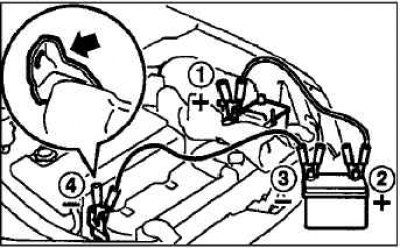
Connect one end of the jumper cables to the positive (+) terminal of the dead battery, and the other end of the cable to the positive (+) terminal of the battery on the other vehicle (used as a booster source).
Connect one end of the other jumper cable to the negative (–) terminal of the other vehicle's battery (used as an additional source), and the other end of this cable to the engine block of the vehicle with the dead battery at a point that is furthest from the battery.
Note: Before connecting the cable to the positive terminal, remove the protective cover from the battery.
Attention! Strictly follow the following sequence of wire connection operations: 1–2–3–4.
Make sure that the alligator clip 4 (see fig.) is securely fastened in the indicated place. If the connection is made directly to the negative terminal of the storage battery, this may result in flammable gases released from the battery causing a fire and explosion.
Do not connect the positive (+) cable to the negative (–) terminal. This may cause a spark and cause the battery to explode.
Use jumper cables that match (in terms of wire cross-section and insulation) both batteries. Otherwise, the cables may melt.
Before using the connecting wires, check them for damage or corrosion.
The original article is on the website: www.MitsubishiMan.ru
Start the engine of the car with the battery used as an additional source and let the engine idle for a few minutes, then start the engine of the car with the discharged battery.
Caution! Always maintain the engine speed of the vehicle whose battery is used as an additional power source so that it does not stall.
After the engine is started, disconnect the jumper wires in the reverse order of how they were connected.
Warning! Charging a battery installed in a vehicle may cause a fire, explosion, or damage to the vehicle. If it is absolutely necessary to charge the battery while it is in the vehicle, disconnect the negative battery cable.
Warning: To prevent explosion, do not allow sparks, open flames or smoking near the battery.
When charging or handling the battery in an enclosed area, ensure good ventilation.
Before charging the battery, unscrew all the caps of its cans.
Battery electrolyte is a solution of sulfuric acid, which has a corrosive effect. If the electrolyte gets on your hands, eyes, clothes, etc., or on the painted surface of the car, they should be immediately washed with plenty of water. If the electrolyte gets into your eyes, immediately rinse them with water and seek medical attention.
If the engine runs unstably after replacing the battery
If the engine starts to run unstably after replacing the battery, perform the ECU learning procedure as described below.
1. Stop the car in a safe place.
2. Set the gearshift lever to neutral position "N". Stop the engine.
3. Start the engine again.
4. Turn off the air conditioning system.
5. Warm up the engine until the coolant temperature gauge needle is approximately in the middle of the scale.
6. Turn off and start the engine again.
7. Let the engine idle for about 10 minutes.
8. The training procedure can be considered complete after the idle speed has stabilized.
Note: If the engine continues to run rough after completing the ECU learning procedure, have the vehicle checked by an authorized Mitsubishi dealer.