
1. Place the cars side by side at a distance that ensures the connection of connecting wires, but excludes the contact of cars. If vehicles are touching, unwanted grounding may occur. In this case, you will not be able to start the engine of your car. In addition, the electrical systems of both vehicles may be damaged.
2. Moving vehicles can cause injury. Set the parking brake on both vehicles. Install the automatic transmission selector lever (by car with automatic transmission) into position «R» («Parking»), shift lever (in a car with a manual transmission) to neutral «N». Switch off the ignition.
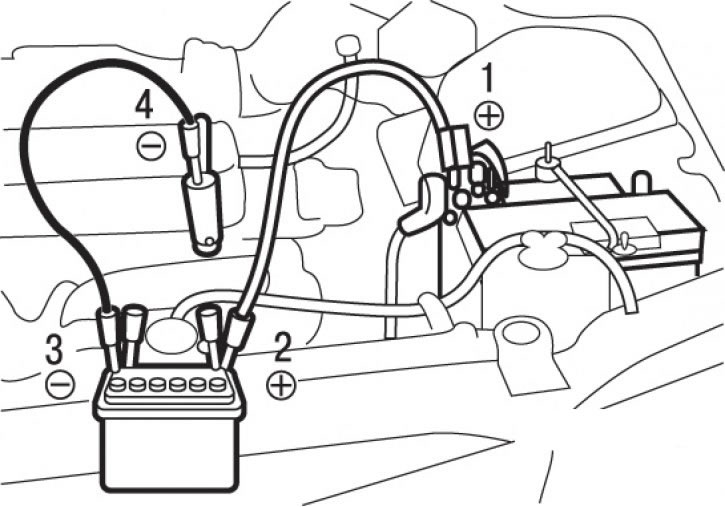
Pic. 1.55. The sequence of connecting wires when starting the engine of a car with a gasoline engine (models 1800) from an external source
3. Connect the end of one of the connecting wires to the positive («+») terminal of the discharged battery, and the other end of this wire to the positive terminal («+») car battery «donor» (pic. 1.55).
4. Connect one end of the other connecting wire to the negative («–») battery terminal of another vehicle (used as an additional source), and the other end of this wire to the engine block of a car with a dead battery at a point that is as far as possible from the battery.
5. Start the car engine with the battery used as «donor», let the engine idle for a few minutes, and then start the vehicle with the dead battery.
Always maintain the engine speed of the engine of the car, the battery of which is used as an additional source of power, so that it does not stop.
6. After the engine starts, disconnect the connecting wires in the reverse order to their connection.
Note. If the vehicle is equipped with an anti-lock brake system (ABS) and you start driving with an incompletely charged battery, uneven engine operation is possible, as well as the inclusion of a warning lamp for a malfunction of the anti-lock brake system (ABS).