



To start the engine from another car's battery using special wires, follow the steps described in the operating instructions. Failure to follow instructions may result in fire, explosion or damage to vehicles.
1. Park the cars close enough to each other to allow the wires to be connected. In this case, the cars must not touch each other. Otherwise, an undesirable connection of the vehicle masses may occur. The car engine will not start, and poor ground contact may cause damage to electrical equipment.
Caution: Check the voltage in the electrical system of another vehicle. It must be 12 V. Otherwise, connecting the batteries may cause damage to both vehicles.
2. Moving cars from a standstill may result in injury to people. Set the parking brake on both vehicles. Shift the automatic transmission to P (Park) or the manual transmission to N (neutral gear). Turn off the ignition.
Caution: Before connecting the jumper cables to the batteries, turn off the ignition on both vehicles. Take care to ensure that wires or clothing are not caught in the fan or drive belt. This may result in injury.
Note: Turn off all lights, heater and other equipment that uses electricity. This will prevent sparks from forming and reduce the load on both batteries.
3. Make sure that the electrolyte level in the battery cells is normal.
Warning: If the electrolyte is not visible or frozen, do not attempt to start the engine using an external power source! If the electrolyte is frozen or its level is insufficient, the battery may fail or explode when power is supplied from outside.
4. Connect one end of the jumper cable to the positive (+) terminal of the discharged battery (A) and the other end to the positive (+) terminal of the auxiliary battery (B).
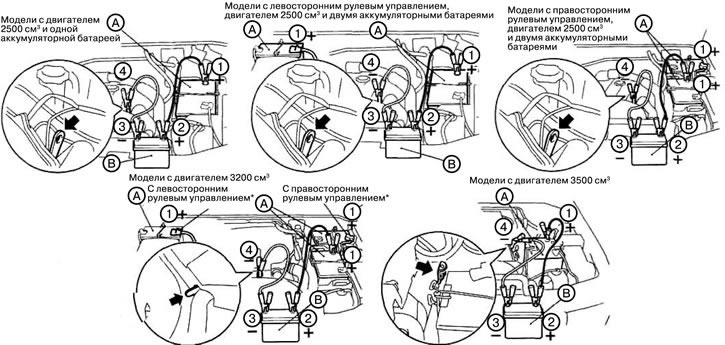
Note: Equipment is installed upon request.
5. Connect one end of the second cable to the negative (-) terminal of the booster battery (B) and the other end to the engine block of the vehicle with the dead battery at a location as far away from the battery as possible.
Note: Remove the terminal cover before connecting the wire to the positive (+) battery terminal.
Attention:
- Follow the sequence of actions specified in points 1→2→3→4.
- Make sure that the end of the wire mentioned in the item is connected exactly to the specified location (see picture). If the wire is connected directly to the negative terminal of the battery, flammable gases emitted by the battery may be ignited by a spark and explode.
- When connecting connecting wires, be careful not to connect the positive (+) wire to the negative one!—) removing the battery. This will cause sparking which may cause the battery to explode.
Attention:
- The connecting wires should be routed in the engine compartment in such a way that they are not caught by the cooling fan or other rotating parts.
- The cross-section of the connecting wires should be selected in accordance with the capacity of the battery. Otherwise, the heat generated may damage the wires.
- Before using the connecting wires, make sure that they are not damaged or corroded.
6. Start the engine of the vehicle with the booster battery, let it idle for a few minutes, then start the engine of the vehicle with the discharged battery.
Caution: Do not turn off the engine of the vehicle from whose battery the starting device is used.
7. After starting the engine, disconnect the connecting wires in the reverse order.
Attention:
- Charging the battery directly on the vehicle is dangerous: it may catch fire or explode. Damage to the vehicle is also possible. If you need to charge it in the vehicle, disconnect the negative (-) cable from the vehicle ground.
- Avoid sparking, smoking or working with open flames near the battery. This may lead to an explosion.
- When charging or using the battery in an enclosed area, ensure adequate ventilation.
- Before charging the battery, remove all plugs from it.
- The electrolyte is a corrosive solution of sulfuric acid. If electrolyte gets in (battery acid) if it gets on your hands, in your eyes, on your clothes or on the paintwork of your car, you should rinse it off thoroughly with water. If electrolyte gets into your eyes, rinse them immediately with plenty of water and then consult a doctor.
- Do not attempt to start the engine by pushing, towing, or while driving downhill. This may result in damage to the vehicle.
- Always wear safety glasses when working near a battery.
- Keep children away from the battery.
Note: If you drive a vehicle equipped with anti-lock brakes with a partially discharged battery, the engine may run rough; in addition, the ABS warning light may come on.