



Contents: Checking voltage ⤓ Test without load ⤓ Load testing ⤓ Engines 1.5 l, 1.6 l, 1.8 l, 2.0 l…⤓ Engines 3.0L DOHC ⤓ 3.0L SOHC and 3.5L engines ⤓
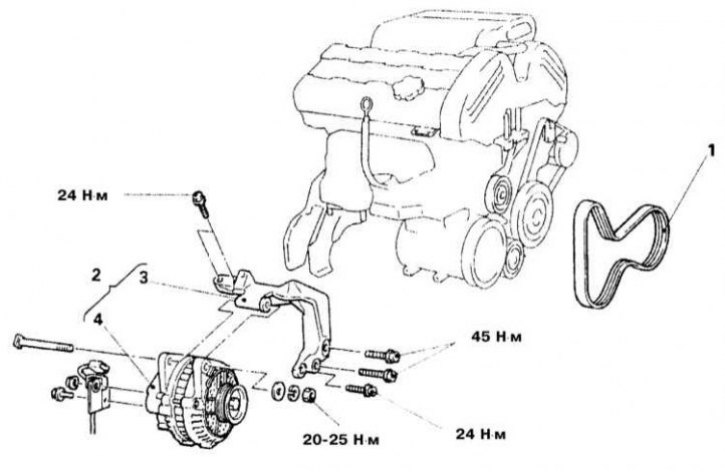
Generator Installation Details for 3.0L DOHC Models
1 - Drive belt; 2 - Assembling the generator with the support bracket; 3 - Support bracket; 4 - Generator
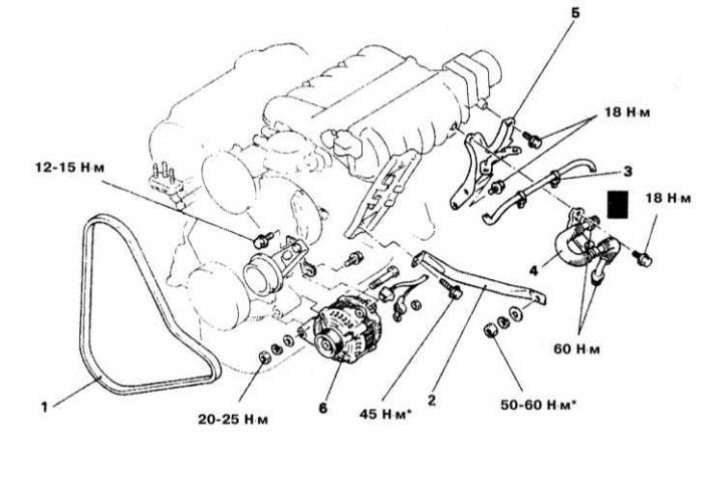
Generator Installation Details for 3.0L SOHC Models
1 - Drive belt; 2 - Reactive rod; 3 - EGR Temperature Sensor Wiring (California Models); 4 - EGR pipe; 5 - Mounting bracket for the upper section of the intake manifold (pressure chamber); 6 - Generator
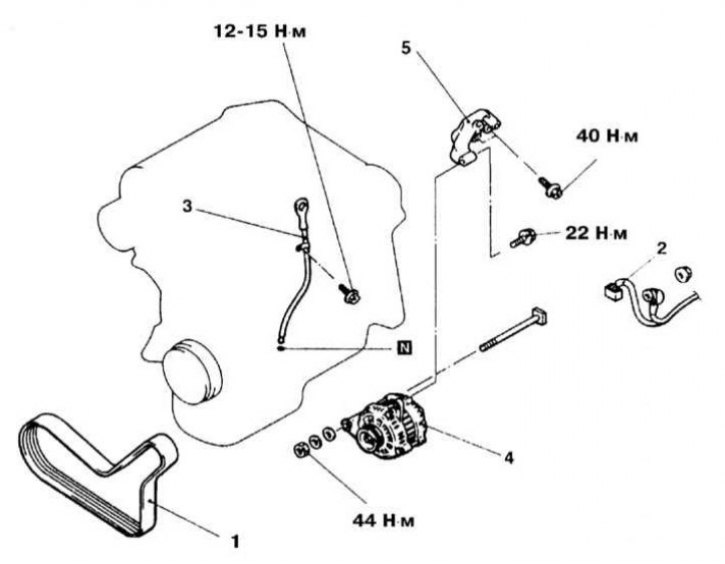
Generator Installation Details on 3.5L Models
1 - Drive belt; 2 - Generator wiring; 3 - Engine oil level dipstick; 4 - Generator; 5 - Generator support bracket
Checking voltage
1. Turn off the engine and turn on the headlights for 15-20 seconds to remove the surface charge from the battery.
2. Measure the battery voltage. Record the measurement result.
Test without load
1. Engage neutral gear (models with manual transmission)/move the selector lever to position "P" (models with automatic transmission). Set the parking brake and support the wheels with wheel chocks.
2. Connect the tachometer to the engine according to the instrument manufacturer's instructions.
3. Switch off all on-board electrical consumers (radio, heater fan, windshield wipers, etc.).
4. Start the engine and increase its speed to 1500 rpm.
5. Read the voltmeter reading that records the battery output voltage - it should rise by 0.5÷25 V relative to the reading taken during the initial check. If everything is OK, proceed to checking the generator under load.
6. If the voltage increase value goes beyond the permissible range, this indicates a failure of the generator/voltage regulator.
Note: It is also possible that the electrical wiring and its contact connections are not in good working order.
7. The best information about the condition of the generator can be obtained by testing it on a workbench using a special tester - follow the manufacturer's instructions.
Load testing
1. With the engine running, turn on as many on-board electrical consumers as possible (high beam, heater fan, etc.).
2. Increase engine speed to 2000 rpm.
3. Read the reading of the voltmeter connected to the battery terminals - the voltage should remain at least 0.5 V higher than the initial value, otherwise there is a malfunction of the generator/voltage regulator. Also check the condition of the connecting wiring and its contact connections.
4. Try testing the generator on a workbench using a special tester - follow the instructions of the device manufacturer.
Engines 1.5 l, 1.6 l, 1.8 l, 2.0 l and 2.4 l
Removal
1. Disconnect the negative cable from the battery.
Warning! If the car stereo system is equipped with a security code, make sure you have the correct combination to activate the audio system before disconnecting the battery!
2. Remove the access cover located under the left side of the vehicle.
3. On turbocharged Galant models, remove the intake air duct.
4. Remove the drive belts (see Chapter Settings and ongoing maintenance).
5. Remove the water pump pulleys.
6. Remove the upper generator support bracket.
7. On 1.6L models, remove the battery with tray and windshield washer fluid reservoir, then unscrew the upper mounting bolts and remove the radiator (see Chapter Engine).
Note: Move the radiator to the side without disconnecting the hoses from it.
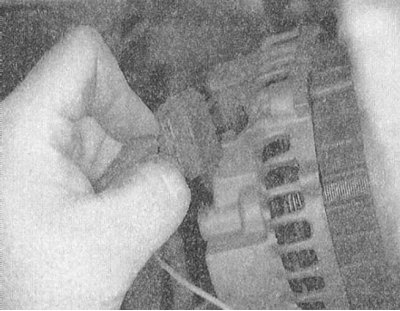
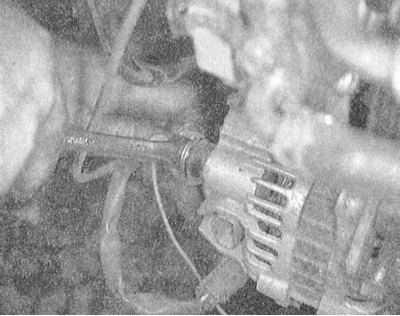
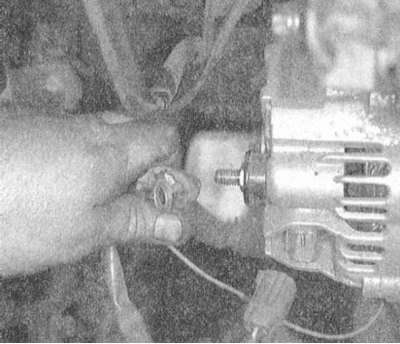
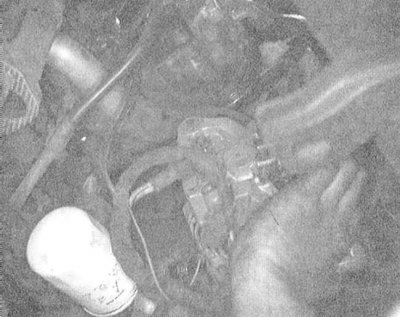
8. Disconnect the electrical wiring from the generator.
 |  |
 | 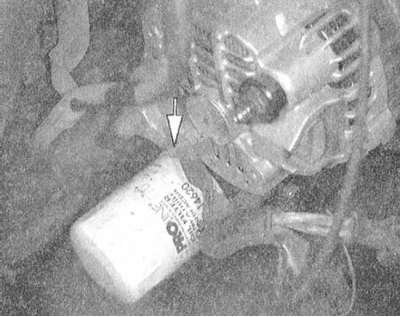 |
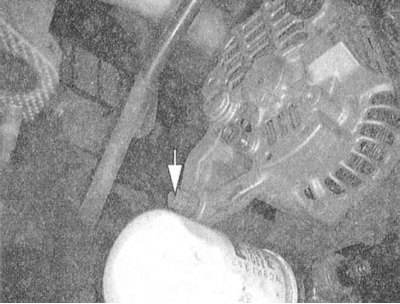
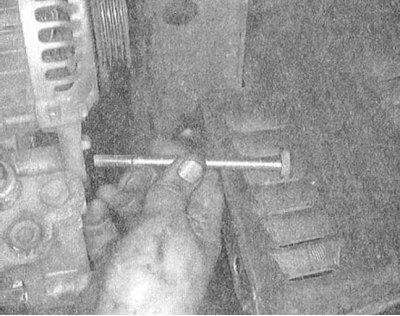
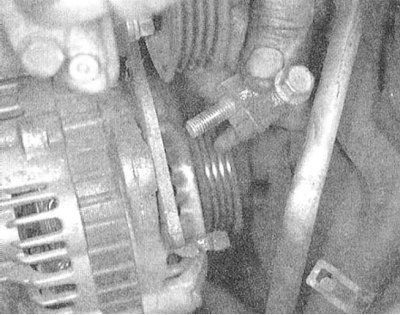
9. Unscrew the mounting bolts and remove the generator.
 |  |
 |  |
Installation
1. Install the generator in its regular place, install the lower bolt, screw on and lightly tighten the fastening nut.
2. On 1.6L models, install the radiator and secure it with the upper bolts. Install the battery tray, battery and windshield washer fluid reservoir.
3. Install the upper generator support bracket and secure the wiring harness to the assembly.
4. Install the water pump pulleys.
5. Install and adjust the drive belts (see Chapter Settings and ongoing maintenance).
6. On turbocharged Galant models, install the air intake sleeve.
7. Install the access cover (left under the vehicle).
8. Connect the negative cable to the battery and check the charging system for proper operation.
Engines 3.0L DOHC
Removal
1. Generator installation details on 3.0L DOHC models are shown in the illustration.
2. Disconnect the negative cable from the battery.
Warning! If the car stereo system is equipped with a security code, make sure you have the correct combination to activate the audio system before disconnecting the battery!
3. Remove the headlight washer fluid reservoir.
4. Remove the A/C fan and the upper radiator support cushion.
5. Loosen the tensioner and remove the alternator drive belt.
6. Remove the upper and lower generator mounting bolts.
7. Loosen the support bracket mounting bolts.
8. Remove the support bracket.
9. Disconnect the electrical wiring and remove the generator.
Installation
1. Install the generator in its regular place and connect the electrical wiring to it.
2. Install the support bracket and tighten the mounting bolts to the required torque.
3. Secure the generator to the support bracket and tighten the fasteners to the required torque (24 Nm).
4. Install and adjust the drive belt (see Chapter Settings and ongoing maintenance).
5. Install the A/C fan and upper radiator support cushion.
6. Reinstall the headlight washer fluid reservoir.
7. Connect the negative cable to the battery and check the charging system for proper operation.
3.0L SOHC and 3.5L engines
Removal
1. Generator installation details on 3.0L SOHC models and 3.5L models are shown in the illustrations.
2. Disconnect the negative cable from the battery.
Warning! If the car stereo system is equipped with a security code, make sure you have the correct combination to activate the audio system before disconnecting the battery!
3. Remove the air intake sleeve.
4. Release the tensioner and remove the alternator drive belt.
5. On California models, remove the rear row converter assembly.
6. Remove the power unit reaction rod.
7. On 3.0L SOHC models, disconnect the EGR temperature sensor wiring and remove the EGR pipe, also remove the intake air plenum mounting bracket (upper section of intake manifold).
8. Disconnect the electrical wiring from the generator.
9. Remove the upper and lower generator mounting bolts.
10. Lower the generator down and remove it from under the vehicle.
Installation
1. Install the generator in its original place.
2. Tighten the lower generator fastener to the required torque (20÷25 Nm).
3. Connect the electrical wiring to the generator.
4. On 3.0L SOHC models, install the plenum chamber mounting bracket. Install the mounting bolt and tighten it to the specified torque (18 N·m). Install the EGR pipe and connect the wiring to the EGR temperature sensor. Tighten the pipe retainer fasteners to torque (60 N·m).
5. Install the power unit reaction rod and tighten its fasteners to the required torque (45 Nm: bolt and 50÷60 Nm: nut).
6. If removed, install the rear converter assembly.
7. Install and adjust the drive belt (see Chapter Settings and ongoing maintenance).
8. Connect the air intake hose.
9. Connect the negative cable to the battery and check the charging system for proper operation.