



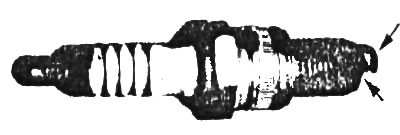
When removing the spark plugs (arrows), check their condition.
It is recommended to remove the spark plugs every 6 thousand km for a visual assessment of the mechanical condition of the engine.
A small deposit of light brown or grey colour or rusty red colour (if unleaded fuel is used) on a spark plug that has been in operation for any period of time is considered normal. Any other colour or abnormal amount of deposit indicates that there is a problem with the engine. The gap between the centre and ground electrodes may increase by no more than 0.025 mm every 1500 km under normal conditions.
If the spark plug is installed in an engine that is running properly, the spark plugs can be removed, cleaned, adjusted (gap) and reinstalled without any damage to the engine.
If the spark plug is dirty and works intermittently, then you need to investigate the cause and clean or replace the spark plug.
There are several reasons why a spark plug may become fouled, and you can learn to identify them by visually inspecting the spark plug.
Spark plugs suitable for use in an engine come in a wide range of heat ratings. The amount of heat a plug absorbs is determined by the length of the lower insulator. The longer the insulator, the hotter the plug will run; the shorter the insulator, the colder it is. Spark plugs that absorb (or retain); little heat and remain too cool, will collect lead, oil and carbon residues because they are not hot enough to burn off these residues. This causes fouling and, consequently, misfires. Spark plugs that absorb too much heat will not have deposits. But the electrodes will quickly burn out and, in some cases, pre-ignition (glow ignition) can result. Pre-ignition occurs when the tip of the plug becomes so hot that it ignites the fuel mixture before the actual spark ignition occurs. This pre-ignition is usually the cause of knocking noises at low speeds and high loads. Under severe conditions, the temperature can become sufficient to ignite the fuel mixture in the combustion chamber before it does at the tip of the plug. In this case, great damage will be done to the pistons, rings and valves.
(The original can be found on the website: www.MitsubishiMan.ru)
In most cases, the manufacturer's recommended heat ratings are correct and will provide good performance over a wide range of operating conditions. However, if you primarily drive long distances at high speeds, you may want to run plugs one heat rating cooler than the standard. If you primarily drive short distances, where the engine may not always reach operating temperature, a hotter plug may help burn off the deposits that tend to accumulate under these conditions.
Removal
When removing spark plug wires, always hold them by the rubber boot.
Do not mix up the wire numbers when removing and installing.
Remove the wires from the spark plugs by grasping the cap on the wire. If the cap is tightly seated on the spark plug, then to remove it you need to wiggle it while pulling it out. Do not pull the wire by the insulation.
Loosen all spark plugs with a wrench by turning them about two turns.
CAUTION: The cylinder head is made of aluminum. If possible, remove the spark plugs when the engine is cold to avoid damaging the threads.
If the spark plugs are difficult to remove, apply motor oil or silicone spray around the spark plug seat and wait a few minutes.
If you have compressed air, use it to clean the spark plug hole area. Alternatively, you can use a rag or brush. Be careful not to let any foreign objects get into the spark plug hole.
Remove the spark plugs by unscrewing them by hand.
Examination
Check the spark plugs for deposits and wear.
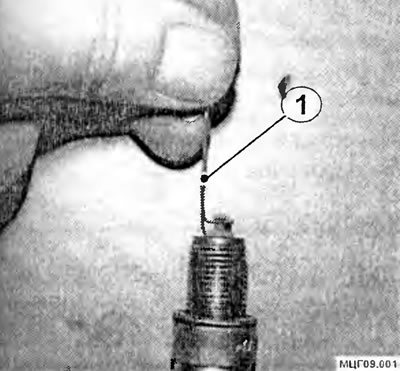
If they are not going to be replaced, clean them thoroughly. Remember that any deposits on the spark plugs reduce their efficiency. The spark plugs can be cleaned in a special spark cleaner, which is sometimes available at service stations, or they can be cleaned with a stiff brush. After cleaning, the electrodes should be treated with a flat file. Do not use emery cloth, as it can leave small particles on the electrodes. The electrodes should be processed until they are flat and have sharp corners. Rounding the electrodes reduces the voltage on them by more than 50%. Check the gap between the spark plug electrodes before installation. The ground electrode should be parallel to the central electrode, and the special probe (1) should pass through the gap with a slight pinch
CAUTION: Never adjust the gap on working spark plugs with platinum-coated electrodes.
Always check the gap, even for new spark plugs. It is not recommended to use a flat feeler gauge to measure the gap, as this can lead to errors in measurements.
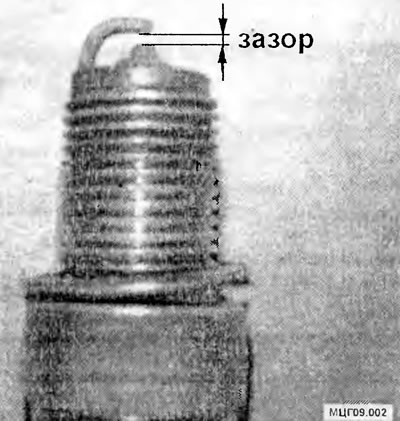
The wire feeler gauge usually has a device attached to it for bending the electrodes. Use this to set the correct gap. Never bend the center electrode. Be careful not to bend the side electrode too much or too often. It can break off in the engine and cause engine failure.
If you don't have a wire feeler gauge of the required thickness, you can use a hacksaw blade for cutting metal, which is typically 0.8 mm thick.
Installation
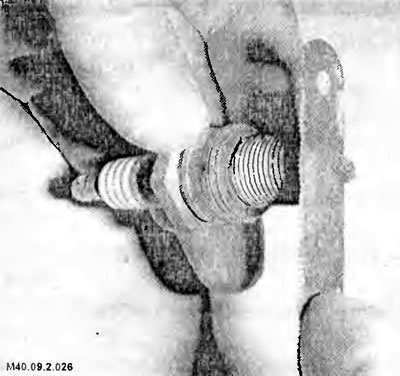
Lubricate the spark plug threads with motor oil. Insert the spark plugs into the holes and tighten them by hand. Make sure they fit the threads precisely.
Tighten the spark plugs with a wrench. Do not tighten them too much, just until they are tight. If you have a torque wrench, tighten to 15-20 Nm.
Place the caps with wires on the spark plugs. Check the tightness of the caps.