
English Русский
Български
Беларускі
Український
Српски
Hrvatski
Română
Polski
Slovenský
Magyar
Articles Bookmark Contacts Sitemap   
Company Audi Company Ford Company Hyundai Company Kia Company Mazda Company Mercedes-Benz Company Nissan
MitsubishiMan.ru


Home Colt Lancer Galant L200 Outlander Pajero Others
L200 4 (2005-2014, diesel)

The principle of operation of ASC and ATC systems (Mitsubishi L200 4)

  • Home
  • L200
  • 4 (2005-2014, diesel)
  • Chassis and running gear
  • Brake system
  • The principle of operation of ASC and ATC systems
0
Contents: How Active Stability Control (ASC)…⤓ The principle of operation of the…⤓

How Active Stability Control (ASC) works


The ASC system controls the steering torque using the brake mechanism of each wheel.

For example, if the car starts to skid on a slippery surface and does not turn to the right enough, the system increases the braking force of the right rear wheel, thereby creating an additional torque. When the car turns too much, the system increases the braking force of the left front wheel, creating a restoring torque. In addition, if the car enters a turn at too high a speed, the system reduces engine power, allowing the turn to be completed without skidding.
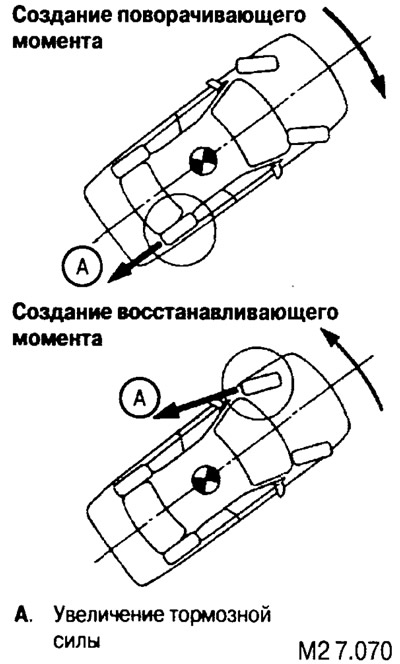


The principle of operation of the active stability control system (ASTC)


The ATS system maintains vehicle stability in the event of wheel slippage by applying the brakes and reducing engine torque via the engine-ECU unit.
This article is available at: russian, bulgarian, belarusian, ukrainian, serbian, croatian, romanian, polish, slovak, hungarian
This article was reviewed by: Nikita Romanov
Share with friends:
◀ Previous
L200 4: Brake system
Next ▶

Actuators of the stability control system
Electronic stability control system sensors
Electronic stability control system
Self-diagnosis and fault codes of the ABS system
Controlling brake fluid pressure with EBD system
Safe mode and stability system diagnostic functions
Acceleration and Yaw Rate Sensor — Removal and Installation
Removal and installation the steering wheel position sensor
Removal and installation the front passenger airbag
Removal and installation the driver's airbag and rotating joint
Similar materials for other Mitsubishi models

➤ Engine diagnostics performed during operation Mitsubishi Colt 4 and 5 (1991-2003)
➤ Operation in winter Mitsubishi Lancer 3 and 5 (1984-1992)
➤ Diagnostics of faults in vehicle components and systems Mitsubishi Galant 6 and 7 (1987-1998)
➤ Intake and exhaust systems — removal, inspection and… Mitsubishi Outlander 1 (2003-2008)
➤ Detecting faults in electrical equipment systems Mitsubishi Pajero 1 and 2 (1982-1999)
➤ Checking the operation of the fuel pump Mitsubishi Carisma (1995-2004)
Link in different formats to this article
Comments and feedback from visitors
No comments yet


Add up two numbers 10 + 42


L200 4 (2005-2014, diesel) 
  • General information
  • User manual
  • Maintenance
  • Power unit
  • Diesel engine
  • Lubrication system
  • Fuel system
  • Control system
  • Transmission
  • Clutch
  • Mechanical gearbox
  • Transfer case
  • Front axle
  • Rear axle
  • Chassis and running gear
  • Car suspension
  • Steering
  • Brake system
  • Body and interior
  • Exterior (external elements)
  • Interior (internal elements)
  • Doors, locks and windows
  • Electrical equipment
  • Equipment and devices
  • Electrical circuits
MitsubishiMan.ru © 2018–2026 • Mobile version • Articles about Mitsubishi • Contacts • Sitemap: EN BG BY UA RS HR RO PL SK HU • Site search • Bookmark
Colt 2 and 3 (1983-1993) · Colt 4 and 5 (1991-2003) · Colt 5 (1995-2003) · Lancer 3 and 5 (1984-1992) · Lancer 9 (2000-2007) · Galant 5 (1983-1989) · Galant 6 and 7 (1987-1998) · L200 4 (2005-2014) · Outlander 1 (2003-2008) · Pajero 1 and 2 (1982-1999) · Pajero 4 (2006-2021) · Carisma (1995-2004) · Space Star (1998-2005) ·
This resource sets cookies 🍪 to avoid bothering you with repeated data entry.