



Contents: Selector position ⤓ Notes on driving a car with a CVT ⤓ Manual mode of gear shifting of the…⤓
Selector position
1. To control the variator, a selector is installed on the central console, to the side of the driver. The selector is connected to the variator by a cable and can be used to set the variator operating mode.
2. To prevent damage to the variator when the wrong range is selected (for example, moving from "D" to "R" when moving forward), a lock is installed on the selector, only when pressed "dangerous" switching is possible. The lock allows you to avoid a situation when one of the unacceptable ranges of movement can be engaged due to carelessness.
 When switching, you need to press the lock and the brake pedal
 When switching to the lock, you do not need to press
 When switching, you need to press the lock
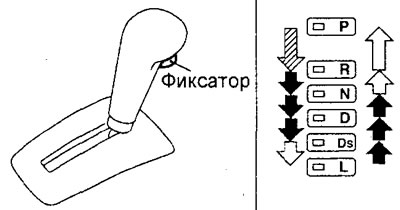
Variator without manual gear shift mode (the selector can be set to the following positions: "P", "R", "N", "D", "Ds", "L").
[The article was obtained from this portal: www.mitsubishiman.ru]
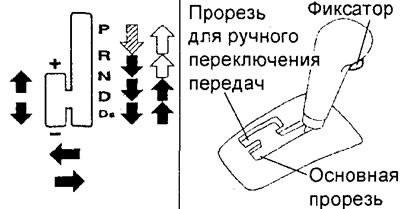
Variator with manual gear shift mode (the selector can be set to the following positions: "P", "R", "N", "D" or "Ds").
Position "P"
Selected when the car is parked for a long time. In this position of the selector, all controls in the variator are switched off, and its output shaft is locked; the vehicle cannot move. It is permissible to move the selector to this position only when the vehicle has come to a complete stop. Moving the selector to the "P" position while moving will cause the variator to break down.
Position "R"
Reverse. The selector can be moved to this position only when the car is stationary. Moving the selector to the "R" position while moving forward can lead to failure of the variator and other transmission components.
Position "N"
Corresponds to neutral. All control elements are switched off in the variator, which ensures the absence of a rigid kinematic connection between its driving and driven shafts. The output shaft locking mechanism is switched off, i.e. the car can move freely.
It is not recommended to move the selector to the "N" position while coasting. Never turn off the ignition when driving downhill. This practice is dangerous, as you can lose control of the car.
Position "D"
The main driving mode. It provides forward movement. It is recommended to use it in normal driving conditions.
Position "Ds"
It is recommended to use this mode for dynamic driving and more effective engine braking on slopes.
Position "L"
This range allows for maximum engine braking. It is recommended for driving on steep descents, ascents and off-road.
Notes on driving a car with a CVT
1. Do not press the accelerator pedal when braking (brake pedal depressed) or when shifting the selector lever from the "P" or "N" position to the drive position, as this may cause damage to the gearbox.
2. Always press the brake pedal when moving the selector lever from the "P" or "N" position to the drive ("R" or "D" position).
3. During short stops (before traffic lights, etc.), you can leave the car with the gear engaged and hold it in place by pressing the brake pedal. During long stops, move the selector to the "N" position.
4. Do not hold the vehicle on a slope by pressing the accelerator pedal while in gear. Press the brake pedal or use the parking brake.
5. After connecting the battery cables, gear shifting may be jerky. This is not a sign of a gearbox malfunction. Gear shifting will become smooth after a certain period of time, during which the CVT control system will perform several gear shifts.
6. (Manual transmission models) When the ignition is turned on, the indicator on the instrument cluster lights up corresponding to the position of the CVT selector.
7. After a long period of parking at low outside temperatures (-35°C or less), it may be difficult to start the vehicle, even if the selector is in the "D" position. Let the engine run for 10 minutes or longer to warm up the CVT fluid.
8. Before engaging the gear in manual mode ("Sport Mode") with the vehicle stationary and the engine running, press the brake pedal all the way down to prevent the vehicle from moving unexpectedly. Release the brake pedal only when you are ready to move.
Manual mode of gear shifting of the variator
1. There are two slots on the central console in which the variator selector moves: the main slot (see the subsection "Selector positions") and the slot for manual gear shifting. Regardless of whether the car is moving or stationary, switching to manual gear shifting mode is done by moving the variator selector from position "D" to the corresponding slot.
2. In manual mode, you can quickly change gears by moving the selector forward (+) or backward (-). Each movement will engage a higher or lower gear accordingly. Unlike a manual transmission, manual mode allows you to change gears while pressing the accelerator pedal.
Caution: Move the selector smoothly, without excessive force, between the slots of the console and between different positions. Otherwise, the selector may break.
Note:
- In manual mode, it is possible to engage only one of the forward gears.
- When switching to manual gear shift mode, the "D" indicator on the instrument cluster will go out and the "1" indicator will light up. Then, when shifting gears, the indicator corresponding to the gear engaged in the gearbox will light up.
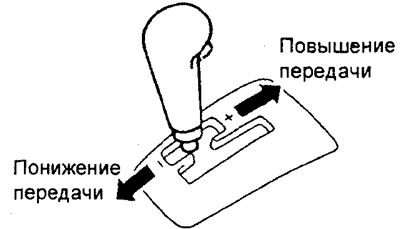
3. There is no automatic upshift in manual mode. The driver must engage the overdrive gear according to road conditions and engine speed.