



Contents: Checking the engine oil level ⤓ Checking the condition of the…⤓ Checking the wiring harnesses ⤓ Checking the operation of the engine…⤓ Checking the fluid level in the…⤓ Checking the hoses, tubes and…⤓ Checking for oil and working fluid…⤓ Checking the hoses, tubes and…⤓
Checking the engine oil level
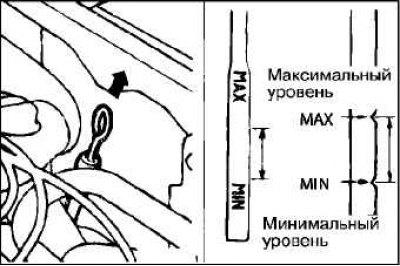
Make sure the engine oil level is between the maximum and minimum marks. If the level drops below the minimum mark, add the required amount of oil.
Checking the condition of the battery and its terminals
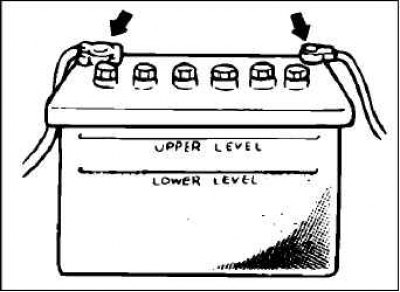
Check the condition of the battery terminals. Make sure they are securely fastened.
Note: Do not remove grease from battery terminals or wire fasteners.
Checking the wiring harnesses
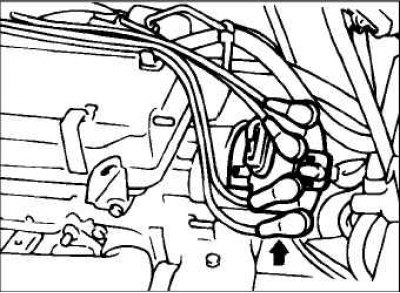
Make sure each wire harness is routed correctly and secured. Check that the connectors are tightly seated.
in the reliability of fastening the high-voltage wires to the spark plugs, the distributor cap (or crankshaft position sensor) and the ignition coil.
Checking the operation of the engine and exhaust system
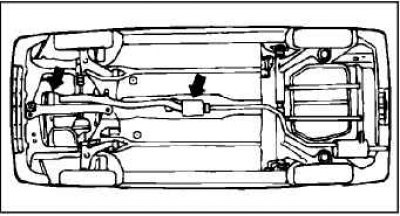
Check the engine operation and smooth movement of the accelerator pedal.
Check the exhaust system components for leaks.
Check for black smoke coming from the exhaust pipe (diesel vehicles).
Try to determine the presence of extraneous creaks, rattling and unwanted vibrations.
Make sure there are no extraneous noises coming from the engine, transmission, axles and vehicle body.
Checking the fluid level in the engine cooling system
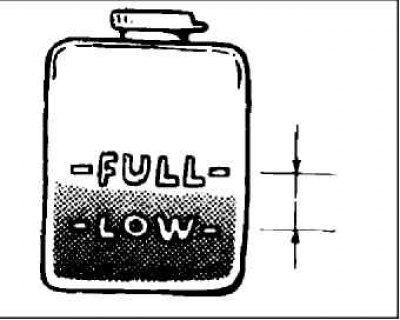
The coolant level in the expansion tank of the cooling system should be above the "LOW" mark at normal engine operating temperature. Make sure that there is no coolant leakage through the connections of the pipes and hoses of the cooling system.
The concentration of antifreeze should be within 30–60%.
Caution: Do not remove the radiator cap if the cooling system is under excess pressure.
Attention! When removing the cap, be careful, steam or hot coolant may escape from under it. Add antifreeze to the expansion tank if necessary.
Checking the hoses, tubes and fittings located under the hood
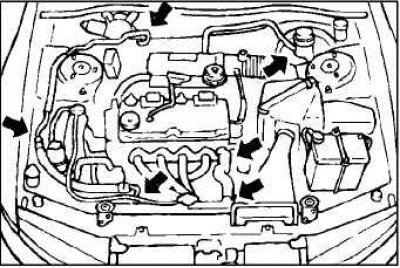
Check all lines and fittings (brake system, fuel system, power steering and air conditioning system). Check for proper placement of lines, leaks in fittings, tighten if necessary.
Check the position of all vacuum hoses, as well as the cooling and heating system hoses.
Caution: Remember that the air conditioning system is under pressure.
Note: Oil stains around the air conditioning system connections do not necessarily indicate leaks. Oil is used to lubricate the connections during assembly. Make sure there are no kinks or twists in the system lines.
Checking for oil and working fluid leaks from the engine
Check for oil leaks from the engine.
Checking the hoses, tubes and fittings located under the bottom of the car
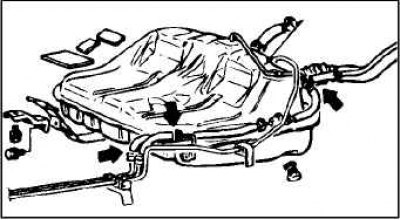
Check all hoses and hydraulic lines and their connections for leaks.
Make sure all hoses and hydraulic lines are routed properly under the vehicle and clear of sharp edges and moving parts.