



Contents: Engine oil change ⤓ Recommended engine oil ⤓ Total volume (including oil filter…⤓ Replacing the oil filter ⤓ Checking the engine idle speed ⤓ Checking the concentration of CO in…⤓ Recommended values ⤓ Checking the performance of the…⤓ Checking the EGR solenoid valve ⤓ Checking the EGR valve (stepper…⤓ Checking the coil resistance ⤓ Checking the valve's functionality ⤓ Checking for carbon deposits ⤓
Engine oil change
Start the engine and let it warm up to operating temperature (80–90°C).
Stop the engine and remove the oil filler cap.
Remove the drain plug from the engine oil pan and drain the engine oil.
Caution: Be careful when performing this operation, the engine oil is hot.
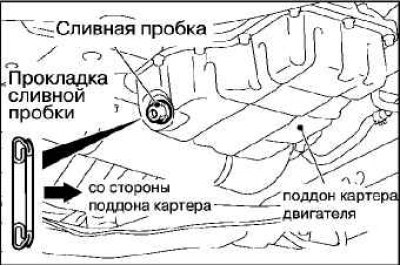
Replace the drain plug gasket with a new one so that it is oriented as shown in the illustration and tighten the plug to the recommended torque.
Recommended tightening torque: 39±5 Nm.
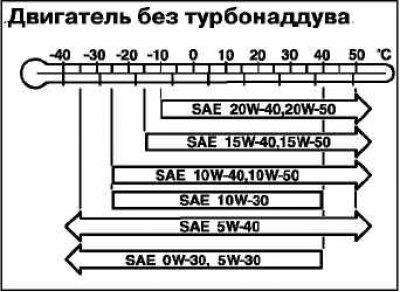 | 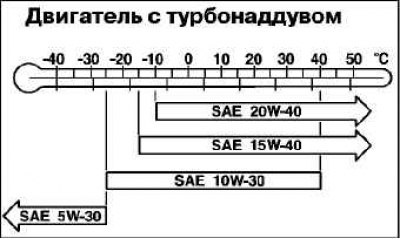 |
Add the recommended amount of engine oil.
Recommended engine oil
ACEA and API classification: "ACEA A1, A2, A3".
Quality class SG or higher.
Total volume (including oil filter volume)
4.3 l – 4G63 (N/A, 4G69 A/T).
4.6 l – 4G63 (T/S, 4G69 M/T).
Remove the dipstick and check if the engine oil is between the "MAX" and "MIN" marks.
Replace the oil filler cap.
Start the engine and let it idle for a few minutes.
Turn off the engine and check the engine oil level.
Replacing the oil filter
Start the engine and let it warm up to operating temperature (80–90°C).
Stop the engine and remove the oil filler cap.
Remove the drain plug from the engine oil pan and drain the engine oil.
Caution: Be careful when performing this operation, as the oil is hot.
Remove the engine compartment cover.
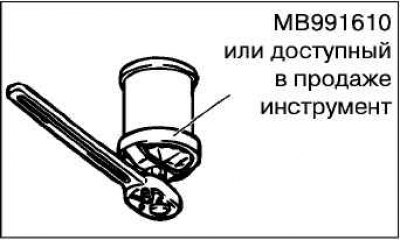
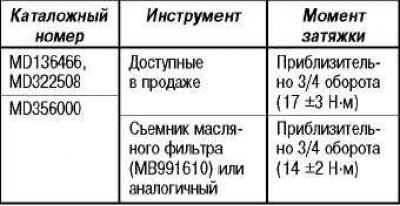
Using the tool specified in the table below, remove the oil filter.
Clean the oil filter mating surface.
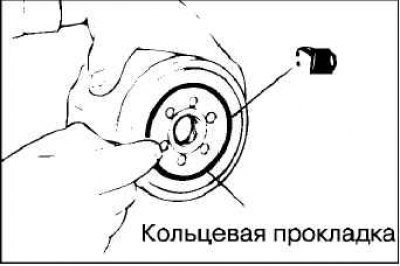
Apply a small amount of engine oil to the O-ring of the new oil filter.
Install the new oil filter until the O-ring seal touches the mating surface and tighten the filter to the recommended tightening torque using the appropriate special tool.
Install a new drain plug and add the required amount of engine oil.
Start the engine.
Increase the engine speed 2-3 times and check for leaks along the filter mating surface.
Checking the engine idle speed
Note: Before performing the check, bring the vehicle to the condition for performing control and diagnostic operations.
Turn the ignition key to the "LOCK" ("OFF") position.
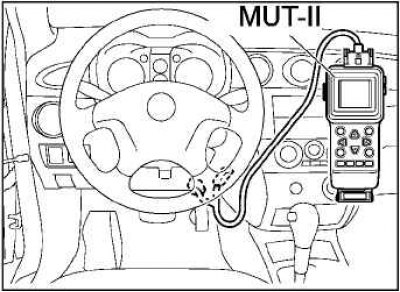
Connect to the MUT-II/III diagnostic connector.
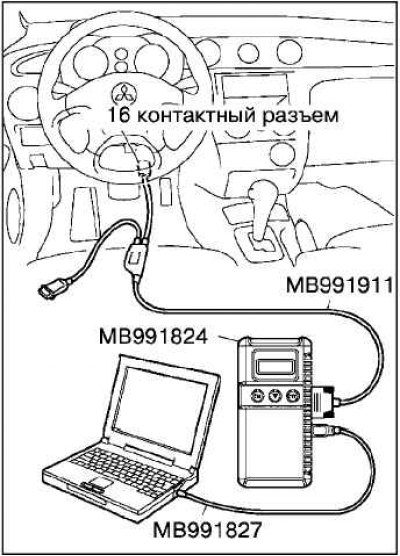
Connect the strobe light.
Start the engine and let it idle.
Check that the ignition timing angle setting matches the recommended value.
Recommended value:
- approximately 10° before TDC – 4G63 N/A, 4G69;
- approximately 5° before TDC – 4G63 T/C.
Check the idle speed.
Recommended value: 750±100 min⁻¹ – 4G69 A/T, 4G63; 680±100 min⁻¹ – 4G69 M/T.
Note: Idle speed is adjusted automatically.
Note: If the idle speed is not within the recommended value, perform an MPI system check.
Turn the ignition key to the "LOCK" ("OFF") position and disconnect the MUT-II/III.
Checking the concentration of CO in exhaust gases
Note: Before performing the check, bring the vehicle to the condition for performing control and diagnostic operations.
Turn the ignition key to the "LOCK" ("OFF") position.
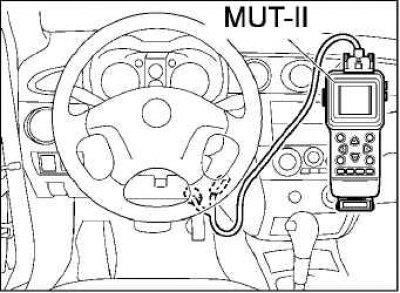 | 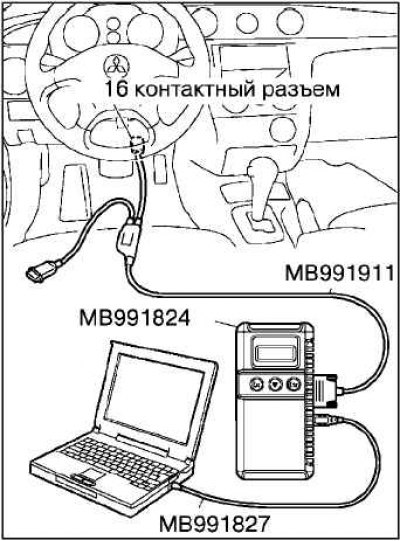 |
Connect to the MUT-II/III diagnostic connector.
Connect the strobe light.
Start the engine and let it idle.
Check that the ignition timing angle setting matches the recommended value.
Recommended value:
- approximately 10° BTDC – 4G63 N/A, 4G69;
- approximately 5° before TDC – 4G63 T/C.
Set the engine speed to 2500 min⁻¹ for 2 min.
Turn on the device for measuring CO and CH in exhaust gases.
Measure the concentration of CO and CH in the exhaust gases.
Recommended values
CO concentration: no more than 0.5%.
CH concentration: no more than 100 ppm.
If the concentration differs from the recommended values, then the following points must be checked:
- diagnostic output;
- fuel pressure;
- injectors;
- ignition coils, spark plugs, high-voltage wires;
- eGR system;
- fuel vapor recovery system;
- compression.
Note: If the concentration of CO and HC in the exhaust gases is higher than the recommended values, even if all check points are positive, replace the three-way catalytic converter.
Turn the ignition key to the "LOCK" ("OFF") position and disconnect the MUT-II/III.
Checking the performance of the exhaust gas recirculation (EGR) system
Remove the EGR valve and inspect it for sticking valve stem, carbon deposits, etc. If defective, wash the valve in a suitable solvent to clean it and ensure proper operation.

Connect a vacuum pump to the valve.
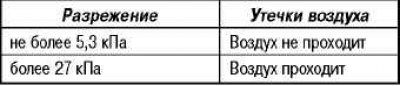
Create a vacuum of 67 kPa and check the valve for leaks.
Check whether air is passing through the EGR system air passage.
Replace the gasket and tighten to the recommended tightening torque. Recommended tightening torque: 20±2 N·m.
Checking the EGR solenoid valve
Disconnect the vacuum hose from the solenoid valve.
Disconnect the wiring harness.
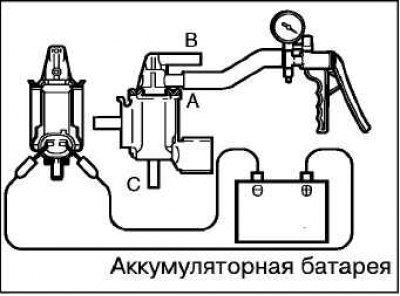
Connect the vacuum pump to port A of the solenoid valve.
Check for leaks by creating a vacuum with voltage applied directly from the battery to the EGR solenoid valve and without voltage applied.
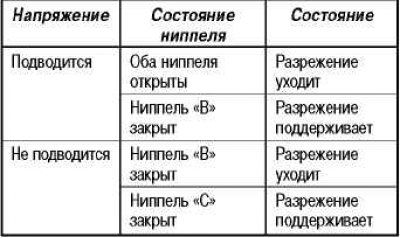
Measure the resistance between the terminals of the solenoid valve.
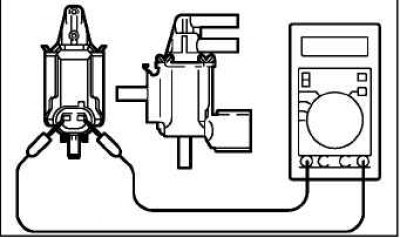
Recommended value: 29–35 Ohm (at 20°C).
Remove the EGR valve and inspect it for sticking valve stem, carbon deposits, etc. If defective, wash the valve in a suitable solvent to clean it and ensure proper operation.
Checking the EGR valve (stepper motor); checking the valve by the sound of its operation)
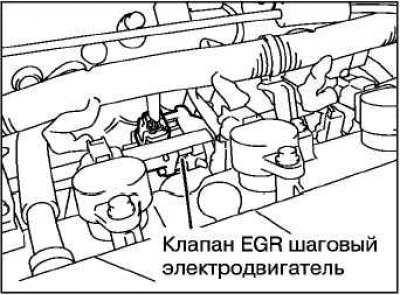
Check for the presence of sound coming from the stepper motor, which should be heard when the ignition is turned on (the engine does not start).
If the stepper motor operation sound is not heard under the above conditions, check the condition of the stepper motor power supply circuit.
Note: If the power supply circuit is OK, the cause of the malfunction may be in the stepper motor itself or the electronic motor control unit.
Checking the coil resistance
Disconnect the connector from the EGR valve.
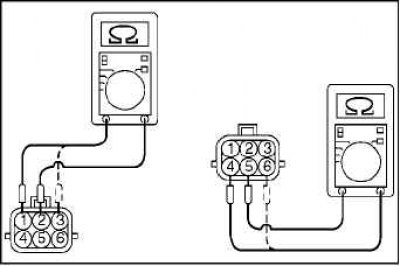
Measure the resistance of the valve coil between terminals 2 and 1 or 3 of its connector.
Nominal value: 20–24 Ohm (at 20°C).
Measure the resistance of the valve coil at terminals 5 and 6 or 4 of its connector.
Nominal value: 20–24 Ohm (at 20°C).
Install the new EGR valve, replacing the gasket, and tighten the sensor mounting bolts to the recommended torque.
Recommended tightening torque: 24 ±4 Nm.
Checking the valve's functionality
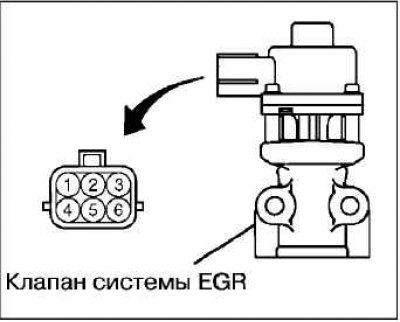
Remove the EGR valve.
Connect the special tool (test lead harness MB991658) to the terminals of the valve connector itself.
Connect terminal 2 to the (+) terminal of the battery.
Caution: Continuous connection of the valve to the power source may damage the coil.
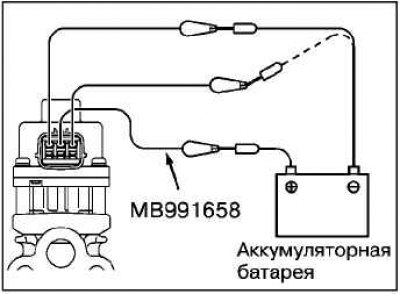
Connect terminals 1 and 3 to the (–) terminal of the battery. If the stepper motor is working properly, there will be a slight vibration along its body.
Connect the (+) terminal of the battery to terminal 5 of the sensor.
Caution: Continuous connection of the valve to the power source may damage the coil.
Connect terminals 4 and 6 to the (–) terminal of the battery.
If the stepper motor is working properly, there will be a slight vibration along its body.
Install the new EGR valve, replacing the gasket, and tighten the sensor mounting bolts to the recommended torque.
Recommended tightening torque: 24 ±3 Nm.
Checking for carbon deposits
Remove the EGR valve and check for carbon deposits in the EGR valve passages. If there is a lot of deposits, remove them with a wire brush.
Attention! The use of liquid solvents when removing carbon deposits is not allowed: the solvent, getting on the windings of the electric motor, causes its failure.
Install the new EGR valve, replace the gasket and tighten the sensor mounting bolts to the recommended torque.
Recommended tightening torque: 24 ±4 Nm.