
English Русский
Български
Беларускі
Український
Српски
Hrvatski
Română
Polski
Slovenský
Magyar
Articles Bookmark Contacts Sitemap   
Company Audi Company Ford Company Hyundai Company Kia Company Mazda Company Mercedes-Benz Company Nissan
MitsubishiMan.ru


Home Colt Lancer Galant L200 Outlander Pajero Others
Pajero 4 (2006-2021) Pajero 1 and 2 (1982-1999)

Removal and installation of springs (1983-89) (Mitsubishi Pajero 1)

  • Home
  • Pajero
  • 1 (1982-1999)
  • Chassis and running gear
  • Rear suspension
  • Removal and installation of springs (1983-89)
0

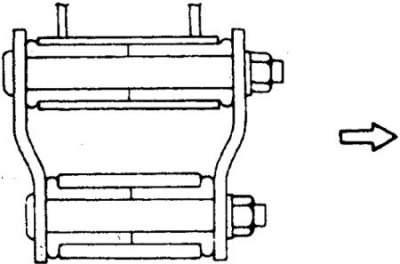
Correct installation of spring shackle bolts


1. Remove the rear wheels, disconnect the handbrake cable.

2. Place 2 jacks under the bridge and disconnect the shock absorbers from the bridge.

3. Unscrew the U-bolt nuts, unscrew and remove the rear shackle bolts and the front spring bolt, remove the spring.

4. Installation is carried out in reverse order.

The article is reprinted from this source: MitsubishiMan.ru

5. The spring mounting bolts must be facing outwards.

6. Tighten the U-bolt nuts to a torque of 100–120 N·m, and the shock absorber bolt to a torque of 18–25 N·m. (after lowering the car), the front spring bolt nut – with a torque of 140 Nm, the earring nuts 45–60 Nm.
This article is available at: russian, bulgarian, belarusian, ukrainian, serbian, croatian, romanian, polish, slovak, hungarian
This article was reviewed by: Arseny Pavlov
Share with friends:
◀ Previous
Pajero 1 and 2: Rear suspension
Next ▶

Removal and installation springs (1989-98)
Rear shock absorbers — removal and installation
Rear anti-roll bar
Similar materials for other Mitsubishi models

➤ Valve springs, crackers and seals — replacement without… Mitsubishi Colt 4 and 5 (1991-2003)
➤ Removal and installation of struts and coil springs of the… Mitsubishi Galant 6 and 7 (1987-1998)
Link in different formats to this article
Comments and feedback from visitors
No comments yet


Add up two numbers 22 + 19


Pajero 4 (2006-2021) 
  • General information
  • User manual
  • Troubleshooting
  • Maintenance
  • Technical specifications
  • Power unit
  • Engine repair
  • Cooling system
  • Lubrication system
  • Fuel system
  • Engine management system
  • Intake and exhaust system
  • Engine electrical equipment
  • Transmission
  • Clutch
  • Manual gearbox
  • Automatic gearbox
  • Drive shafts
  • Chassis and running gear
  • Front suspension
  • Rear suspension
  • Brake system
  • Steering
  • Body and interior
  • Exterior (external elements)
  • Interior (internal elements)
  • Doors, locks and windows
  • Body dimensions
  • Electrical equipment
  • Safety system (SRS)
  • Air conditioner
  • Equipment and devices
  • Electrical diagrams
Pajero 1 and 2 (1982-1999) 
  • General information
  • User manual
  • Seats and seat belts
  • Instruments and controls
  • Driving and operation
  • Maintenance
  • Power unit
  • Gasoline engines
  • Diesel engines
  • Ignition system
  • Engine electrical equipment
  • Cooling and lubrication system
  • Power and exhaust system
  • Fuel system (gasoline)
  • Fuel system (diesel)
  • Transmission
  • Clutch
  • Mechanical gearbox
  • Automatic gearbox
  • Drive shafts and axles
  • Chassis and running gear
  • Front suspension
  • Rear suspension
  • Steering
  • Brake system
  • Body and interior
  • Exterior (external elements)
  • Interior (internal elements)
  • Doors, locks and windows
  • Electrical equipment
  • Equipment and devices
  • Heater and air conditioner
  • Cruise control
  • Headlights and lighting
  • Electrical circuits
MitsubishiMan.ru © 2018–2026 • Mobile version • Articles about Mitsubishi • Contacts • Sitemap: EN BG BY UA RS HR RO PL SK HU • Site search • Bookmark
Colt 2 and 3 (1983-1993) · Colt 4 and 5 (1991-2003) · Colt 5 (1995-2003) · Lancer 3 and 5 (1984-1992) · Lancer 9 (2000-2007) · Galant 5 (1983-1989) · Galant 6 and 7 (1987-1998) · L200 4 (2005-2014) · Outlander 1 (2003-2008) · Pajero 1 and 2 (1982-1999) · Pajero 4 (2006-2021) · Carisma (1995-2004) · Space Star (1998-2005) ·
This resource sets cookies 🍪 to avoid bothering you with repeated data entry.