Wheel alignment
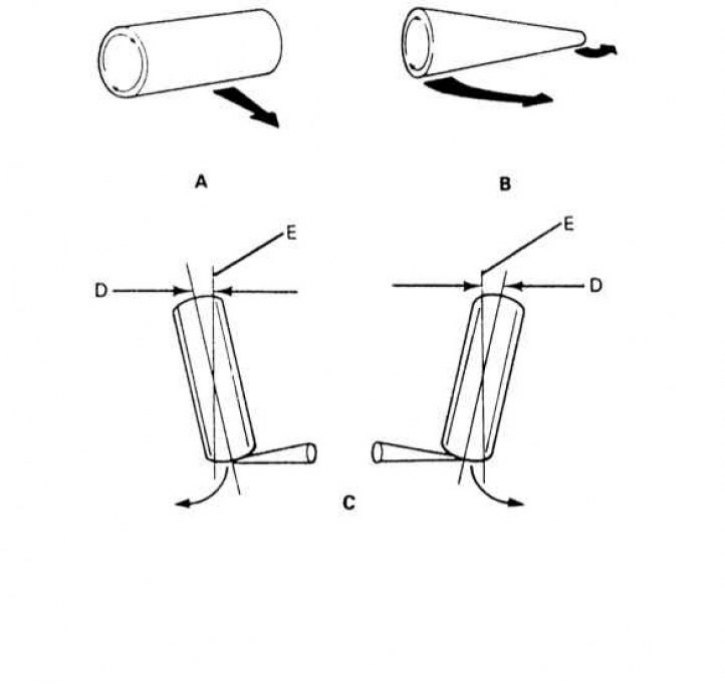
A - The cylinder will roll in a straight line; B - The cone will roll in a circle with the center at the narrow end; C - Diagram of wheel contact with the road surface; D - Positive camber; E - Vertical plane
General information
Wheel alignment angles determine the geometry of the position of the wheels relative to the vehicle's suspension and the road surface. Violation of this geometry adjustment leads to decreased vehicle controllability and increased tire wear. The front wheel alignment angles of the vehicle that must be checked include camber, run-out (the longitudinal tilt angle of the wheel's turning axis), and toe-in (see below).
Adjusting the suspension geometry requires the use of special expensive and bulky equipment and should be performed by car service specialists.
Convergence
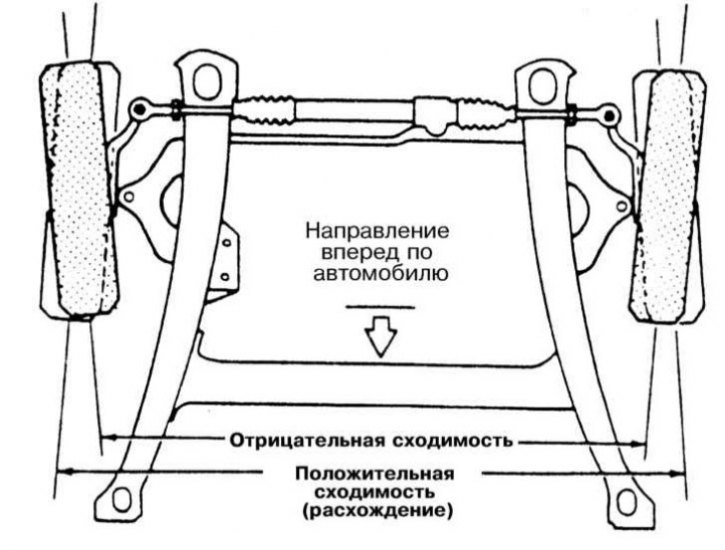
Toe-in is the amount of convergence of the front edges of the car wheels. This violation of the parallelism of the wheels helps to minimize tread wear due to skidding when turning. With zero toe-in, the distance between the front edges of the wheels is equal to the distance between their rear edges. Normal toe-in usually does not exceed fractions of an inch (1 inch = 2.54 cm). Violation of the toe-in adjustment leads to accelerated wear of the tire treads due to their slipping on the road surface.
Collapse
Camber is the angle of the plane of the wheels relative to the vertical. If the wheels are tilted with their upper edges outward, the camber is called positive, and vice versa. The camber value is measured in degrees. Correct camber adjustment determines the size and position of the contact patch of the treads with the road and allows you to compensate for changes in the geometry of the suspension when turning and when the car is moving on an uneven road surface. A small negative camber allows you to increase the contact patch of the tread when turning, however, if excessive, it leads to a violation of the directional stability of the car and an increase in jerks transmitted to the steering wheel.
Run-out
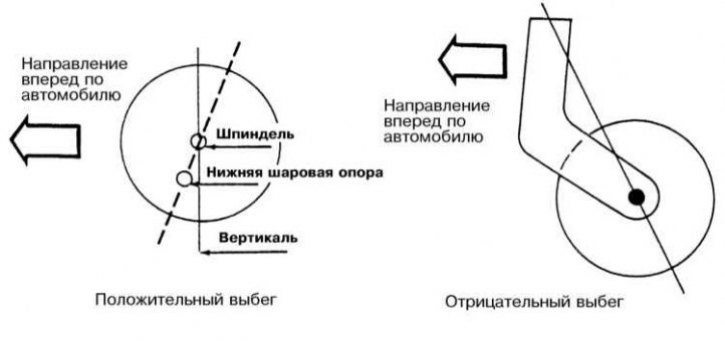
The coasting is the angle of the longitudinal inclination of the wheel's turning axis, i.e., the angle of deviation from the vertical of the wheel's turning axis in the plane of the latter. If the turning axis is tilted backwards, the coasting is called positive, and vice versa. Positive coasting ensures the self-return of the front wheels to a straight-line position when exiting a turn, thereby increasing the vehicle's directional stability, but if excessive, it reduces the vehicle's maneuverability.
The article was obtained from this portal [mitsubishiman.ru]
Note: Lowering the rear of the vehicle will increase the positive wheel runout.