



Contents: Mirage models up to 1992. ⤓ Mirage models since 1993. ⤓ Galant models up to 1993 with rear…⤓ Galant models up to 1993 with rear…⤓ Galant models from 1994 with drum…⤓ Galant models from 1994 with rear…⤓ Diamante Models ⤓
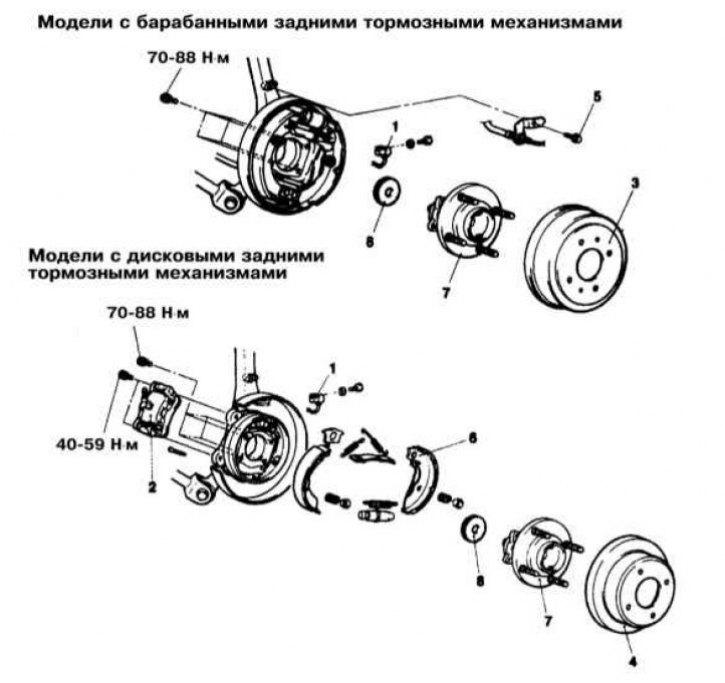
Hub assembly design on Galant models since 1994.
1 - Wheel sensor (models with ABS); 2 - Brake caliper; 3 - Brake drum; 4 - Brake disc; 5 - Support bracket bolt; 6 - Brake shoes; 7 - Rear hub; 8 - Wheel sensor rotor (models with ABS)
Mirage models up to 1992.
Removal
1. Jack up the car and place it on stands. Remove the corresponding rear wheel.
2. On models with rear disc brakes, remove the caliper and brake disc (see Chapter Brake system).
3. Remove the dust cover and loosen the bearing nut - do not use a pneumatic drive to loosen the nut.
4. Remove the outer wheel bearing.
5. Remove the brake drum/hub assembly complete with inner bearing and seal.
6. Remove the oil seal and inner bearing from the hub assembly.
Installation
1. Lubricate the inner bearing and install it into the hub assembly/brake drum.
2. Install a new oil seal.
3. Screw the self-locking nut so that 2-3 mm of thread remains under it. Measure the torque of turning the nut counterclockwise - if the measurement result is less than 6 Nm, the nut must be replaced.
4. Install the brake drum/hub assembly into its original location.
5. Lubricate the outer wheel bearing and install it on the spindle.
6. Tighten the self-locking nut to the required torque (150÷200 Nm).
7. Using a dial gauge, determine the hub/drum end play. If the measurement is greater than 0.002 mm, repeat the nut tightening procedure. If re-tightening the nut does not produce the desired result, replace the bearings.
8. Install the protective cover and wheel.
9. Lower the car to the ground.
Mirage models since 1993.
Attention! Disassembling wheel bearings on these models is not possible. If necessary, the hub assembly is replaced!
Removal
1. Jack up the car and place it on stands. Remove the corresponding rear wheel.
2. On models equipped with ABS, remove the wheel sensor.
3. Remove the caliper and brake disc/brake drum (see Chapter Brake system).
4. Remove the dust cover and loosen the bearing nut - do not use a pneumatic drive to loosen the nut.
5. Remove the hub assembly.
Installation
1. Install the hub assembly in its regular place. Tighten the flange nut to the required torque (180 Nm).
2. Install the dust cover.
3. On models with ABS, reinstall the wheel sensor - make sure that the air gap value does not exceed the permissible range (0.3÷0.9 mm).
4. Install the brake disc and caliper/brake drum.
5. Install the rear wheel and lower the vehicle to the ground.
Galant models up to 1993 with rear drum brakes
Removal
1. Jack up the car and place it on supports. Remove the rear wheels.
2. Remove the protective cover and loosen the hub nut.
3. Remove the brake drum (see Chapter Brake system). The outer wheel bearing should fall out of the hub when you remove the drum - be careful not to drop it.
4. Remove the hub assembly.
5. Remove the inner bearing.
6. Check the condition of the bearing components. If scratches, burrs or traces of overheating are found on the surfaces of the races, the latter are replaced as a whole set - the races to be replaced are knocked out using a brass drift.
Installation
1. Before installation, the bearing races should be lubricated with special bearing grease. Make sure the races are fully seated - use a suitable mandrel.
2. Carefully pack the bearings with grease, and use the rest to lubricate the hub.
3. Install the inner bearing, lubricate and seat the new seal - use a special mandrel.
4. Install the brake drum (see Chapter Brake system).
5. Lubricate and install the outer bearing, install the washer and screw on the nut.
6. Rotate the drum to tighten the nut to 17 N·m, then release it to release the preload and tighten it again, this time to 10 N·m.
7. Lock the nut and install a new cotter pin.
8. Install the wheel and lower the car to the ground.
Galant models up to 1993 with rear disc brakes
Removal
1. Jack up the car and place it on supports. Remove the rear wheels.
2. Remove the mounting bolt(s) and the wheel sensor support bracket from the hub assembly knuckle.
Attention! Try to avoid contact of the sensor sensitive element with the rotor teeth!
3. Remove the brake caliper and tie it to the suspension elements (see Chapter Brake system).
4. Remove the brake disc (see Chapter Brake system).
5. Remove the protective cover, nut and lock washer.
6. Remove the hub assembly.
Note: The rear hub cannot be disassembled and in case of bearing failure it is replaced as an assembly.
7. If necessary (models with ABS), unscrew the two mounting bolts and remove the wheel sensor rotor from the hub to be replaced.
Installation
1. Install the wheel sensor rotor onto the hub. Tighten the mounting bolts to the required torque (11 Nm).
2. Install the hub assembly in its original place.
3. Install the lock washer, screw on a new lock nut and tighten it to the required torque (200÷260 Nm). Pin the nut and install the protective cover.
4. Install the brake disc and brake caliper.
5. Install the wheel sensor and tighten its mounting bolts to the required torque (11 Nm).
6. Install the wheel and lower the car to the ground. Before driving, pump the foot brake pedal.
Galant models from 1994 with drum brakes on the rear wheels
Removal
1. The design of the hub assembly of the models under consideration is shown in the illustration.
2. Jack up the car and place it on stands. Remove the corresponding rear wheel.
3. On models with ABS, remove the wheel sensor.
4. Remove the brake drum (see Chapter Brake system).
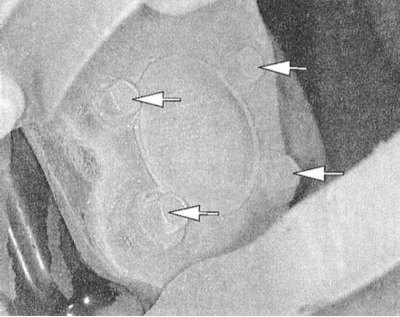
5. From the rear of the knuckle, unscrew the four hub mounting bolts.
6. Remove the hub from the knuckle.
Attention! The hub cannot be disassembled!
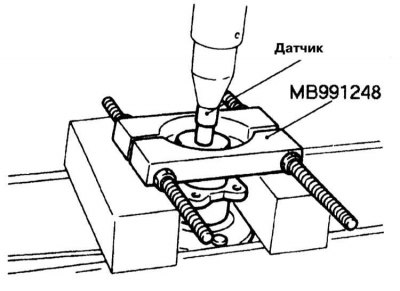
7. If necessary (models with ABS), remove the wheel sensor rotor from the hub to be replaced - use a special head type MB991248.
Installation
1. Press the wheel sensor rotor onto the new hub (models with ABS).
2. Install the hub on the knuckle and tighten the mounting bolts to the required torque (74÷88 Nm).
3. Install the brake drum (see Chapter Brake system).
4. On models with ABS, install a wheel sensor.
5. Install the wheel and lower the car to the ground.
Galant models from 1994 with rear disc brakes
Removal
1. The design of the hub assembly of the models under consideration is shown in the illustration.
2. Remove the cotter pin and loosen the hub nut. Remove the washer.
3. Jack up the car and place it on stands. Remove the corresponding rear wheel.
4. On models with ABS, remove the wheel sensor.
5. Remove the caliper and tie it to the suspension elements (see Chapter Brake system).
6. Remove the brake disc (see Chapter Brake system).
7. Remove the upper anchor springs of the parking brake friction shoes.
8. Remove the lower friction shoe tension spring.
9. Remove the shoe guide springs.
10. Disconnect the drive cable from the parking brake actuator lever.
11. From the rear of the hub assembly knuckle, remove the four hub mounting bolts.
12. Remove the hub assembly with wheel bearings.
Attention! The hub cannot be disassembled!
13. If necessary (models with ABS), remove the wheel sensor rotor from the hub to be replaced - use a special head type MB991248.
Installation
1. Press the wheel sensor rotor onto the new hub (models with ABS).
2. Install the hub on the knuckle and tighten the mounting bolts to the required torque (74÷88 Nm).
3. Install the parking brake friction shoes (see Chapter Brake system).
4. Install the brake disc onto the hub and temporarily secure it by screwing on a pair of wheel nuts.
5. Install the brake mechanism anchor bracket and insert the brake pads into it.
6. Install the brake caliper, then remove the temporarily installed wheel nuts.
7. On models with ABS, install a wheel sensor.
8. Install the wheel and lower the car to the ground.
Diamante Models
Attention! The hub on these models is not subject to repair and in case of component failure it must be replaced as a whole!
Removal
1. Jack up the car and place it on stands. Remove the corresponding rear wheel.
2. Remove the brake caliper and brake disc (see Chapter Brake system). Tie the caliper to the suspension elements with wire.
3. On models with ABS, remove the mounting bolt and wheel sensor from the trailing arm.
Attention! Try to avoid contact of the sensor sensitive element with the rotor teeth!
4. Remove the protective cover, loosen the self-locking hub nut and remove the lock washer.
5. Remove the hub assembly from the wheel axle spindle.
6. If necessary, loosen the mounting bolts and remove the wheel sensor rotor from the hub (models with ABS).
Installation
1. Attach the wheel sensor rotor to the hub (models with ABS).
2. Install the hub in its regular place. Screw on a new self-locking nut (don't forget to put a lock washer underneath) and tighten it to the required torque (230 Nm), - make sure the seat marks are aligned correctly.
3. Using a dynamometer and a cord wrapped around the bolt heads, measure the turning force of the hub assembly. If the measurement result exceeds 10 N, repeat the tightening procedure of the nut. If necessary, replace the hub.
4. Using a dial gauge, determine the amount of axial play of the hub assembly - the maximum permissible value is 0.05 mm.
5. Install the brake disc and brake caliper.
6. On models with ABS, reinstall the wheel sensor, making sure that its wiring is correctly routed.
7. Using a non-magnetic blade-type feeler gauge, measure the air gap between the sensor's sensitive element and the signal rotor's teeth. The required value is 0.2÷0.7 mm. Tighten the sensor's support bracket nut and recheck the air gap at different points on the rotor. Replace the rotor if necessary.
8. Bleed the brake circuit and reinstall the rear wheel.