



The cylinder block is made of gray cast iron. In case of severe wear or scoring of the cylinder surface, the cylinders must be honed, i.e. ground, in a special workshop. After that, oversized pistons must be installed. The crankshaft in main bearings is located at the bottom of the block. Connecting rods are connected to the crankshaft through plain bearings, which communicate with the pistons. At the bottom of the engine is the oil pan, which collects engine oil, which is necessary for lubrication and cooling of the engine. A cylinder head made of aluminum alloy is installed on top of the engine, since this material has better thermal conductivity and less weight than cast iron.
The cylinder head of a petrol engine is designed according to the so-called cross-flow principle. This means that the fresh air-fuel mixture enters from one side of the cylinder head, and the exhaust gases are ejected from the opposite side. The cross-flow design ensures accelerated gas exchange and, thanks to this, greater power output. The camshaft is located in the upper part of the cylinder head. It is driven by the crankshaft via a toothed belt transmission and acts via rocker arms on the V-shaped valves.
The 124 and 136 hp engines have two camshafts, one for the intake and one for the exhaust valves. There are 4 valves per cylinder, 2 intake and 2 exhaust valves, arranged in a V-shape, opened by rocker arms. Since the valve clearance is compensated here by hydraulic tappets, valve clearance adjustment is not required on these engines, the valve mechanism is maintenance-free.
In a diesel engine, to save space, the intake and exhaust manifolds are tilted to one side of the cylinder head. The camshaft located at the top acts on the vertically positioned valves through rocker arms, which have roller bearings at the point of contact with the camshaft to reduce noise.
The engine is lubricated by an oil pump mounted in the front part of the engine block in one housing together with the crankshaft seal. In this case, we are talking about a sickle pump, the inner rotor of which is connected to the crankshaft and is driven by it. Oil is pumped from the oil pan and through holes and channels gets to the bearings of the crankshaft and camshaft, as well as to the working surfaces of the cylinders.
The water pump is mounted in the engine block and is driven by the V-belt of the generator. It is necessary to pay attention to the fact that the engine cooling system circuit is filled with antifreeze and anticorrosive compound, as well as lime-free water throughout the year
To prepare a ready-to-ignite air-fuel mixture, the COLT/LANCER II models are equipped with a register carburetor with an automatic engine start device, or a fuel injection device for 1.6L engines. The COLT/LANCER III is equipped with an electronic carburetor (1.3L) or an electronic fuel injection device, which, as a rule, do not require maintenance.
The ignition spark is generated by an electronic ignition device that sets the ignition timing. The ignition distributor for 1.3 and 1.5 litre engines is located on the left at the rear of the cylinder head. It is driven by the camshaft via a helical gear. Since September 1990, the ignition distributor has been located on the right at the front of the cylinder head and is driven by the camshaft via a carrier. 16-valve engines (1.6 and 1.8 litres) do not have an ignition distributor. Ignition is performed by a fully electronic ignition system with 2 ignition coils located in a branch of the intake manifold. Warning: The radiator fan may switch on even when the engine is not running and the ignition is off.
Due to the formation of stagnant thermal zones, this can happen repeatedly. Therefore, when working in the engine compartment and with a hot engine, you can always expect the radiator fan to suddenly turn on. To prevent this from happening, you should remove the electrical connector from the fan motor.
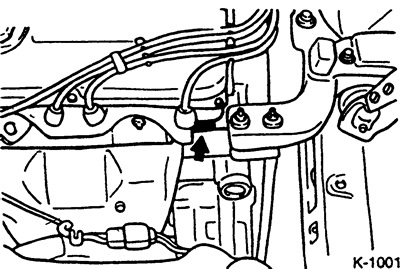
The engine number consists of the engine code and the serial number. For petrol engines, the number is stamped on the top side of the engine block. For diesel engines, the engine number is on the right side of the block.
The engine code has 4 digits, for example, for a 1.3L engine - 4G 13. The factory number starts from AA0001 to AA9999, then follows AB0001, etc. up to AY9999 and finally to YY9999.
The engine code is also stamped on the identification plate, which is riveted to the front inside the engine compartment.
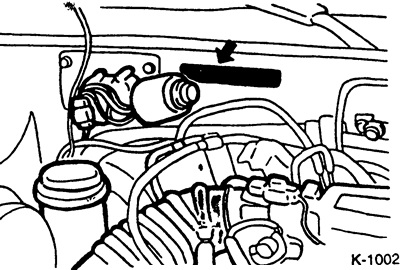
The vehicle body number is stamped on the rear transverse bulkhead of the engine compartment.
Body number coding:
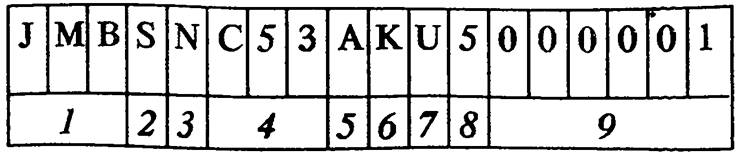
1 - Mitsubishi World Manufacturer's Mark (Europe, left-hand drive)
2 - Body type
L = 5-door hatchback, M = 3-door hatchback, S for limousine
3 - Gearbox type
F = 4-speed transmission, N = 5-speed transmission, K = 3-speed automatic transmission, R = 4-speed automatic transmission.
4 - Short model designation
C10 = COLT II/LANCER II, C50 = COLT III, C60 - LANCER III, C70 = LANCER III with all-wheel drive.
5 - Vehicle type
A = passenger car, V = combi.
6 - Information about the year of model production
E = 1984, F-1985... K = 1989, L = 1990 etc.
7 - Place of production
U = Mizushima Motor Vehicle Works
8 - Engine design
9 - Current issue
Each model in each year starts with 000001.