
English Русский
Български
Беларускі
Український
Српски
Hrvatski
Română
Polski
Slovenský
Magyar
Articles Bookmark Contacts Sitemap   
Company Audi Company Ford Company Hyundai Company Kia Company Mazda Company Mercedes-Benz Company Nissan
MitsubishiMan.ru


Home Colt Lancer Galant L200 Outlander Pajero Others
Lancer 9 (2000-2007, petrol) Lancer 3 and 5 (1984-1992)

Checking/adjusting the start of fuel supply by the injection pump (Mitsubishi Lancer 3)

  • Home
  • Lancer
  • 3 (1984-1992)
  • Power unit
  • Diesel power system
  • Checking/adjusting the start of fuel supply by the injection pump
0
Contents: Examination ⤓ Adjustment ⤓
After adjusting the tension, removing or replacing the toothed belt, and also after loosening the fastening of the injection pump or toothed belt pulleys, it is necessary to adjust the start of fuel supply by the injection pump.

The start of the feed can be checked both on the removed and installed engine. To check, you need a pointer indicator with a corresponding adapter to screw it into the pump.

Verification conditions:
  • Correct timing belt tension, see item 1.12.
  • Correct adjustment of engine control, see paragraph 1.18.
  • The engine is at operating temperature (coolant temperature is about 80°C). Fast idle mode is on, see Fig. K-2402.

Examination


Turn off the ignition.

Set the crankshaft to the TDC position of cylinder 1.
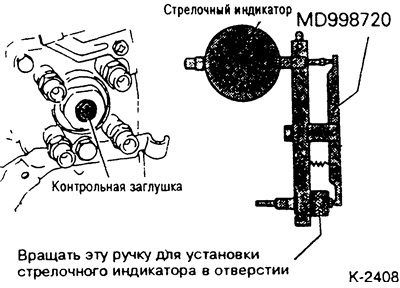


Loosen the union nuts of the injection line on the pump using a spanner. Hold the pressure valve with the spanner.

Unscrew the plug bolt (inspection plug) on the injection pump cover.

Screw in an adapter, for example MITSUBISHI MD-998720, and a small pointer indicator (measuring range from 0 to 3.0 mm) instead of the control plug.
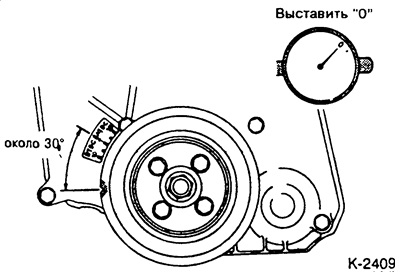


Turn the crankshaft counterclockwise approximately 30° before TDC. Check that the adapter is inserted correctly. Set the dial indicator to "0".

Rotate the pulley slightly in both directions and check whether the needle of the dial indicator moves. After that, precisely set the pulley to the crankshaft position 30° before TDC.
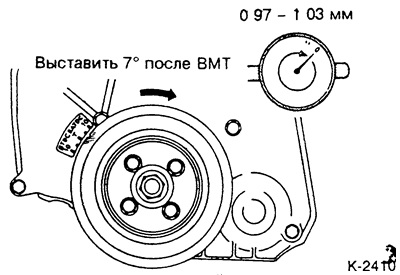


Turn the crankshaft clockwise to the position 7° after TDC. The dial indicator should show the required value. Required value: 0.97-1.03 mm.

Note: If the measured value is within the specified tolerance, no new adjustment is required. When making a new adjustment, set the value to 10 mm.


[The original article was published on: MitsubishiMan]

Adjustment


If the measured value is not within the specified range, slightly loosen the 2 fuel injection pump nuts, see Fig. K-2401.
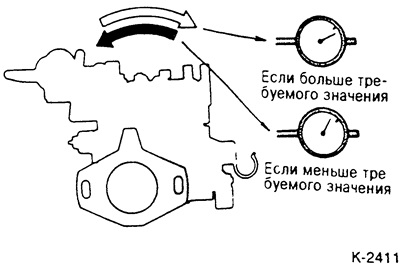


Turn the injection pump to the right or left until the measured value is 1 mm and temporarily tighten the injection pump nuts.

Repeat the feed start check and, if necessary, adjust the adjustment.

Unscrew the adapter with the pointer indicator and screw in the control plug with a new gasket, tightening it with a force of 15 Nm. If there are any leaks, tighten the bolt to 20 Nm.
This article is available at: russian, bulgarian, belarusian, ukrainian, serbian, croatian, romanian, polish, slovak, hungarian
This article was reviewed by: Dmitry Vasiliev
Share with friends:
◀ Previous
Lancer 3 and 5: Diesel power system
Next ▶

Removal and installation injectors
High pressure fuel pump (HPFP)
Injection system — device
Checking / adjusting the idle speed
Checking and replacing the fuel shut-off valve
Operation in winter
Diagnostics of faults in the fuel system of a diesel engine
Similar materials for other Mitsubishi models

➤ Start of fuel supply by injection pump — checking and… Mitsubishi Colt 4 and 5 (1991-2003)
➤ Checking the fuel pump, measuring the fuel pressure Mitsubishi Galant 6 and 7 (1987-1998)
➤ Removal and installation the fuel injection pump pulley Mitsubishi L200 4 (2005-2014, diesel)
➤ General information about the fuel supply and injection… Mitsubishi Outlander 1 (2003-2008)
➤ Removal and installation of fuel injection pump Mitsubishi Pajero 1 and 2 (1982-1999)
➤ Checking and adjusting the fuel injection timing Mitsubishi Carisma (1995-2004)
Link in different formats to this article
Comments and feedback from visitors
No comments yet


Add up two numbers 11 + 25


Lancer 9 (2000-2007, petrol) 
  • General information
  • User manual
  • Maintenance
  • Power unit
  • Repair of MPI engines
  • Repair of GDI engines
  • Engine overhaul
  • Cooling and lubrication system
  • MPI fuel injection system
  • GDI fuel injection system
  • Intake and exhaust system
  • Starting and charging system
  • Transmission
  • Automatic gearbox
  • Variator (CVT)
  • Drive shafts and gearbox
  • Chassis and running gear
  • Front suspension
  • Rear suspension
  • Steering
  • Brake system
  • Body and interior
  • Doors, locks and windows
  • Exterior (external elements)
  • Interior (internal elements)
  • Electrical equipment
  • Heater and air conditioner
  • Security system SRS
  • Equipment and devices
  • Wiring diagrams (saloon)
  • Wiring diagrams (wagon)
Lancer 3 and 5 (1984-1992) 
  • General information
  • Maintenance
  • Power unit
  • Engine repair
  • Lubrication system
  • Cooling system
  • Ignition system
  • Fuel system
  • Carburetor
  • Fuel injection
  • Diesel power system
  • Exhaust system
  • Transmission
  • Clutch
  • Car gearbox
  • Chassis and running gear
  • Front suspension
  • Rear suspension
  • Steering
  • Brake system
  • Wheels and tires
  • Body and interior
  • Exterior (external elements)
  • Interior (internal elements)
  • Heating system
  • Electrical equipment
  • Equipment and devices
  • Power devices
  • Electrical circuits
MitsubishiMan.ru © 2018–2026 • Mobile version • Articles about Mitsubishi • Contacts • Sitemap: EN BG BY UA RS HR RO PL SK HU • Site search • Bookmark
Colt 2 and 3 (1983-1993) · Colt 4 and 5 (1991-2003) · Colt 5 (1995-2003) · Lancer 3 and 5 (1984-1992) · Lancer 9 (2000-2007) · Galant 5 (1983-1989) · Galant 6 and 7 (1987-1998) · L200 4 (2005-2014) · Outlander 1 (2003-2008) · Pajero 1 and 2 (1982-1999) · Pajero 4 (2006-2021) · Carisma (1995-2004) · Space Star (1998-2005) ·
This resource sets cookies 🍪 to avoid bothering you with repeated data entry.