



Contents: Main characteristics of the system ⤓ Fuel injection control (fuel supply) ⤓ Additional air regulation (idle…⤓ Adjusting the ignition timing angle ⤓ Self-diagnosis function ⤓ Other management functions ⤓ Ignition system ⤓ Air flow control system ⤓ Emission Control System ⤓ Positive Crankcase Ventilation (PCV)…⤓ Fuel vapor recovery system ⤓ Exhaust Gas Recirculation (EGR)…⤓ Catalytic converter ⤓
Main characteristics of the system
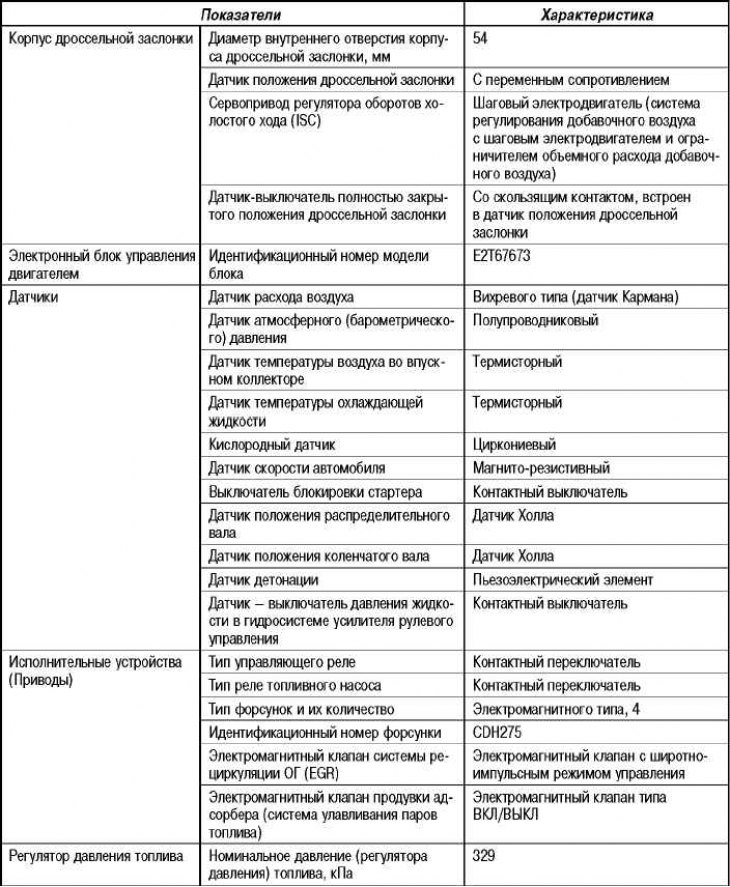
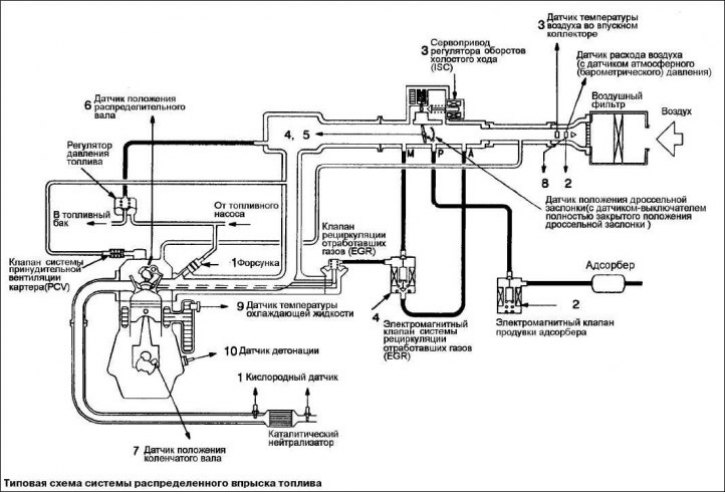
The distributed fuel injection system consists of sensors that record the engine status, an electronic engine control unit (engine-ECU), which performs control functions based on signals from sensors and actuators operating on commands from the control unit.
Fuel injection control (fuel supply)
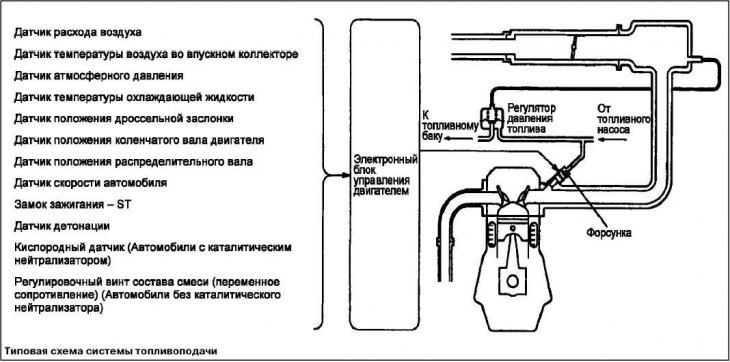
The fuel delivery system used in Mitsubishi Motors vehicles is designed to provide an accurate fuel dosage that provides the best combination between power output, fuel efficiency and low exhaust gas toxicity.
In fuel supply systems, the electronic engine control unit receives signals from the relevant sensors and controls the fuel injectors in such a way as to ensure the best air-fuel mixture composition at various engine modes. When operating modes change, the fuel system immediately adapts to them.
The moment of the beginning of the opening of the injector and the duration of its open state are set in such a way that the fuel-air mixture of the optimal composition, corresponding to the continuously changing operating conditions of the engine, enters the engine. The injector is installed on the inlet pipe of each cylinder. Fuel is supplied by the fuel pump from the fuel tank to the fuel manifold under pressure, the value of which is maintained by the pressure regulator. In the fuel manifold, the fuel, under a certain pressure, is distributed to each injector. Under normal conditions, fuel is injected once per two crankshaft revolutions for each cylinder.
The control unit controls fuel injection, idle speed and ignition timing. In addition, the control unit has a number of diagnostic modes that simplify troubleshooting.
The firing order of the cylinders is 1–3–4–2. This mode is called sequential fuel injection. The electronic control unit ensures enrichment of the fuel-air mixture during engine warm-up, as well as during operation under maximum load, implementing control without feedback on the mixture composition ("open-loop").
If the engine is warmed up or operates in partial modes, the control unit ensures the maintenance of the stoichiometric (theoretically necessary for complete combustion of the fuel) composition of the fuel-air mixture, implementing feedback control ("closed-loop") by mixture composition using signals from the oxygen sensor. This ensures maximum efficiency of the three-way catalytic converter.
Additional air regulation (idle speed control)
The electronic engine control unit maintains optimum idle speed depending on external conditions and engine load by regulating the amount of air entering the engine through the bypass channel bypassing the throttle valve. The engine control unit controls the servo drive of the idle speed controller (ISC), ensuring the maintenance of
set rotation speed depending on the coolant temperature and the air conditioner load. In addition, when the air conditioner is turned on and off, which is done in idle mode, the stepper motor of the idle speed controller (ISC) doses the amount of additional air in such a way as to eliminate fluctuations in the crankshaft rotation speed.
Adjusting the ignition timing angle
The power transistor connected to the primary circuit of the ignition coil closes and opens the circuit. Thus, optimal control of the ignition advance angle is carried out in accordance with the engine operating mode.
The electronic engine control unit determines the optimum ignition timing angle depending on the engine crankshaft speed, the volumetric air flow entering the engine, the coolant temperature and atmospheric pressure.
Self-diagnosis function
If a malfunction occurs in one of the sensors or actuators related to the exhaust gas toxicity reduction systems, the engine malfunction indicator lamp lights up on the instrument panel ("CHECK ENGINE"), warning the driver about the malfunction.
If the electronic control unit registers a malfunction in the operation of one of the sensors or actuators, the unit issues a corresponding diagnostic trouble code.
The data recorded in the RAM of the electronic control unit, related to sensors and actuators (malfunction codes), can be read using MUT-II. In addition, in a certain operating mode of MUT-II, forced control of actuators is possible.
Other management functions
The fuel pump control turns on the fuel pump relay, which supplies current to the pump motor.
The air conditioner relay control turns the air conditioner compressor electromagnetic clutch relay on and off.
The fan relay control regulates the speed of the radiator fan of the cooling system and the condenser fan of the air conditioner depending on the coolant temperature and the vehicle speed.
Ignition system
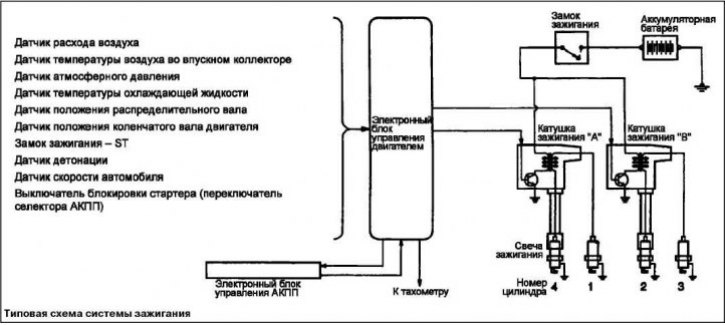
To ensure efficient combustion, the ignition system must ignite the air-fuel mixture in the engine cylinder at the right moment. Correctly selected ignition timing ensures that the heat energy released and the pressure developed in the cylinder as a result of combustion are released at the optimal moment in accordance with the piston position. The electronic engine control unit receives signals from the relevant sensors and controls the ignition timing.
Air flow control system
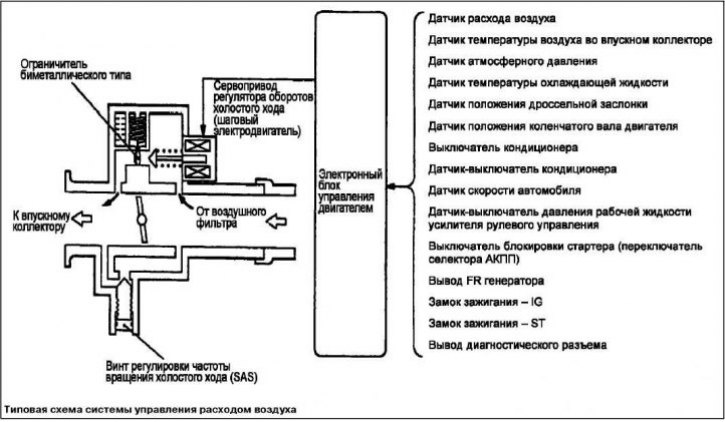
The air flow control system consists of an air flow measurement system and an idle speed control system. The air flow measurement system ensures optimum air flow control during normal vehicle driving by changing the throttle position.
The idle speed control system regulates the air flow through the intake system when the throttle valve is fully closed. This system monitors engine speed and throttle position along with other input variables.
Emission Control System
Emission control systems are required to control the content of hydrocarbons (CH), carbon monoxide (CO), and nitrogen oxides (NOx). The following systems are installed on Mitsubishi Motors vehicles to reduce the emission of harmful components in exhaust gases.
Positive Crankcase Ventilation (PCV) System
The gases from the combustion chamber pass through the piston rings into the engine crankcase. These leaked gases (bloW-by gases) harmful when released into the atmosphere.
Positive crankcase ventilation valve (PCV valve) is the main element of this system, it passes crankcase gases into the intake manifold, where they, mixing with the air-fuel mixture, are directed into the engine combustion chamber.
Fuel vapor recovery system
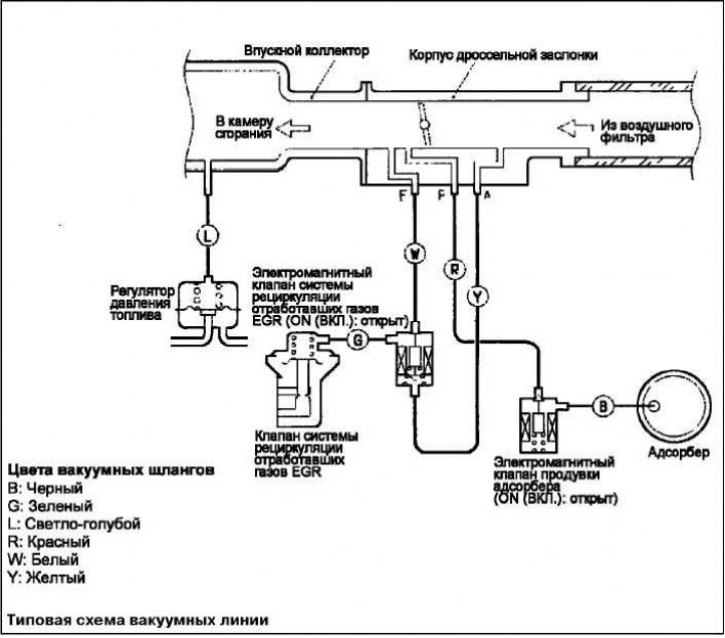
The fuel vapor recovery system collects fuel vapors, which contain a high concentration of hydrocarbons (CH) and are transferred from the fuel tank to the storage canister.
The fuel vapors are held there until they mix with the intake air and burn in the engine's combustion chamber.
Exhaust Gas Recirculation (EGR) System
The exhaust gas recirculation system, under certain engine operating conditions, takes some of the exhaust gases from the exhaust manifold and directs them to the intake manifold to reduce the temperature in the combustion chamber.
Nitrogen oxides (NOx) are formed in gases as a result of combustion of mixtures at high temperatures.
Catalytic converter
The catalytic converter helps reduce the content of harmful components, being, in fact, a second combustion chamber. The catalyst helps to carry out chemical reactions to prolong the combustion processes in the exhaust gases, which significantly reduces the content of harmful components in them. The catalytic converter works especially effectively when certain proportions of the air-fuel mixture are observed.
To monitor the operation of the exhaust gas toxicity control system, some vehicle models are equipped with an on-board diagnostics (OBD) system.