



Contents: Type of self-diagnostic system ⤓ Features of diagnostics using a…⤓ Diagnostic connector ⤓ Explanations on the operation of the…⤓ Explanations on the operation of the…⤓ Standard troubleshooting scheme ⤓ Recheck for signs of malfunction and…⤓ Checking the Engine Malfunction…⤓ Reading diagnostic trouble codes ⤓ Clearing diagnostic trouble codes ⤓ Diagnosis in the "Diagnosis 2" mode ⤓ Testing using the "DATA LIST" and…⤓ Freeze Frame Data ("FREEZE FRAME") ⤓ Ready to test status ⤓ Checking the terminals of the engine…⤓
Type of self-diagnostic system
On models with a self-diagnosis system such as EOBD or OBD-II, the standard diagnostic code consists of one letter and 4 digits (for example: "P00G0"). The numbering of such codes is continuous, i.e. the fault codes for different systems are not repeated.
On models with the OBD-II system, a new "Freeze Frame Data" function has been added to the engine control unit (freeze frame data). When a fault is detected by the self-diagnosis system, the corresponding diagnostic code will be recorded and the current parameters of the main engine units and systems at that moment will be recorded ("data freeze frame"). This data, read using the tester, can simplify the analysis of the conditions under which the fault occurred.
Features of diagnostics using a tester
The algorithm of the Mitsubishi diagnostic system is slightly different from the standard algorithm (OBD II protocol), therefore, to perform correct diagnostics, it is recommended to use the MUT-II tester.
It is recommended to connect the tester (MUT-II) with the ignition off, as this may cause a failure of the electronic control units.
Before connecting the tester to the diagnostic connector, make sure that the condition and shape of the connector terminals are normal.
Diagnostic connector
The vehicle was equipped with one standard 16-pin main diagnostic connector (located under the instrument panel).
Explanations on the operation of the engine malfunction indicator lamp ("CHECK ENGINE")
The indicator lamp comes on for a few seconds immediately after the ignition is turned on to indicate that the lamp itself is functioning normally.
Next (after starting or with the engine running), the indicator lamp lights up to warn the driver that the self-diagnostic system has detected a malfunction.
Note: If the indicator lamp lights up due to a control unit malfunction, it is impossible to establish communication between the tester and the control unit, and it is not possible to read diagnostic codes.
In the event of a critical fault (the presence of a serious defect in the fuel injection system or the exhaust emission control system), the warning lamp will remain on continuously while the vehicle is moving until the fault code is cleared after the fault has been corrected (i.e. after repair).
Note: Clearing the fault code does not correct the fault
The indicator lamp will go out when the ignition is switched off (key: "OFF").
Conditions under which the indicator lamp is lit ("CHECK ENGINE") may go out on signal from control unit when ignition is on (fault code remains)
Note: For a fault, a cycle means starting and stopping the engine or three trips (road tests of the vehicle) during which the fault is monitored.
For a transmission fault: If the engine control unit has not detected a fault within three cycles under the appropriate modes and conditions (see conditions for setting the code).
For a malfunction in the exhaust emission system (misfiring): if the engine control unit has not detected a malfunction during the cycle under similar engine operating conditions (crankshaft speed, coolant temperature, etc.) under which the malfunction was first detected.
Explanations on the operation of the self-diagnostic system
The engine control unit monitors input/output signals (some constantly, others only under certain conditions). If a system malfunction is detected constantly or for a specified period of time, or if several more such signals are received by the engine control unit after the first incorrect signal, the engine control unit will perceive this as a malfunction, write the corresponding malfunction code to memory and send a signal to the output of the self-diagnostic system.
Note: Normally, if the control unit detects a fault, the warning lamp will illuminate and the fault code will not be stored until the engine is restarted and the same fault is detected again.
For some faults, the warning lamp will illuminate and a corresponding fault code marked with "*" will be recorded the first time it is detected.
Since the memory (RAM of the engine control unit) is powered directly by the battery, the diagnostic results are saved even when the ignition switch is turned to the "OFF" position. The fault codes will be erased when the battery terminal or the engine control unit connector is disconnected. In addition, the fault codes are erased if a signal to erase the fault codes is sent from the tester to the engine control unit with the ignition on (the key in the "ON" position).
Attention! If you disconnect the connector of any sensor with the ignition on (key in the "ON" position), the control unit will perceive this as a malfunction and the corresponding code will be written into the control unit memory. In this case, delete the fault codes.
Standard troubleshooting scheme
Simulate signs of a malfunction to check for their presence and determine the nature and conditions of occurrence (engine operating mode, operating conditions, etc.).
(Original version of the article on the website: «MITSUBISHIMAN.ru»)
Read the fault codes and determine the causes of the fault, the components to be checked and the order in which they are checked.
Check the input signals of the engine control unit using a tester or motor tester. If the signals are normal, then the corresponding sensor (element) is in good condition. Proceed to check the next component,
Check the output signals of the engine control unit using a motor tester and check the operation of the actuators using the ACTUATOR TEST function of the tester. If the signals of the engine control unit and the actuator are normal, then the actuator control is normal. Proceed to check the next component.
If the ECU signals are normal, check and repair the wiring of the system components if necessary. After repair, check the ECU signals again. If the signals are normal this time, check the input and output signals for the next component to be checked.
If the wiring is OK, but the input and output signals of the engine control unit are not normal, check the individual components of the system and repair or replace them if necessary. After repair, check the signals of the engine control unit again. If the signals are normal this time, check the signals for the next component to be checked.
Recheck for signs of malfunction and repair
If the suspected wiring circuit and specific components are checked and no faults are found, but the ECU input and output signals are abnormal, then evaluate the symptoms more closely (the initial diagnosis may have been incorrect or incomplete). When checking further, try to expand the fault search to other groups of components (repair if necessary).
Try to simulate the symptoms of the malfunction to be sure that the malfunction has been eliminated. Eliminate the cause of the malfunction to prevent the defect from reoccurring.
Checking the Engine Malfunction Indicator Lamp ("CHECK ENGINE")
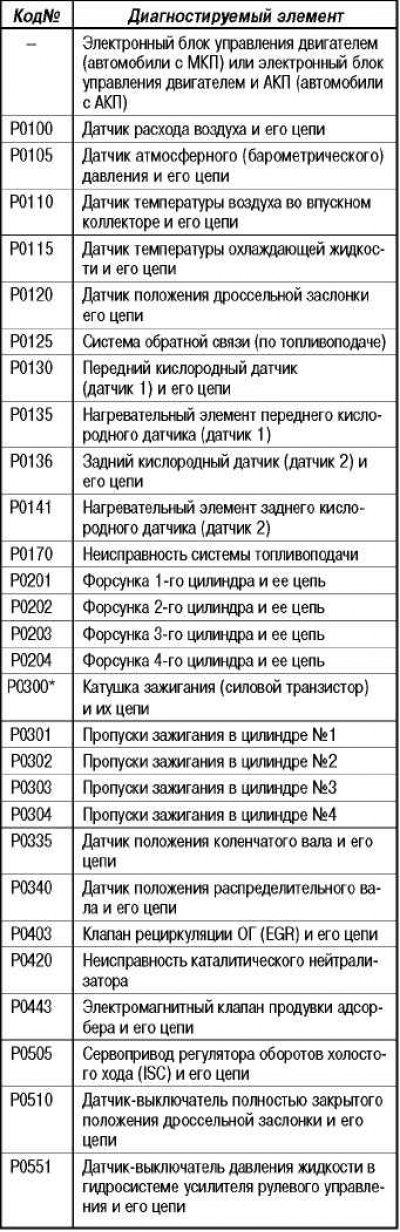
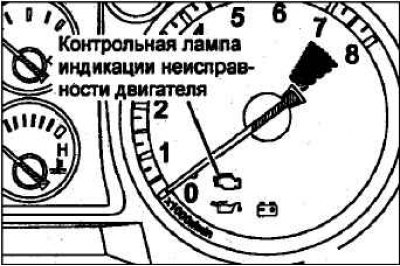
If a malfunction occurs in any of the following components of the Multi-Purpose Irrigation (MPI) system, the Engine Malfunction Indicator Lamp (EMI) will illuminate ("CHECK ENGINE"). If this lamp remains on even when the engine is running, check for a fault code. It is important to remember that the engine malfunction indicator lamp will always remain on for 5 seconds after the ignition key is turned to the "ON" position.
Fuel injection system components (or conditions) that, if faulty (or not met), cause the engine malfunction indicator lamp to light up ("CHECK ENGINE")
Note: If the warning lamp lights up due to a malfunction of the engine control unit (vehicles with manual transmission) or the engine and automatic transmission control unit (vehicles with automatic transmission), communication between the MUT-II and the engine control unit (vehicles with manual transmission) or the engine and automatic transmission control unit (vehicles with automatic transmission) is not possible, and the diagnostic trouble code cannot be read.
Note: Once the engine control unit (vehicles with manual transmission) or the engine and automatic transmission control unit (vehicles with automatic transmission) has detected a fault, the engine malfunction indicator lamp lights up each time the engine is restarted and the same fault is indicated again. However, for the item marked with "*" in the table, the indicator lamp lights up only once, the first time the fault is detected.
Note: Once the check engine light comes on, it will go out when the following conditions are met:
Note: When the engine control unit (vehicles with manual transmission) or the engine and automatic transmission control unit (vehicles with automatic transmission) has detected a fault in the transmission three times.
Note: The "*" sign in the table: in this case, "one time" means the period from engine start to engine stop.
Note: In the misfire evaluation mode, when the vehicle driving conditions (engine speed, coolant temperature, etc.) are similar to the condition under which the malfunction was first detected.
Note: "Sensor 1" means the sensor is installed closer to the engine, and "Sensor 2" means the sensor is installed further from the engine than the first one.
Reading diagnostic trouble codes
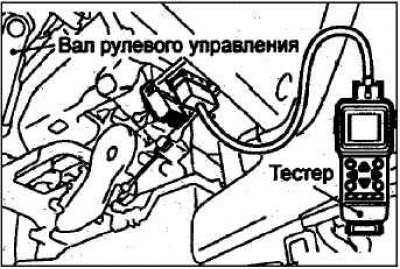
Make sure that the battery is in good condition, as fault detection is not possible if the battery voltage is low.
Turn off all additional equipment.
Set the automatic transmission selector lever to the "N" position.
Caution: Do not disconnect the battery until the diagnostic results have been fully read, as the fault code will be cleared from the ECU memory when the battery or ECU connector is disconnected.
Turn the ignition key to the "OFF" position.
When checking with a tester, connect the tester to the diagnostic connector under the instrument panel.
Attention! When connecting or disconnecting the tester, the ignition must be switched off (ignition key in the OFF position).
Turn on the ignition and read the diagnostic codes.
After completing the test, turn the ignition switch to the "OFF" position and then disconnect the tester from the diagnostic connector.
Clearing diagnostic trouble codes
Turn the ignition key to the "OFF" position.
If a tester is used, connect it to the diagnostic connector and erase the codes.
When not using the tester, disconnect the negative battery cable for 10 seconds or more.
After disconnecting the wire from the negative terminal of the battery, the contents of the memory of the electronic control units of other systems will be lost.
Turn the ignition key to the "ON" position, then check that the normal status code is displayed.
After warming up the engine, let it idle for at least 10 minutes.
Diagnosis in the "Diagnosis 2" mode
Using MUT-II, switch the electronic control unit to the diagnostic mode "Diagnosis 2".
Conduct a road test.
Read diagnostic codes and perform repair procedures to correct the detected malfunction.
Turn the ignition key to the OFF position and then turn it back to the ON position.
Note: When the ignition is turned off, the ECU will switch the test mode from "Diagnosis 2" to "Diagnosis 1" mode.
Clear diagnostic codes.
Testing using the "DATA LIST" and "ACTUATOR TEST" modes of the MUT-II
Perform a test using the DATA LIST and ACTUATOR TEST modes of the MUT-II.
If a malfunction is detected, check the vehicle's electrical wiring, relevant components and parts.
After repair, retest using MUT-II and verify that the repair has restored the abnormal input and output signal to normal.
Clear diagnostic trouble codes from the ECU memory.
Disconnect the MUT-II, restart the engine and road test to ensure that the problem has been corrected.
Freeze Frame Data ("FREEZE FRAME")
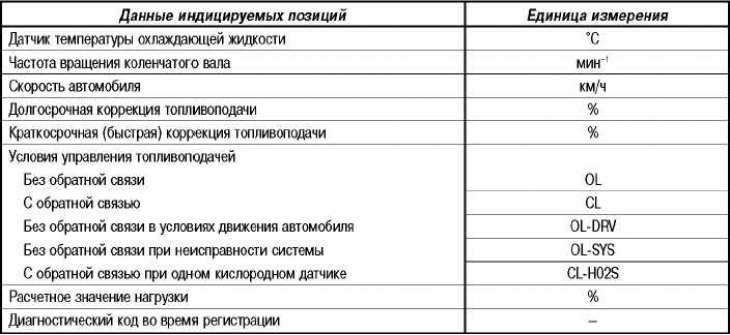
When the ECU (manual transmission vehicles) or ECU and A/T (automatic transmission vehicles) detects a malfunction and stores a diagnostic trouble code, it also stores the current engine status. This function is called "freeze frame" ("FREEZE FRAME"). By analyzing the freeze frame data with MUT-II, an effective troubleshooting can be performed. The displayed positions of the freeze frame data are shown in the table below.
Note: If multiple faults are detected in multiple systems, only the fault that was detected first is remembered.
List of indicated positions
Ready to test status
The electronic engine control unit (cars with manual transmission) or the electronic engine and automatic transmission control unit (cars with automatic transmission) monitors the following main diagnostic elements, judges their condition (serviceable/faulty) and remembers the dynamics of changes in their technical condition. The latter can be read using MUT-II (if the electronic control unit had information about the technical condition of some element before, MUT-II displays "Complete").
Finally, if the diagnostic trouble codes are erased, or if the battery is disconnected, then the information about the technical condition of the element is also erased (the memory of the electronic control unit is reset).
- Catalytic Converter: P0420.
- Oxygen sensor: P0130.
- Oxygen sensor heating element: P0135, P0141.
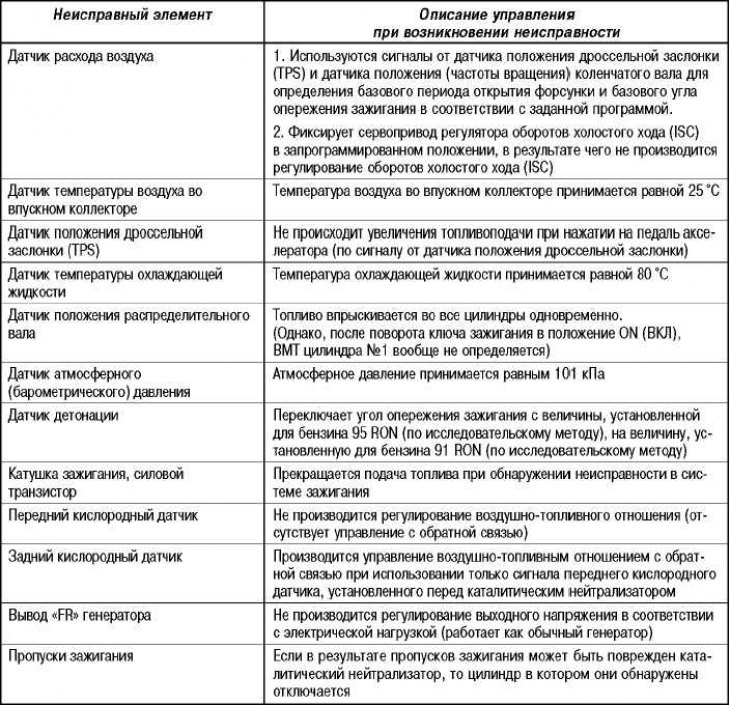
Emergency Operation Reference Table
When the self-diagnostic system detects a malfunction of one of the main sensors, the system switches to emergency control mode ("FAIL SAFE FUNCTION"), so that the vehicle can continue moving (to the service station).
Checking the terminals of the engine control unit connector
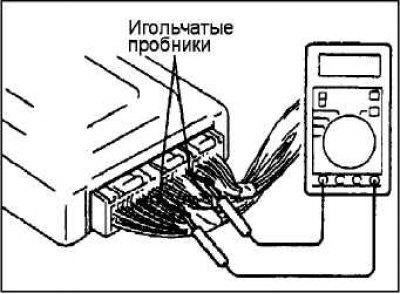
Connect the needle probes (test lead harness MB991223 or paper clip) to the voltmeter probes:
According to the check table, insert a needle test probe (paper clip) into each terminal of the engine control unit (ECU) or engine and automatic transmission (ATU) connector on the wiring harness side and measure the voltages, checking their values according to the check table.
Note: Measure voltages with the connector connected to the electronic engine control unit (ECU) or the engine and automatic transmission control unit (ATU).
Note: For ease of connection to the connector terminals, you can extend the electronic engine control unit (ECU) or the electronic engine and automatic transmission control unit (ATU).
Note: It is permissible to conduct checks in a different order than that specified in the check table.
Caution! Shorting the positive (+) probe connected to the connector terminal to ground may cause damage to the wiring, sensor, engine control unit (ECU) or ECU and A/T (A/T), or all of these components. Be very careful not to let this happen.
If the voltmeter detects any deviation from the nominal value, check the corresponding sensor, actuator and corresponding wires, then repair or replace.
After repairing or replacing a part (unit), recheck the voltage with a voltmeter to ensure that the fault has been corrected.