



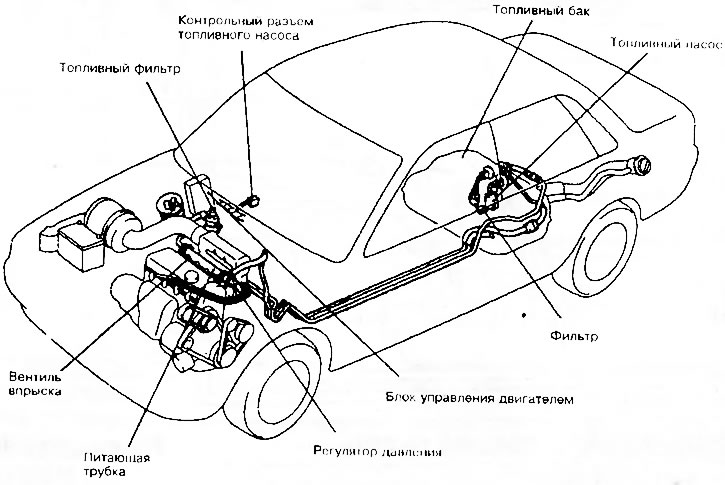
Typical layout of MPI fuel injection system components
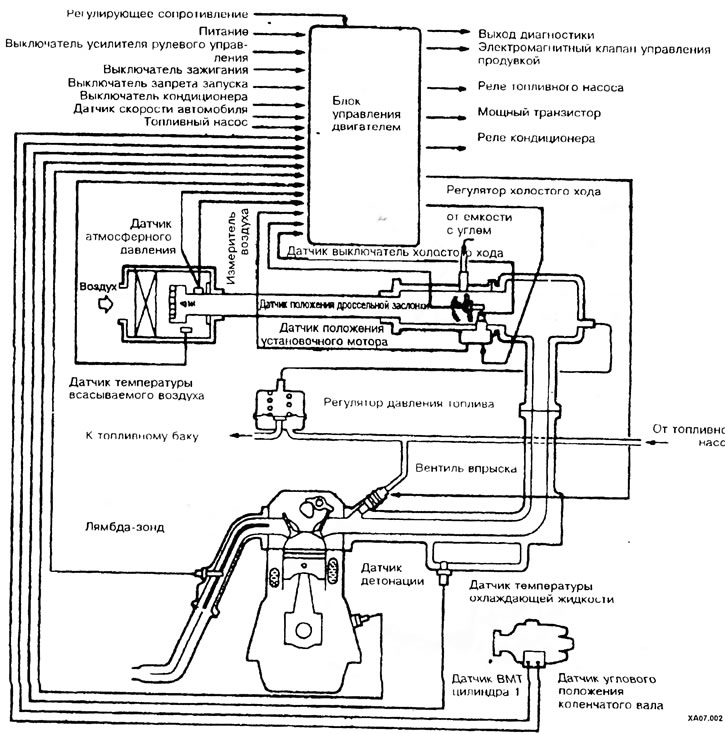
Injection system operation diagram
The MPI fuel injection system operates using several units and parts: the fuel pump, which is located in the fuel tank, pumps fuel from it and delivers it through the fuel filter along the distribution line to the injection valves (injectors). The injection valves are controlled by the control unit, which calculates the injection moment and the amount of injected fuel. When current flows through the electromagnet winding, the injection valve needle is pulled in and fuel is injected (if the current circuit is broken, the spring returns the needle, and the valve is locked). The injection valves are controlled separately in the ignition sequence. The pressure regulator, located on the distribution line, maintains constant pressure in the fuel system.
The intake air is cleaned in the air filter, in the body of which is located the air mass meter, transmitting information to the control unit. Pulse signals from other sensors, such as the atmospheric pressure meter or intake air temperature sensor, also come there.
Cleaned air is supplied to the engine through the intake manifold.
The lambda probe (oxygen sensor) is used to measure the oxygen content in the exhaust gases and transmit information to the control unit in the form of voltage.
The throttle body contains a throttle valve, which regulates the amount of air through the gas pedal. Also in the throttle body is an idle speed adjustment mechanism, which regulates the air supply bypassing the throttle valve. The idle speed regulator is equipped with an idle speed sensor and an idle speed switch.