



Removal
Before you begin removing parts, perform the following operations:
- a) Remove the engine crankcase protective cover.
- b) Remove the support bracket and engine mount assembly.
The parts are removed in the order of numbers indicated in the figures "Removing the crankshaft pulley" and "Replacing the timing belt".
When removing parts, pay attention to the following operations:
1. Removing the power steering pump and air conditioning compressor drive belt.
a) Loosen bolts "A", "B" and "C" of the power steering pump.
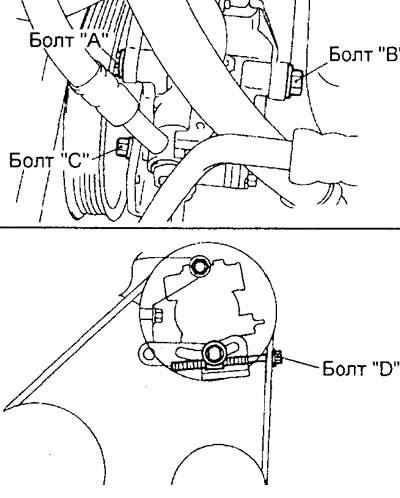
b) Loosen the adjusting bolt "D" to release the belt tension, then remove the belt.
Caution: If the power steering pump and air conditioning compressor drive belt is reused, an arrow indicating the direction of rotation (clockwise) must be chalked on the reverse (non-working) surface of the belt.
2. Removing the generator drive belt.
a) Loosen the lock bolt "A" on the generator adjusting bar and the articulated joint bolt.
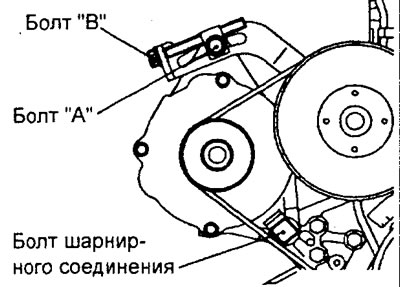
b) By turning the adjusting bolt "B", release the tension of the generator drive belt, then remove the belt.
Caution: If the alternator drive belt is reused, it is necessary to mark an arrow with chalk on the reverse (non-working) surface of the belt indicating the direction of rotation (clockwise).
3. Removing the crankshaft pulley.
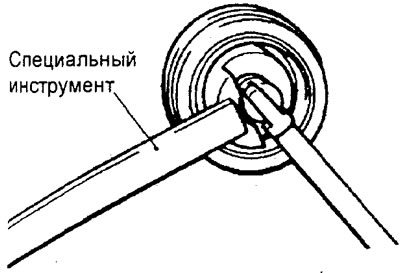
Using a special tool, secure the crankshaft pulley from turning and unscrew the crankshaft pulley mounting bolt.
Caution: Secure the special tool securely to prevent it from moving.
4. Removing the timing belt.
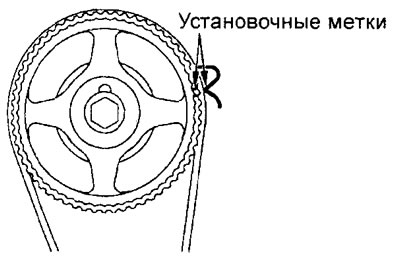
a) Turn the crankshaft clockwise until the timing marks on the camshaft pulley and the crankshaft toothed pulley are aligned with the corresponding timing marks for setting the piston of cylinder No.1 to TDC of the compression stroke.
Caution: Always turn the crankshaft clockwise only.
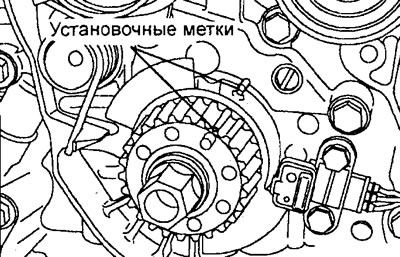
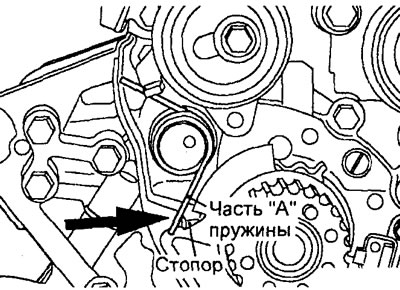
b) Using pliers, pull part "A" of the tensioner spring past the stopper on the oil pump housing, then remove the spring.
Note: Be careful when removing the tensioner spring, do not damage the timing belt with the "A" part of the spring when straightening it.
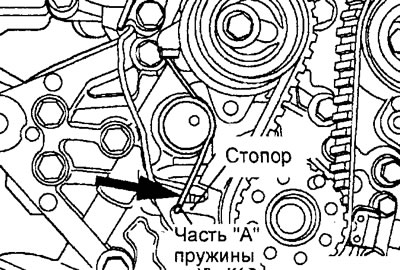
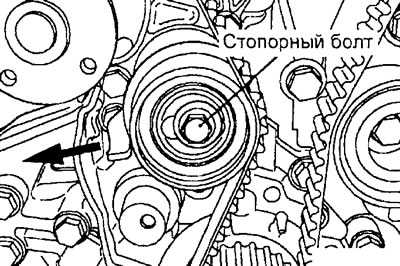
c) Loosen the timing belt tensioner lock bolt.
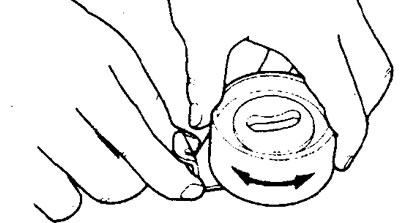
d) Move the timing belt tensioner in the direction of the arrow shown in the figure to release the belt tension.
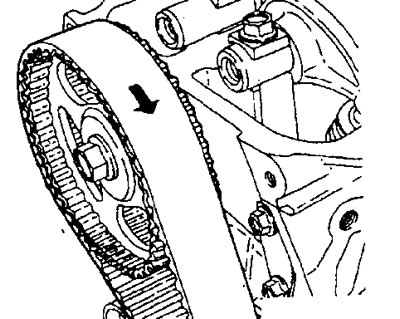
d) Remove the timing belt.
Note: If the timing belt is reused, it is necessary to mark with chalk an arrow on the reverse (non-working) surface of the belt indicating the direction of rotation (clockwise).
Examination
Note: When replacing the timing belt, it is recommended to replace the tensioner and tensioner spring.
1. Check the ease and smoothness of rotation of the rollers.
2. Check for excessive play in the bearings and extraneous noise when the roller rotates. Replace if necessary.
3. Check the condition of the spring and tensioner bracket.
Installation
Attention:
- Since water or oil can seriously reduce the life of the timing belt, when removing parts, ensure that the timing belt, pulleys and tensioner bracket are clean and dry, never wash them. Contaminated parts must be replaced.
- If any of the parts are oily, check for oil leaks through the seals (including the front camshaft seal).
- Check the condition and smooth rotation of the tensioner roller.
- If you are installing a timing belt that has been in use, check its condition (see chapter "Maintenance and general check and adjustment procedures").
Installation is carried out in the reverse order of removal.
When installing parts, please pay attention to the following operations:
1. Installing the timing belt tensioner.
a) Set the timing belt tensioner to the position shown in the figure and temporarily tighten the lock bolt.
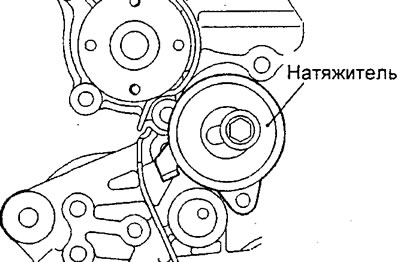
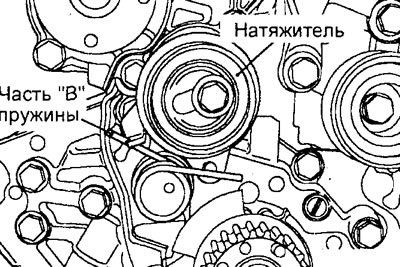
b) Install the tensioner spring,
c) Place the "B" part of the tensioner spring behind the tensioner bracket.
c) Using pliers, insert part "A" of the tensioner spring behind the stopper on the oil pump housing.
2. Installing the timing belt.
Attention:
- Install the timing belt so that the belt tension does not weaken between the pulleys and rollers.
- Install a used belt so that the arrow on the back of the belt matches the direction of rotation of the belt (clockwise).
a) Check that the marks on the camshaft pulley and the toothed pulley of the crankshaft are aligned with the corresponding installation marks (in this case, the piston of cylinder No.1 will be at TDC of the compression stroke).
Caution: If the timing marks are not aligned, the valves may "meet" the piston when the camshaft pulley turns when the piston is at TDC.
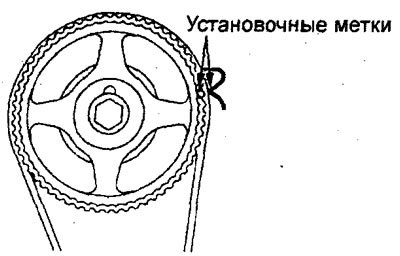
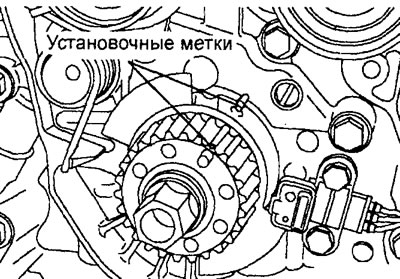
b) Install the timing belt in the following order, ensuring that the working branch (side) of the belt is tensioned: crankshaft toothed pulley, camshaft pulley and tensioner roller.
Caution: After installing the timing belt, apply force to the camshaft pulley to turn it counterclockwise and check that the belt is fully tensioned and all timing marks are aligned.
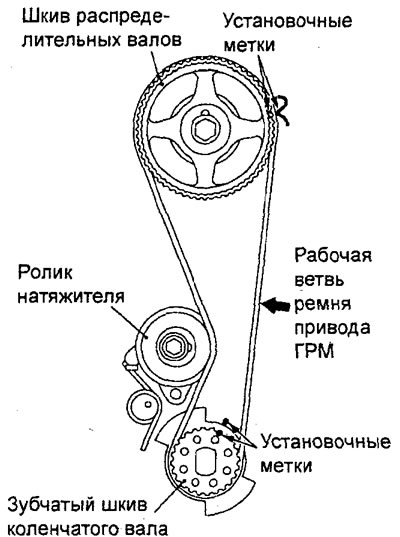
c) Adjust the timing belt tension.
3. Adjusting the timing belt tension.
a) Loosen the lock bolt 1/4-1/2 turn so that the timing belt is tensioned by the tensioner spring force.
The original article was published on [MitsubishiMan.ru]
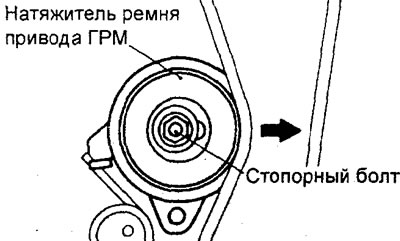
b) Turn the crankshaft in the direction of rotation (clockwise) by 2 turns and make sure that all marks on the pulleys are aligned with the corresponding timing marks.
Caution: Since the purpose of this operation is to apply the appropriate tension force to the working branch of the timing belt using the torque on the camshaft, turn the crankshaft only two revolutions. Do not turn the crankshaft in the opposite direction (counterclockwise).
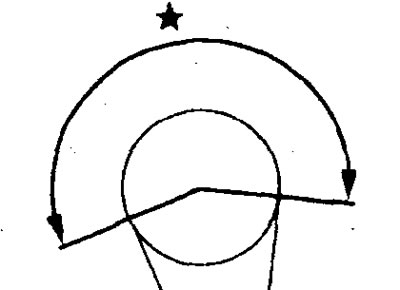
c) Check that there is no protrusion of the timing belt teeth relative to the camshaft pulley in sector "A" shown in the figure, and that normal engagement of the timing belt with the pulleys is ensured. Then tighten the tensioner roller lock bolt to the rated torque.
Tightening torque: 20 - 26 Nm
4. Installing the crankshaft pulley,
a) Clean the threaded hole in the end of the crankshaft, the end of the shaft, the washer of the pulley mounting bolt and the surfaces in contact with it.
b) Lubricate the mating surface (cone) of the crankshaft nose and the thread of the crankshaft pulley bolt with a minimum amount of engine oil.
c) Before installing the crankshaft pulley mounting bolt, it is necessary to install the bolt washer with the chamfered side facing the bolt.
d) Using a special tool, secure the crankshaft pulley from turning, install and tighten the crankshaft pulley mounting bolt to the specified torque.
Tightening torque: 121-135 Nm
After completing the installation of the parts, perform the following operations:
- a) Install the support bracket and engine mount assembly.
- b) Install the engine crankcase protective cover.
- c) Adjust the tension of the drive belts of the attachments (see chapter "Maintenance and general check and adjustment procedures").