



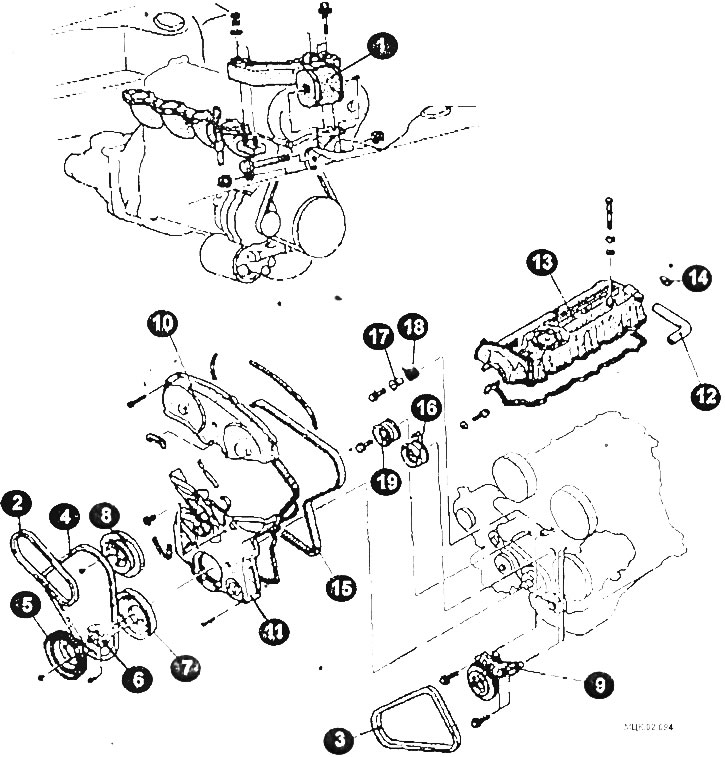
Timing Belt Mounting Elements
1 - Engine mount bracket; 2 - V-belt of power steering; 3 - V-belt of the air conditioning compressor; 4 - generator V-belt; 5 - crankshaft pulley; 6 - adapter; 7 - vibration damper; 8 - water pump pulley; 9 - tension roller bracket; 10 - Upper timing belt casing; 11 - lower toothed belt casing; 12 - ventilation hose; 13 - cylinder head cover; 14 - cylinder head cover seal (semi-circular); 13 - toothed belt; 16 - toothed belt tensioner; 17 - spacer sleeve; 18 - spring; 19 - guide roller.
Removal
Remove the shroud and then remove the air filter.
Disconnect the upper intake manifold from the lower and from the holders. First disconnect the branch pipe for the outlet channel, and remove the vent and intake air hoses.
Remove the glow plugs.
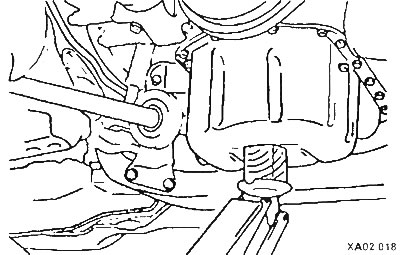
Place a jack with a wooden block under the oil pan and support the engine to remove the engine mount bracket.
Remove the V-belt.
Loosen all rocker arm adjusting bolts so that the ends of the bolts protrude only 0±2 mm.
Remove the upper timing belt cover.
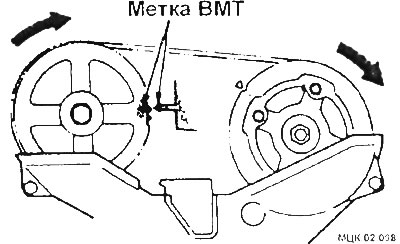
Turn the crankshaft clockwise until the camshaft wheel mark is at TDC.
There are several ways to turn the crankshaft:
Raise the car from the front side. Engage 5th gear, pull the handbrake. Turn the raised front wheel, the crankshaft will rotate.
Turn the crankshaft using the central bolt of the belt pulley, but first engage neutral gear and apply the handbrake.
Turn the engine until the mark on the camshaft wheel aligns with the pointer. The piston of the first cylinder is now at TDC.
Unscrew the crankshaft gear.
Remove the lower timing belt cover.
Mark the direction of rotation of the toothed belt with chalk. The toothed belt rotates clockwise.
Loosen the timing belt tension and remove it.
Examination
The toothed belt must be replaced if the following faults are present:
- Traces of oil or coolant on the timing belt. This is caused by leaks in the housing or camshaft seals, or leaks in the water pump.
- Rubber compaction on the outer side of the toothed belt. The belt becomes shiny and hard.
- Rubber tears on the outside of the belt.
- Deformation of the fabric on the inside of the belt.
- Breaks at the base of the teeth and breaks on the narrow side of the belt.
- Severe wear on the narrow side of the belt and teeth. Fraying of the fabric on the loaded side of the teeth. Peeling of the rubber and its change in color to white. Reduction in the width of the teeth.
- Chipped teeth.
Installation
Check and, if necessary, adjust the TDC position of the camshaft, fuel injection pump, oil pump and crankshaft.
Put on the toothed belt, taking into account the marking of the direction of rotation. The old toothed belt should only be installed in the old direction of rotation.
Place the timing belt on the crankshaft gear, then pass it through the guide roller, through the camshaft gear and the oil pump gear. The timing belt should be placed between two adjacent gears in a taut state. With the timing belt on, align the TDC mark on the fuel injection pump gear with the engine mark.
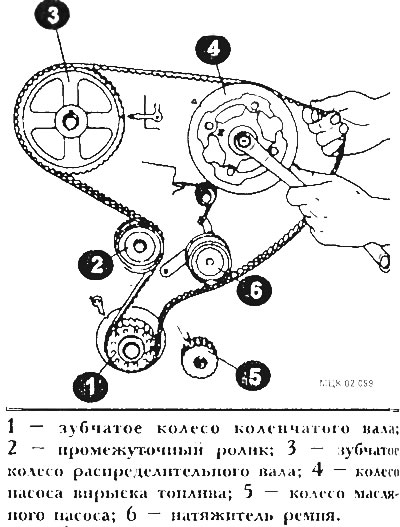
Place the timing belt on the tension roller and tighten the timing belt.
Rotate the timing belt clockwise until all TDC marks align, which should match.
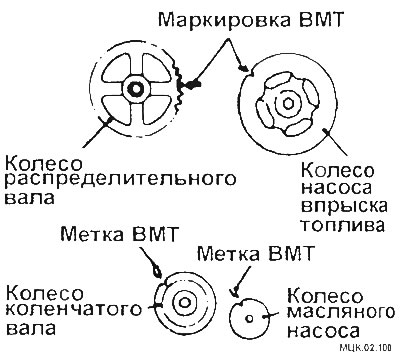
Check the timing belt tension.
Adjust the valve clearances.
Install the cylinder head cover, first installing the gaskets.
Install the upper and lower toothed belt covers. Insert the bolts depending on their diameters and lengths.
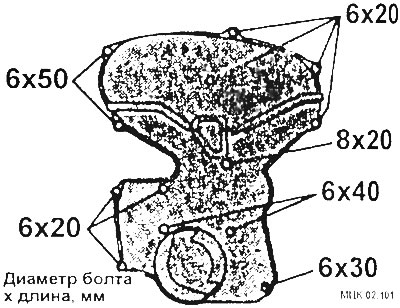
Install the V-belt.
Install the upper engine mount.
Install the glow plugs.
Install the upper part of the intake manifold. To do this, insert new sealing rings into the lower part of the manifold, put on the upper part and tighten the bolts alternately with a force of 15 Nm. Secure the manifold to the holders with a force of 15 Nm. Attach the exhaust pipe with a new seal and secure it with a force of Nm. Connect the air intake ventilation hoses by securing them with clamps.
Install the air filter and then install the lower left cover.