



Contents: Removal and installation ⤓ Examination ⤓ Replacing the fuel level sensor ⤓ Replacing the fuel pump ⤓ Disassembly and assembly of the fuel…⤓
Removal and installation
Before you begin removing parts, perform the following operations:
- a) Drain the fuel from the tank.
- b) Release residual pressure from the high-pressure fuel line.
- c) Remove the central pipe of the exhaust system.
- d) (4WD models) Remove the propeller shaft.
The parts are removed in the order of the numbers indicated in the figures "Removing the fuel tank" and "Removing the fuel tank filler neck".
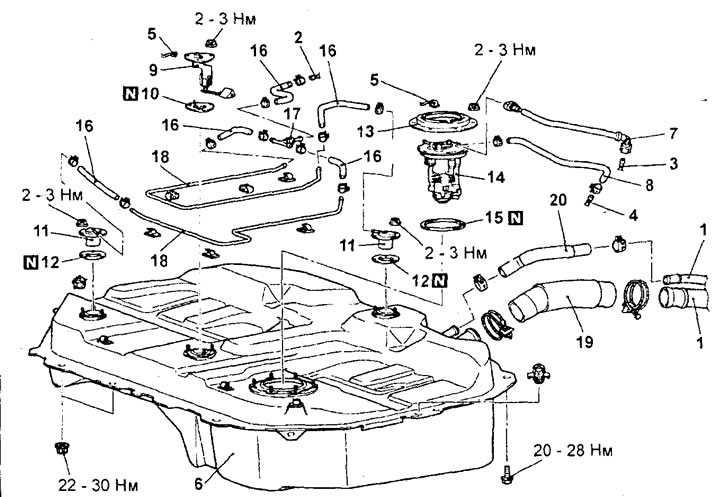
Removal the fuel tank (except 4WD models with 4G15 engine). 1 - Fuel tank drain pipe and filler neck connection, 2 - Evaporative emission system pipe connection, 3 - Fuel pipe connection, 4 - Fuel return pipe connection (disconnect the left parking brake cable retainer, the rear right wheel speed sensor wiring harness retainer and the sensor wiring harness connector), 5 - Wire harness connector, 6 - Fuel tank assembly, 7 - Fuel hose, 8 - Fuel return hose, 9 - Fuel level sensor, 10 - Gasket, 11 - Fuel shut-off valve, 12 - Gasket, 13 - Cover, 14 - Fuel pump assembly, 15 - Gasket, 16 - Evaporative emission system hose, 17 - Check valve, 18 - Evaporative emission system pipe, 19 - Fuel filler neck hose tank, 20 - drainage hose.
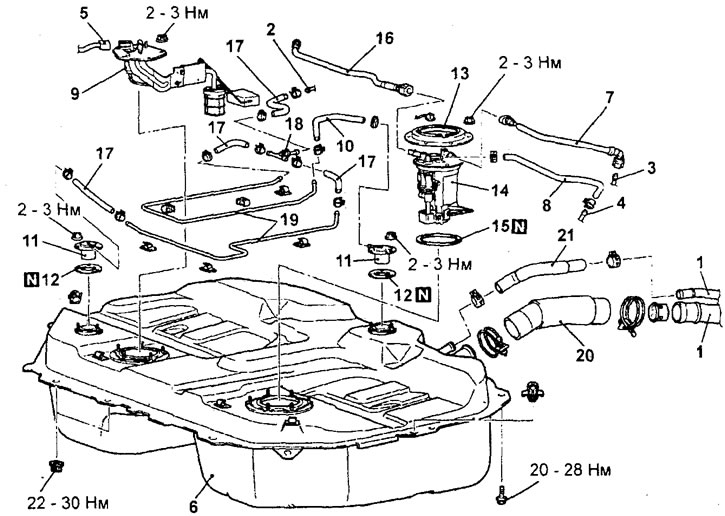
Removal the fuel tank (4WD models with 4G15 engine). 1 - Fuel tank drain pipe and filler neck connection, 2 - Evaporative emission system pipe connection, 3 - High-pressure fuel pipe connection, 4 - Fuel return pipe connection (disconnect the left parking brake cable retainer, the rear right wheel speed sensor wiring harness retainer and the sensor wiring harness connector), 5 - Wire harness connector, 6 - Fuel tank assembly, 7 - High-pressure fuel hose, 8 - Fuel return hose, 9 - Fuel level sensor, 10 - Evaporative emission system hose, 11 - Fuel shut-off valve, 12 - Gasket, 13 - Cover, 14 - Fuel pump assembly, 15 - Gasket, 16 - Fuel inlet hose, 17 - Evaporative emission system hose, 18 - Check valve, 19 - Pipe fuel vapor recovery system, 20 - fuel tank filler hose, 21 - drain hose.
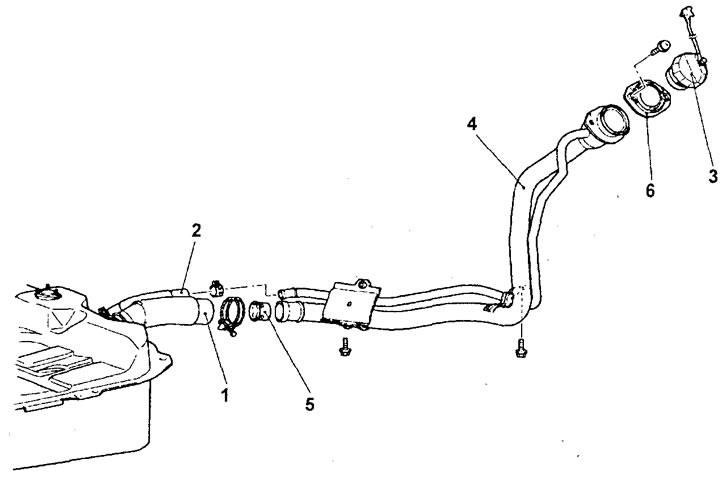
Removal the fuel tank filler neck.1 - filler hose connection, 2 - drain hose connection, 3 - fuel tank filler cap, 4 - fuel tank filler, 5 - fuel tank filler valve, 6 - seal.
When removing parts, pay attention to the following operations.
1. (4WD models) Removing the fuel tank assembly.
a) Disconnect the differential main gear pinion flange from the propeller shaft and also unscrew the differential mounting bracket bolts.
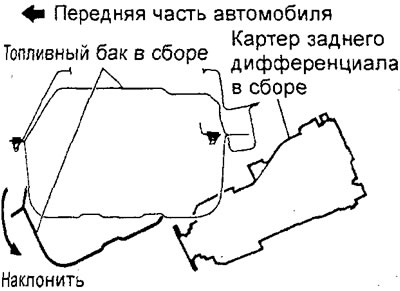
b) Loosen the rear differential housing support bracket mounting bolts and tilt the rear differential housing as shown in the figure.
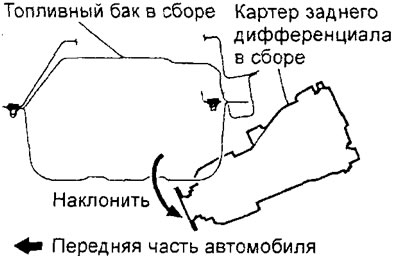
c) Support the fuel tank using the transmission telescopic stand and remove the fuel tank mounting bolts and nuts.
Caution: When performing this operation, do not allow the transmission telescopic strut to be disconnected from the fuel tank.
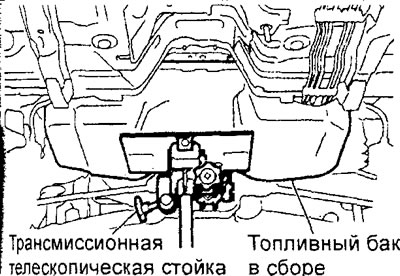
d) Tilt the fuel tank as shown in the figure and disconnect all connectors from the fuel tank.
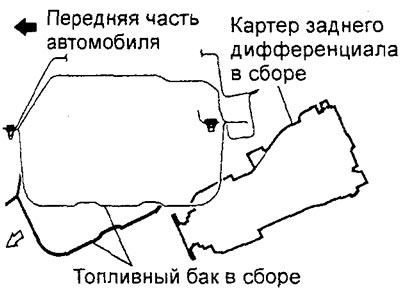
d) Remove the fuel tank assembly in the direction indicated by the arrow in the figure.
Caution: When removing the fuel tank, do not hit it against the rear differential housing.
2. Removing the fuel pump assembly and the fuel level sensor assembly.
Caution: Be careful not to damage the fuel pump assembly and fuel level sensor assembly when removing them from the fuel tank.
2. (2WD models) Disconnect the fuel tank wire harness connector.
Partially lower the fuel tank, then disconnect the wire harness connector.
Installation is carried out in the reverse order of removal.
When installing the parts, pay attention to the installation operation of the high-pressure fuel hose and the fuel inlet hose (4WD models with 4G15 engine only).
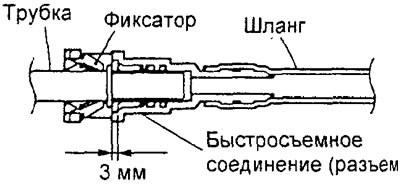
To connect the fuel hose, push the hose connector onto the pipe until the connector lock catches the pipe protrusion. Then pull the connector slightly in the direction of disconnection to ensure that the connection is secure. Check that the play in the connection does not exceed 3 mm.
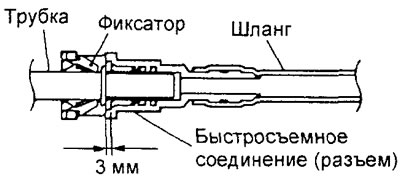
After completing the installation of the parts, perform the following operations:
- a) (4WD models) Install the driveshaft.
- b) Install the central pipe of the exhaust system.
- c) Fill the tank with fuel.
- d) Check the tightness of the fuel line connections.
Examination
1. Check the condition of the fuel tank filler cap.
2. Check the fuel hoses and pipes for cracks, kinks, deformation, abrasions or blockages. If there are signs of blockage or contamination of the fuel pipes located under the floor of the car, it is necessary to remove the corresponding section of pipes and blow it out with compressed air.
Caution: When replacing tubes, install only high-strength steel tubes, as copper and aluminum tubes cannot withstand the high pressure and vibrations that occur during vehicle operation.
3. Checking the fuel shut-off valve (on the fuel tank).
Note: The fuel shut-off valve is installed to prevent fuel from leaking from the tank in the event of an accident (vehicle overturning) into the fuel vapor discharge line.
a) Disconnect the fuel vapor recovery system hose and remove the fuel shut-off valve from the fuel tank.
b) The valve is considered to be in good working order if, when shaking the valve slightly up and down, the sound of a float moving inside (knocking) can be heard.
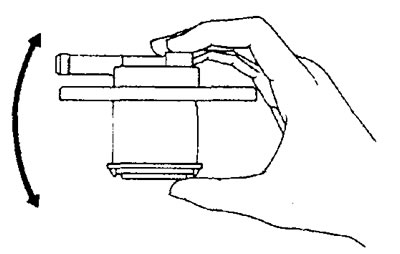
c) Turn over and slowly immerse the fuel shut-off valve in a container of water, blocking the valve nipple with your finger, as shown in the figure.
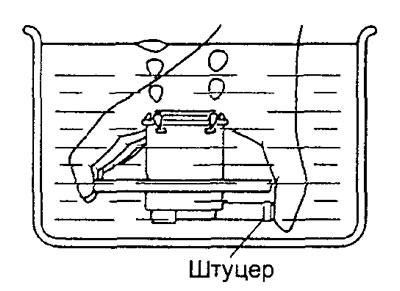
d) Check that the air has been removed from the valve by checking for any air bubbles that appear, then slowly remove the valve from the container.
d) The valve is considered to be in good working order if after opening the nipple there is no water leakage from the valve. If water leaks through the nipple, the valve is considered to be faulty. If faults are detected, replace: fuel shut-off valve.
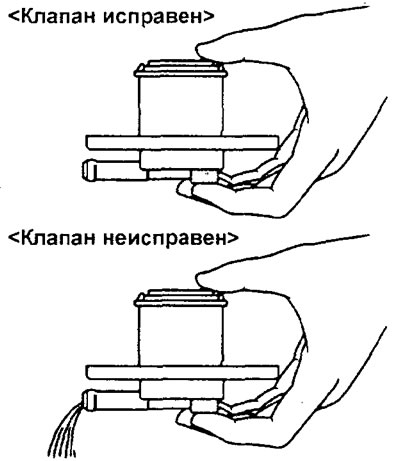
4. Checking the fuel tank.
a) Check the fuel tank for deformation, corrosion or cracks.
b) Check the fuel tank for dust or foreign particles inside.
Note: If the inside of the fuel tank needs cleaning, use kerosene, trichloroethylene or neutral detergent.
c) Check the fuel pump filter in the tank for damage or clogging.
Replacing the fuel level sensor
Note: On 4WD models with 4G15 engine, the fuel level sensor is additional (the main one is located on the fuel pump).
1. Remove the rear seat cushion.
2. Remove the service port cover using a flat-head screwdriver (or similar tool) as shown in the figure.
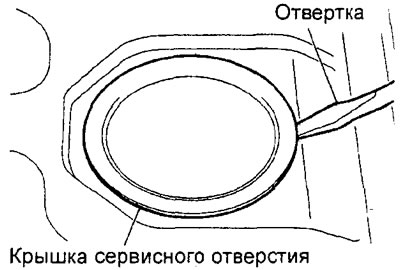
3. (Except 4WD models with 4G 15 engine) Disconnect the wire harness connector.
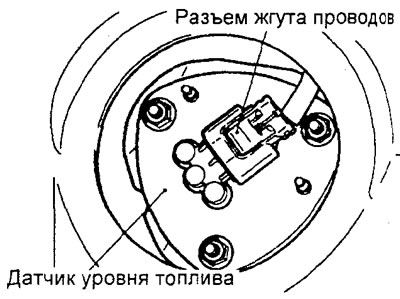
(4WD models with 4G15 engine) Disconnect the wire harness connector and fuel supply hose.
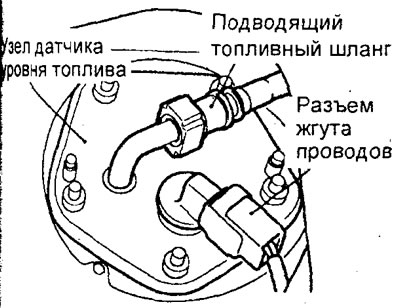
Unscrew the sensor mounting nuts and remove it from the fuel tank through the service hole.
Caution: Be careful when removing and installing the sensor, do not damage the sensor float and the sensor itself.
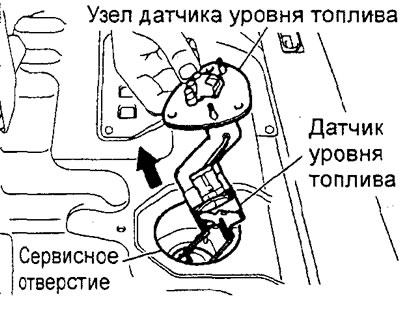
Except 4G15-4WD.
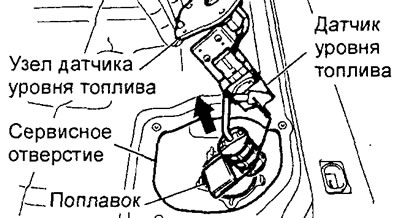
4G15-4WD.
6. Install the fuel level sensor assembly through the service hole and tighten the mounting nuts to the specified torque.
Tightening torque: 2.5 ±0.5 Nm
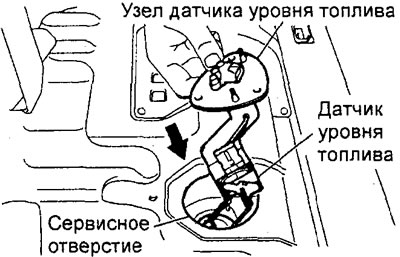
Except 4G15-4WD.
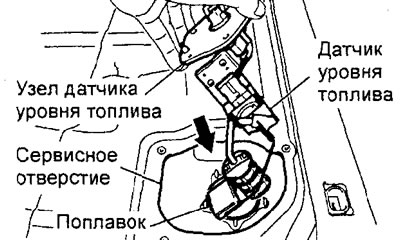
4G15-4WD.
7. (Except 4WD models with 4G15 engine) Connect the wire harness connector.
8. (4WD models with 4G15 engine) Connect the wire harness connector and fuel inlet hose.
Attention:
- To connect the fuel hose, push the hose connector onto the tube until the connector lock catches the tube's protrusion. Then pull the connector slightly in the direction of disconnection to ensure a secure connection.
- Check that the play in the connection does not exceed 3 mm.
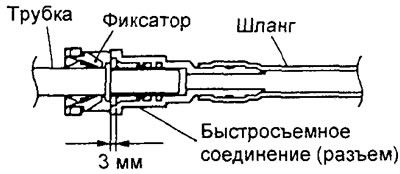
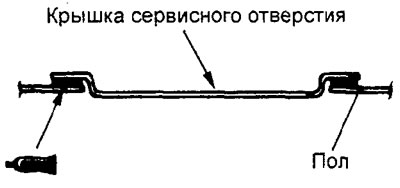
9. Apply sealant to the contact surfaces of the service hole cover and the floor panel, then install the cover.
Sealant Three bond 1521
10. Install the rear seat cushion.
Replacing the fuel pump
1. Remove the rear seat cushion.
2. Remove the service hole cover.
3. Disconnect the wiring harness connector and fuel hoses.
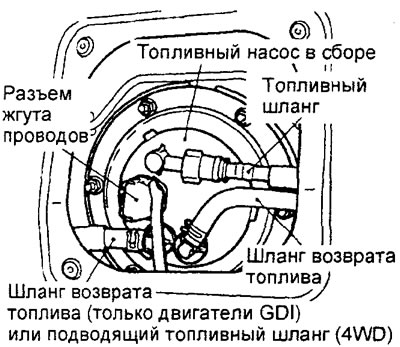
4. Unscrew the mounting nuts, remove the cover and the fuel pump assembly.
Caution: On 4WD models with 4G15 engine, be careful when removing the fuel pump assembly from the fuel tank, do not damage the fuel level sensor float (main) and the sensor itself.
5. Install the fuel pump assembly and cover, then tighten the mounting nuts to the specified torque.
Tightening torque 2 - 3 Nm
6. Connect the fuel hoses and wire harness connector.
Attention:
- To connect the fuel hose, push the hose connector onto the tube until the connector lock catches the tube's protrusion. Then pull the connector slightly in the direction of disconnection to ensure a secure connection.
- Check that the play in the connection does not exceed 3 mm.
7. Install the service hole cover.
8. Install the rear seat cushion.
Disassembly and assembly of the fuel pump
The parts are removed in the order of the numbers indicated in the figure "Disassembling the fuel pump unit".
Installation is carried out in the reverse order of removal.
When installing the parts, pay attention to the operation of installing the sealing sleeve.
Apply a small amount of fuel to the sealing grommet to prevent damage or twisting.
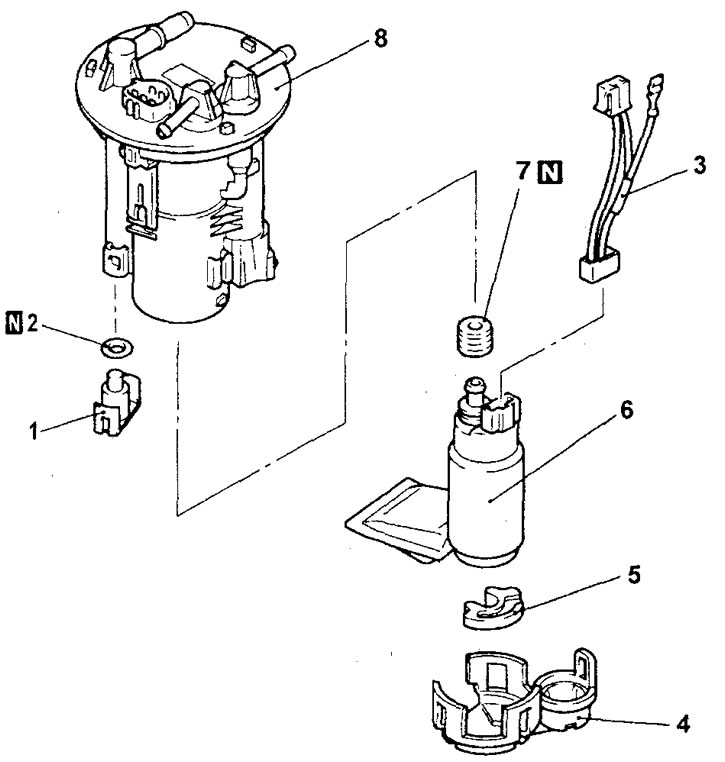
Disassembling the fuel pump unit (except for 4WD models with 4G15 engine).1 - cover, 2 - ring gasket, 3 - fuel pump wiring harness, 4 - bracket, 5 - buffer, 6 - fuel pump, 7 - sealing sleeve, 8 - fuel filter assembly.
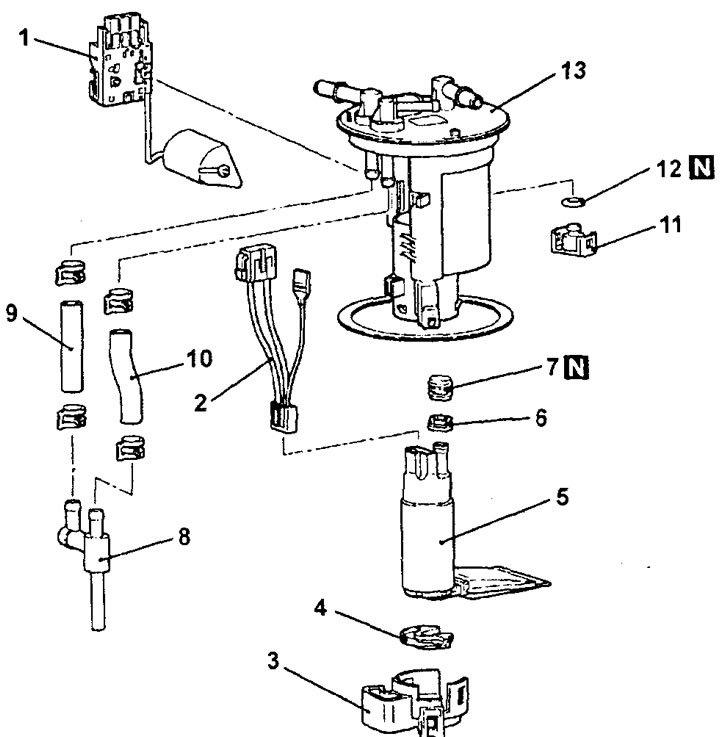
Disassembling the fuel pump unit (4WD models with 4G15 engine). 1 - fuel level sensor (main), 2 - fuel pump wire harness, 3 - bracket, 4 - buffer, 5 - fuel pump, 6 - spacer sleeve, 7 - sealing sleeve, 8 - booster pump, 9 - fuel hose (suction), 10 - fuel hose (return), 11 - cover, 12 - O-ring gasket, 13 - fuel filter assembly.