



Contents: Bleeding residual pressure from the…⤓ Checking the operation of the fuel…⤓ Cleaning the throttle body ⤓ Adjusting the position of the…⤓ Adjusting the base idle speed ⤓ Adjusting the throttle position…⤓ Adjusting the accelerator pedal cable ⤓ Checking fuel pressure ⤓ Table. Checking fuel pressure with…⤓
Bleeding residual pressure from the high-pressure fuel line
Note: Since the fuel line is under pressure, perform this operation before removing fuel system components (hoses, tubes, etc.) to relieve fuel pressure and prevent fuel splashing.
1. Remove the rear seat cushion.
2. Remove the service hole cover.
3. Disconnect the fuel pump wiring harness connector.
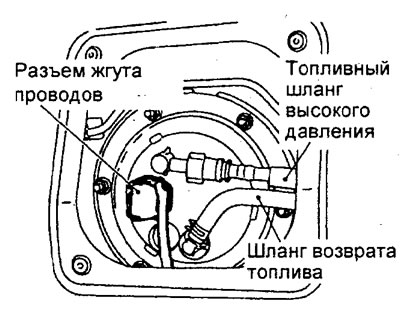
4. Start the engine and let it run until the remaining fuel is used up. After the engine stalls on its own, turn the ignition key to the "OFF" position.
5. Connect the fuel pump wire harness connector.
6. Install the service hole cover, then install the rear seat cushion.
Checking the operation of the fuel pump
1. Check the operation of the fuel pump by forcibly turning it on using a tester.
2. If the fuel pump does not work, then perform the specified check, if the pump is working properly, then check the pump power supply circuit.
a) Turn off the ignition.
b) Remove the rear seat cushion
c) Remove the service hole cover.
d) Disconnect the fuel pump wiring harness connector.
d) Connect the wires from the battery to the connector on the pump as shown in the figure.
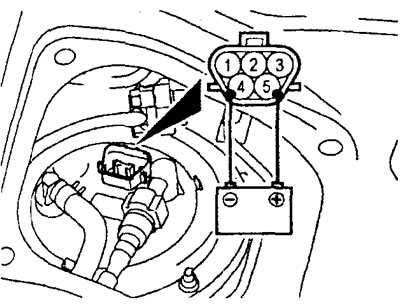
e) Check if the sound of the pump running can be heard.
Note: Since the pump is installed in the fuel tank, remove the fuel tank filler cap to ensure better audibility.
g) If the sound of the pump running is not heard, replace the pump.
h) Check for fuel pressure by lightly pinching the high-pressure fuel hose with your fingers.
i) Connect the fuel pump wire harness connector.
j) Install the service hole cover. Then install the rear seat cushion back in place (if removed).
Cleaning the throttle body
1. Start the engine, warm it up to a coolant temperature of 80°C or higher, and then turn off the engine.
2. Disconnect the air intake hose from the throttle body.
3. Apply the detergent cleaner to the cloth.
Cleaner - Three bond 6601
4. Using this cloth, clean the surface of the throttle valve.
Attention:
- Avoid allowing the cleaner to come into direct contact with the flap.
- Do not allow cleaner to enter the spare channel (on the idle speed control servo) or on the throttle position sensor through the shaft.
- Do not wash off the molybdenum coating applied around the throttle shaft.
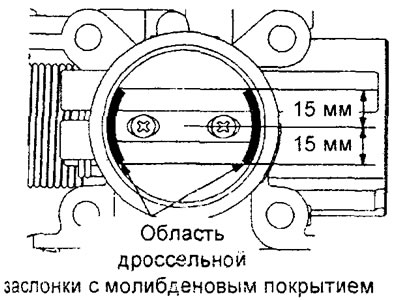
5. Connect the air intake hose to the throttle body.
6. Adjust the base idle speed (see the relevant section).
Adjusting the position of the factory adjustment screw
Note:
- - Do not touch the factory adjustment screw "Fixed SAS" on the throttle body unless absolutely necessary, the position of which is adjusted with high precision at the factory.
- - If the factory adjustment of the "Fixed SAS" screw has been accidentally disturbed, adjust it according to the procedure below.
1. Loosen the accelerator pedal cable.
2. Loosen the lock nut of the "Fixed SAS" factory adjustment screw.
3. Turn the factory "Fixed SAS" adjustment screw counterclockwise until the throttle valve is fully closed.
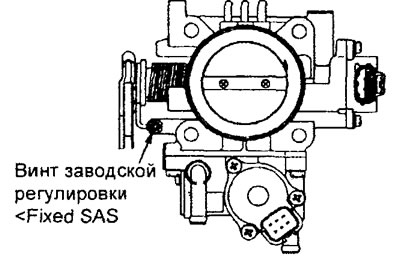
4. Turn the factory adjustment screw "Fixed SAS" until it touches the throttle lever (before the throttle valve starts to open). From this position, turn the screw another turn.
5. While holding the "Fixed SAS" factory adjustment screw from turning, tighten the lock nut securely.
6. Adjust the accelerator pedal cable.
7. Adjust the base idle speed.
8. Check that the output voltage of the throttle position sensor signal is within the standard value.
Adjusting the base idle speed
Attention:
- - The basic idle speed is adjusted at the factory by the idle speed adjustment screw (SAS). During operation, additional adjustment is usually not required.
- - If, by mistake, the factory adjustment has been violated (the position of the SAS screw has been changed), then the idle speed may become either too high or too low when an additional load is applied to the engine (for example, when the air conditioning compressor is turned on).
- If adjustment is still necessary, then before starting work, check the spark plugs, injectors, idle speed control servo drive, compression, etc.
1. Before starting the inspection and adjustment procedures, prepare the vehicle according to the following points.
a) The coolant temperature should be 80-95°C.
b) Lighting, electric fan and all additional equipment must be turned off.
c) Set the CVT or automatic transmission selector lever to position "P".
d) Set the steering wheel to the straight-ahead position.
2. Connect the tester to the diagnostic connector (when the ignition switch is in the "OFF" position).
Note: When the tester is connected, the control terminal of the diagnostic connector is connected to ground.
3. Start the engine and let it idle.
4. If the test is carried out using a tester, select item No.30 of the "ACTUATOR TEST" function of the tester (set the idle speed control servo drive to the base speed position).
5. Measure the engine crankshaft speed at idle.
Nominal value - 700±50 rpm
Note:
- - On a new car (with a mileage of no more than 500 km), the idle speed may be 20-100 rpm lower than the nominal speed, but adjustment is not required in this case.
- - If the engine stalls or the idle speed is too low on a car with a mileage of more than 500 km, then there is probably a deposit of foreign particles inside the throttle body (cleaning is necessary).
6. If the base idle speed differs from the nominal value, adjust it by turning the idle speed adjustment screw (SAS).
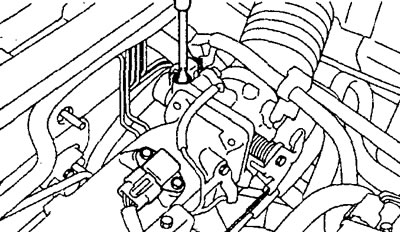
Engine 4G15.
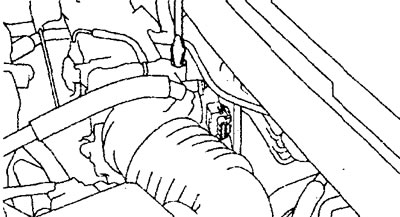
Engine 4G93.
7. Press the "Clear" button of the tester to complete the "ACTUATOR TEST" function of the tester (take the idle speed control servo out of the forced control mode).
Attention: if the "ACTUATOR TEST" function of the tester is not completed, the forced control mode of the device will be maintained for 27 minutes.
8. Turn off the ignition.
9. Disconnect the tester from the diagnostic connector.
10. Start the engine again and allow it to idle for about 10 minutes. Check that the crankshaft speed at idle is within the nominal value.
Adjusting the throttle position sensor
1. Connect the tester to the diagnostic connector (ignition off).
2. If the tester is not available, perform the following operations.
a) Disconnect the throttle position sensor connector.
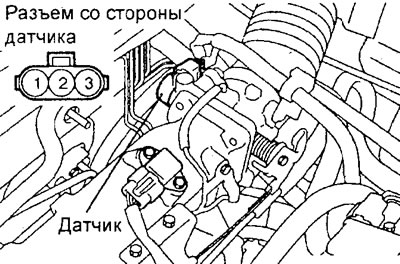
Engine 4G15.
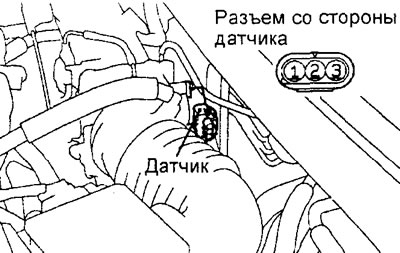
Engine 4G93.
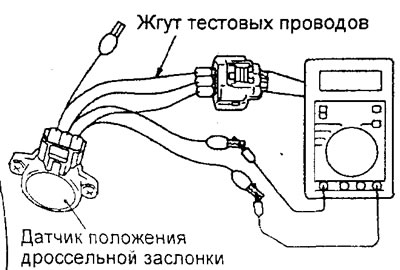
b) Connect the test lead harness between the sensor side connector and the harness side sensor connector.
c) Connect a digital voltmeter between terminal "3" (sensor signal: yellow clamp of the test lead harness) and terminal "1" (sensor ground: red clamp of the test lead harness) of the throttle position sensor connector.
3. Turn the ignition switch to the "ON" position (do not start the engine).
4. Check the output voltage of the throttle position sensor.
Nominal value - 0.335 - 0.935 V
5. If the output voltage does not match the nominal value, loosen the throttle position sensor mounting screws and, by turning the sensor body, adjust its position so that the sensor output voltage matches the nominal value. Then securely tighten the throttle position sensor mounting screws in this position.
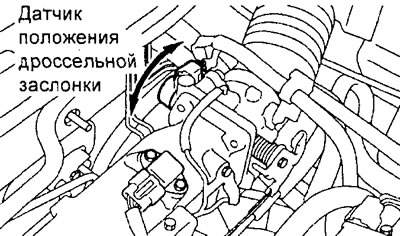
Engine 4G15.
6. Turn the ignition key to the "OFF" position.
7. Disconnect the tester. If the tester is not used, disconnect the test wire harness and reconnect the throttle position sensor connector.
8. If a diagnostic trouble code is displayed after turning the ignition on, clear it using a tester or by disconnecting the negative battery cable for at least 10 seconds. Reconnect the negative battery cable, start the engine and let it idle for at least 10 minutes.
Adjusting the accelerator pedal cable
1. Check the accelerator pedal cable sheath for damage and make sure there are no sharp bends in the cable.
2. Adjust the free play of the accelerator pedal cable when the accelerator pedal is released.
Nominal value - 1-2 mm
3. If the free travel of the accelerator pedal does not correspond to the nominal value or there is no free travel, adjust it.
a) Loosen the cable adjusting bolts on the intake manifold.
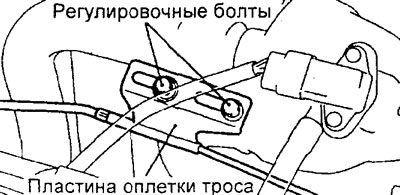
Engine 4G15.
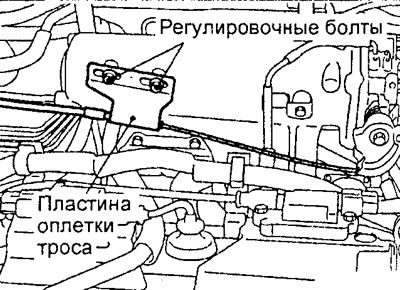
Engine 4G93.
b) By moving the cable sheath plate, set the free play of the cable in accordance with the nominal value.
c) Tighten the cable adjustment bolts to the specified torque.
Tightening torque: 4 - 6 Nm
Checking fuel pressure
1. Bleed residual fuel pressure from the high-pressure fuel lines (see the corresponding subsection).
2. Installing a pressure gauge or pressure sensors before taking measurements (from the high-pressure fuel supply hose side).
a) Disconnect the high pressure fuel slag from the fuel rail.
Caution: Due to residual pressure in the high-pressure fuel line, cover the connection point of the hose with the fuel rail with a rag to prevent fuel from splashing.
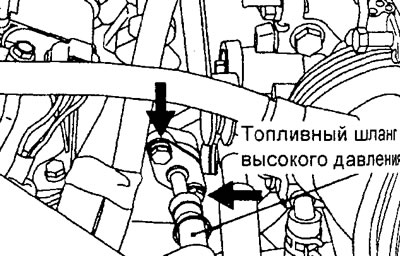
b) Prepare an adapter (tee) for connection to the fuel manifold.
c) Connect the adapter between the high pressure fuel hose and the fuel rail.
d) Install a pressure gauge or pressure sensor on the adapter. Be sure to install suitable O-rings to prevent fuel leaks.
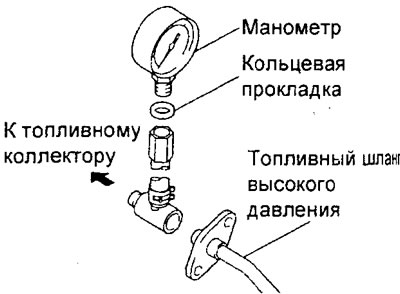
Checking pressure with a nanomometer.
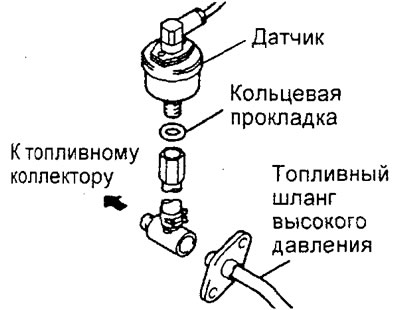
Checking pressure using a pressure sensor.
d) (Testing with pressure sensor) Connect the power wire of the pressure sensor to the power source (cigarette lighter), and the signal wire to the tester.
3. Check for leaks after installing the pressure gauge.
a) Connect the tester to the diagnostic connector.
b) Turn on the ignition. Do not start the engine.
c) Select sub-item #07 of the "ACTUATOR TEST" item of the tester and activate the fuel pump. Make sure there are no fuel leaks at the connection points of the pressure gauge and the elements of the special device.
d) Stop the fuel pump using a tester or turn the ignition switch to the "LOCK" or "OFF" position.
4. Measuring fuel pressure when the engine is running at base idle speed.
a) Start the engine and let it idle.
b) With the engine idling, measure the fuel pressure.
Nominal value (at base idle speed) - approx. 265 kPa
[The article is reprinted from a web resource: MitsubishiMan.ru]
5. Measuring fuel pressure with the fuel pressure regulator hose disconnected.
a) Disconnect the vacuum hose from the fuel pressure regulator and plug it with your finger.
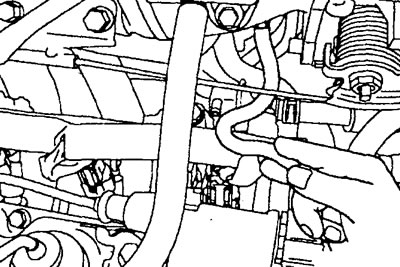
Engine 4G15.
Engine 4G93.
b) Measure the fuel pressure.
Nominal value (at base idle speed) - 324-334 kPa
c) Check that the fuel pressure does not drop at idle speed, even after pressing the accelerator pedal several times.
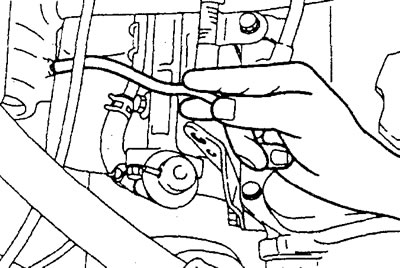
d) Press the accelerator pedal several times in a row, and lightly pinch the fuel return hose with your fingers. Check that you can feel fuel pressure in the hose.
Note: If the fuel flow is low, there will be no pressure felt in the fuel return hose.
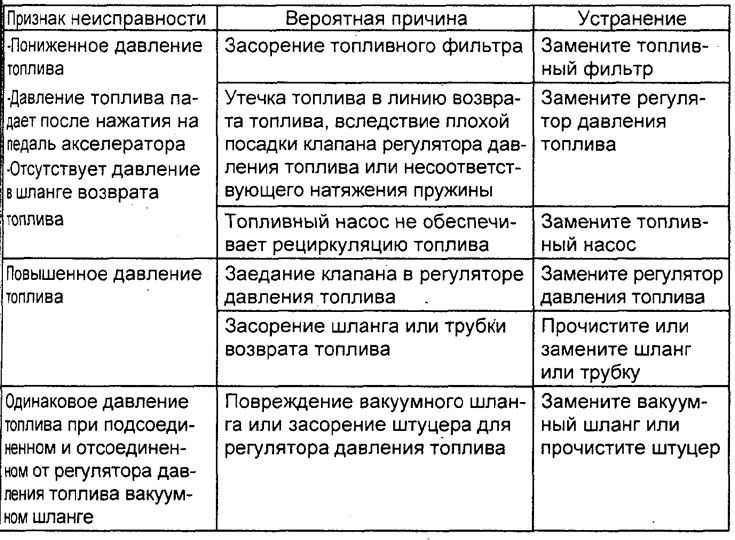
6. Evaluation of the results of fuel pressure measurements with the fuel pump on.
If any of the test results in the previous paragraph are not normal, then perform troubleshooting and troubleshooting in accordance with the table "Checking the fuel pressure with the pump on".
Table. Checking fuel pressure with the pump on.
7. Checking the drop in fuel pressure after turning off the fuel pump.
a) Turn off the engine (turn off the fuel pump) and check for changes in the pressure gauge or fuel pressure sensor readings. The fuel system is in good condition if the pressure in the fuel line does not drop within 2 minutes. If the pressure drops, determine the rate of pressure drop (gradually/instantly) and troubleshoot and eliminate them.
b) If the fuel pressure drops gradually after the engine has stopped, then either the injector is leaking or there are leaks through the fuel pressure regulator valve (the valve is not seated tightly). Replace the faulty element.
c) If the fuel pressure drops immediately after the engine stops, the check valve in the fuel pump remains open. Replace the fuel pump.
8. Removing the pressure gauge or sensor after completing the measurements.
a) Release residual pressure from the high-pressure fuel line.
b) Disconnect the special device assembled with the pressure gauge or pressure sensor from the fuel manifold.
Caution: Due to the presence of residual pressure in the high-pressure fuel line, cover the connection point of the special device with the fuel manifold with a rag to prevent fuel splashing.
c) Disconnect the high pressure fuel hose from the special tool.
d) Replace the O-ring on the high pressure hose tube flange with a new one.
Note: Apply engine oil to the new O-ring before installation.
d) Install the high pressure fuel hose pipe flange into the fuel rail and tighten the flange mounting bolts to the specified tightening torque.
Tightening torque: 7-11 Nm
9. Check for fuel leaks after removing the pressure gauge or sensor.
a) Connect the tester to the diagnostic connector.
b) Turn on the ignition. Do not start the engine.
c) Select sub-item #07 of the "ACTUATOR TEST" item of the tester and activate the fuel pump. Make sure there are no fuel leaks.
d) Stop the fuel pump.
d) Turn off the ignition and disconnect the tester.