Contents: Main relay of the injection system ⤓ Fuel pump relay ⤓ Intake manifold air temperature…⤓ Table. Nominal values. ⤓ Intake Air Temperature Sensor (4G93…⤓ Table. Nominal values. ⤓ Coolant temperature sensor ⤓ Table. Nominal values. ⤓ Throttle position sensor ⤓ Nozzles ⤓ Idle speed control servo ⤓
Caution: The procedures for checking the exhaust gas recirculation (EGR) solenoid valve and the canister purge solenoid valve are given in the relevant section of the chapter "Exhaust Emission Control System".
Main relay of the injection system
1. Make sure there is a closed circuit between terminals "2" and "3".
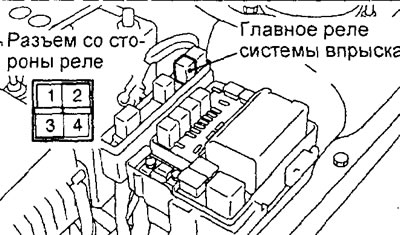
2. Make sure there is no short circuit between terminals "1" and "4".
3. Connect the negative battery cable to terminal "2" of the relay connector and the positive battery cable to terminal "3", then check that the circuit is closed between terminals "1" and "4" when power is supplied from the battery.
4. If faults are detected when checking the circuits according to points "2" - "3", replace the main relay of the injection system.
Fuel pump relay
1. Make sure there is a closed circuit between terminals "1" and "4".
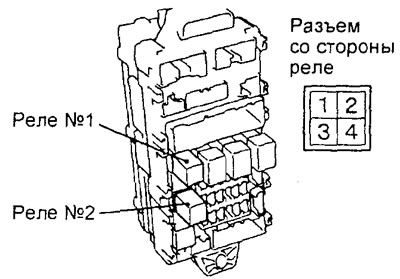
2. Make sure there is no short circuit between terminals "2" and "3".
3. Connect the negative battery cable to terminal "4" of the relay connector and the positive battery cable to terminal "1", then check that the circuit is closed between terminals "2" and "3" when power is supplied from the battery.
4. If faults are detected when checking the circuits in points "2" - "3", replace the fuel pump relay.
Intake manifold air temperature sensor (engine 4G 15)
Note: The intake manifold air temperature sensor is built into the manifold absolute pressure sensor, so the air temperature indicated by the sensor will differ from the ambient temperature depending on the engine condition.
1. Disconnect the intake manifold air temperature sensor connector.
2. Measure the resistance between connector terminals "1" and "3".
Table. Nominal values.
| Temperature | Resistance |
| -20°C | 13.0 -17.0 kOhm |
| 0°C | 5.3 - 6.7 kOhm |
| 20°C | 2.3 - 3.0 kOhm |
| 40°C | 1.0 -1.5 kOhm |
| 60°C | 0.56 - 0.76 kOhm |
| 80°C | 0.30 - 0.42 kOhm |
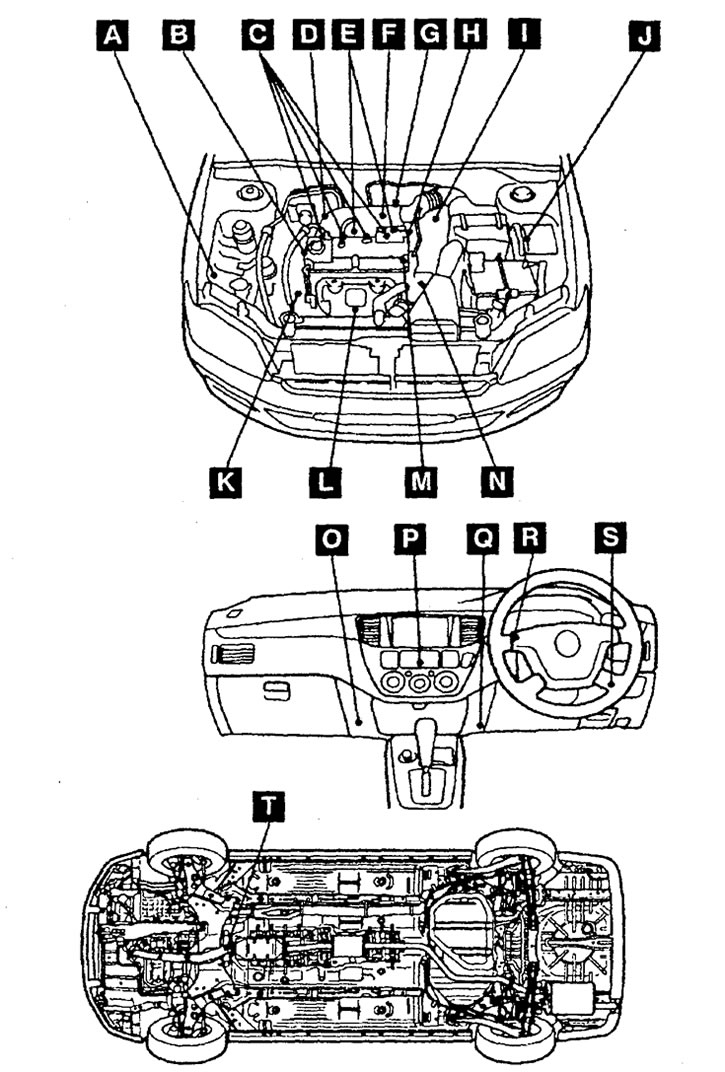
Location of fuel injection system components (4G15 engine). A - refrigerant pressure sensor (air conditioning with automatic control), B - power steering hydraulic fluid pressure switch, C - injectors, D - knock sensor, E - ignition coil (power transistor), F - manifold absolute pressure sensor (with built-in intake manifold air temperature sensor), G - throttle position sensor, H - idle speed control servo (stepper motor), I - start prohibition switch (on the gearbox), J - injection system main relay and air conditioning compressor electromagnetic clutch relay, K - crankshaft position sensor, L - oxygen sensor (front), M - camshaft position sensor, N - coolant temperature sensor, O - engine and variator electronic control unit, P - air conditioning switch, Q - diagnostic connector, R - "CHECK ENGINE" indicator, S - relays (No. 1 and No.2) fuel pump, T - oxygen sensor (rear).
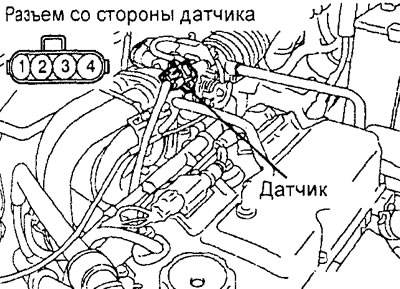
3. Remove the intake manifold air temperature sensor.
4. Measure the resistance by heating the sensor with a hair dryer. As the temperature increases, the resistance should decrease.
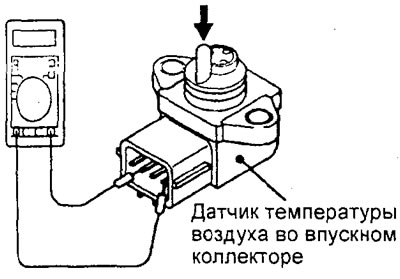
5. If the resistance does not correspond to the nominal value or does not change, replace the intake manifold air temperature sensor.
6. Install the air temperature sensor in the intake manifold, tighten the sensor mounting screws to the specified tightening torque.
Tightening torque: 4-6 Nm
Intake Air Temperature Sensor (4G93 Engine)
Note: The intake air temperature sensor is built into the MAF sensor, so the air temperature indicated by the sensor will differ from the ambient temperature depending on the engine condition.
1. Disconnect the mass air flow sensor connector.
2. Measure the resistance between connector terminals "5" and "6".
Table. Nominal values.
| Temperature | Resistance |
| -20°C | 13.0- 17.0 kOhm |
| 0°C | 5.3 - 6.7 kOhm |
| 20°C | 2.3 - 3.0 kOhm |
| 40°C | 1.0 - 1.5 kOhm |
| 60°C | 0.56 - 0.76 kOhm |
| 80°C | 0.30 - 0.42 kOhm |
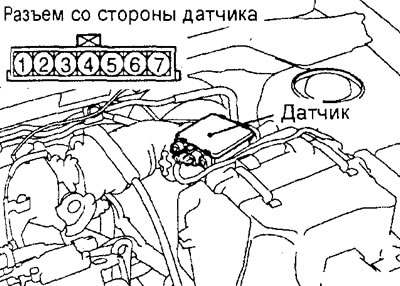
3. Measure the resistance by heating the sensor with a hair dryer. As the temperature increases, the resistance should decrease.
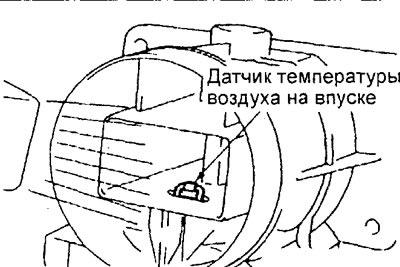
4. If the resistance does not correspond to the nominal value or does not change, replace the mass air flow sensor.
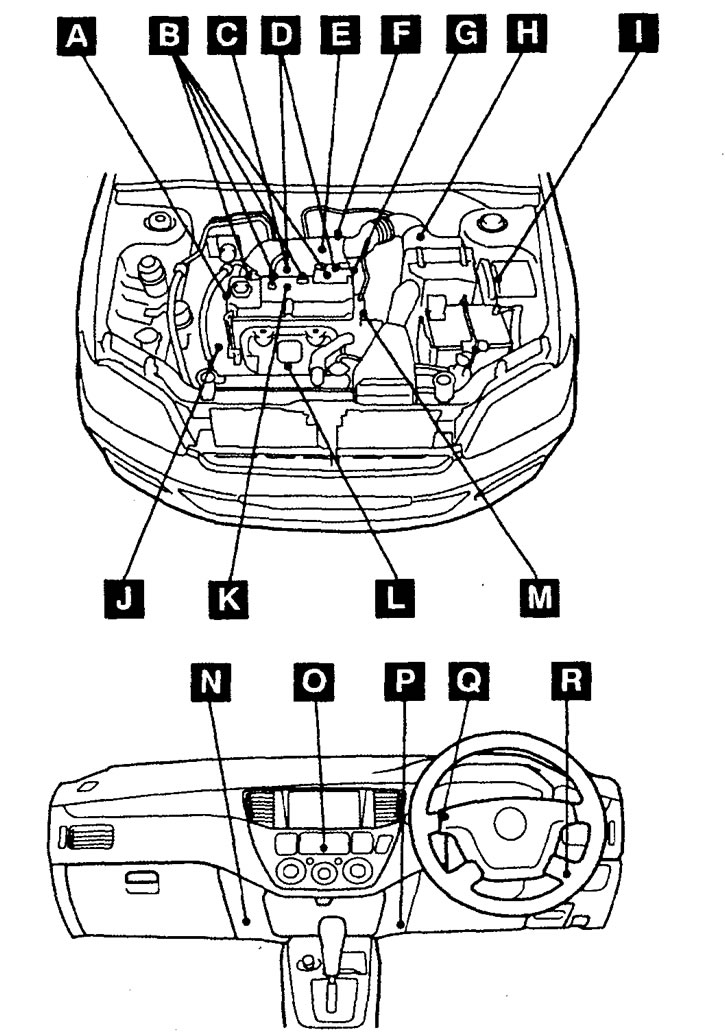
Location of fuel injection system components (4G93 engine). A - power steering hydraulic system fluid pressure switch, B - injectors, C - electromagnetic valve for evacuation of adsorber, D - ignition coil (power transistor), E - EGR valve servo drive, F - throttle position sensor, G - idle speed control servo drive (stepper motor), H - mass air flow sensor (with built-in intake air temperature sensor and barometric pressure sensor), I - main injection system relay, air conditioning compressor electromagnetic clutch relay and electric fan control relay, J - crankshaft position sensor, K - knock sensor, L - oxygen sensor, M - camshaft position sensor and coolant temperature sensor, N - engine and automatic transmission electronic control unit, O - air conditioning switch, P - diagnostic connector, Q - "CHECK ENGINE" indicator, R - fuel pump relay (No. 1 and №2).
Coolant temperature sensor
1. Remove the coolant temperature sensor.
Caution: When removing and installing the sensor, do not touch its connector (plastic part) with the tool.
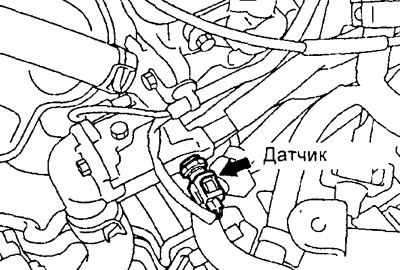
Engine 4G15.
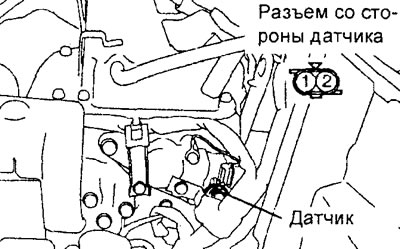
Engine 4G93.
2. Measure the resistance between the sensor terminals by immersing its sensitive element in heated water.
Table. Nominal values.
| Temperature | Resistance |
| -20°C | 14.00 - 17.00 kOhm |
| 0°C | 5.10 - 6.50 kOhm |
| 20°C | 2.10-2.70 kOhm |
| 40°C | 0.90 - 1.30 kOhm |
| 60°C | 0.48 - 0.68 kOhm |
| 80°C | 0.26 -0.36 kOhm |
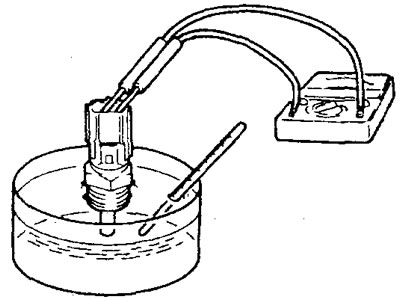
3. If the measured resistance differs significantly from the nominal value, replace the engine coolant temperature sensor.
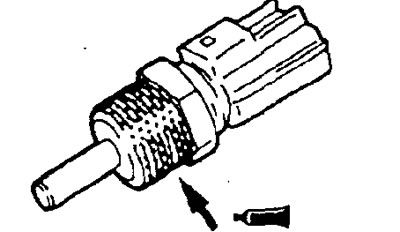
4. Install the engine coolant temperature sensor, applying sealant to the sensor threads. Tighten the sensor to the specified tightening torque.
Sealant - ЗМ NUT Locking Part # 4171 or equivalent
Tightening torque: 19 - 39 Nm
Throttle position sensor
1. Disconnect the throttle position sensor connector.
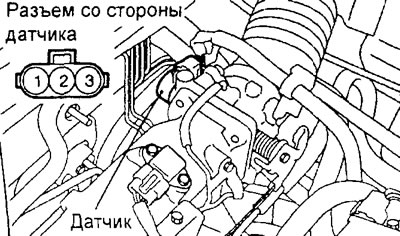
Engine 4G15.
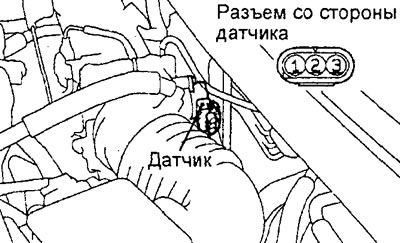
Engine 4G93.
2. Measure the resistance between terminals "2" and "3" of the sensor connector.
Nominal resistance:
- Engine 4G15 - 3.5-6.5 kOhm
- Engine 4G93 - 2.0 - 4.0 kOhm
3. Measure the resistance between the indicated terminals of the sensor connector while slowly opening the throttle valve from the fully closed position (idle) to the fully open position.
Sensor connector pins:
- Engine 4G15 - "1" and "3"
- Engine 4G93 - "1" and "2"
4. The resistance should change smoothly in proportion to the throttle opening angle. If the resistance differs from the nominal value or does not change smoothly, replace the throttle position sensor.
Note: After replacing the sensor, it is necessary to adjust it.
5. Connect the throttle position sensor connector.
Oxygen sensor
Note:
- - Two oxygen sensors were installed on the 4G15 engine: front (located on the exhaust manifold) and rear (located in front of the main catalytic converter).
- - Only one oxygen sensor (front) was installed on the 4G93 engine.
1. Disconnect the oxygen sensor connector and connect the test lead harness.
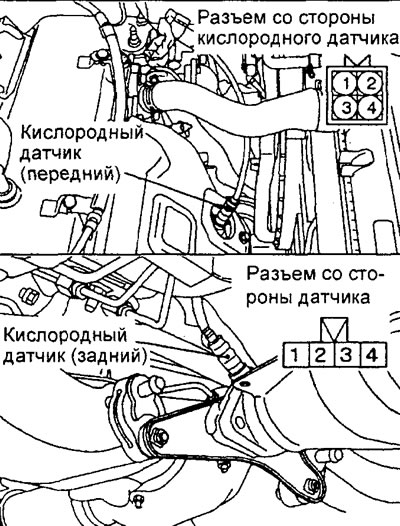
Engine 4G15.
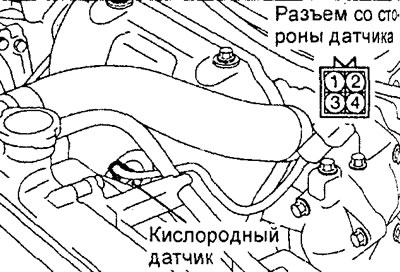
Engine 4G93.
2. Measure the resistance between terminals "1" (red clamp of the test lead harness for the front sensor) and "3" (blue clamp of the test lead harness for the front sensor) of the oxygen sensor connector.
Nominal value (at 20°C) - 4.5 - 8.0 Ohm
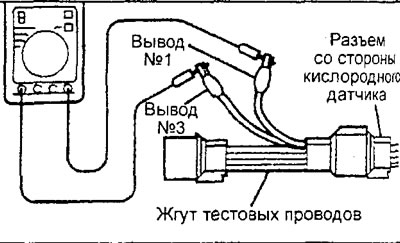
Front oxygen sensor.
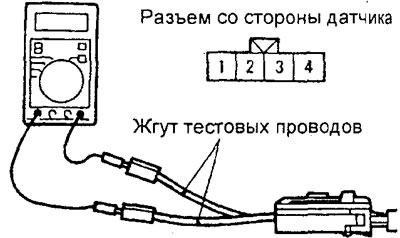
Rear oxygen sensor.
3. If the circuit is open, replace the oxygen sensor.
(The article was taken from the website: mitsubishiman)
4. Warm up the engine (coolant temperature over 80°C).
5. Apply battery voltage to the terminals of the oxygen sensor connector by connecting the positive battery terminal wire to terminal "1" and the negative battery terminal wire to terminal "3".
Caution: Do not reverse the polarity, incorrect connection of the wires may damage the oxygen sensor.
6. Connect a digital voltmeter to terminal "2" (the black clamp on the front sensor test lead harness) and to terminal "4" (the white clamp on the front sensor test lead harness).
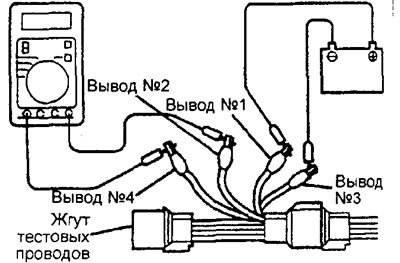
Front oxygen sensor.
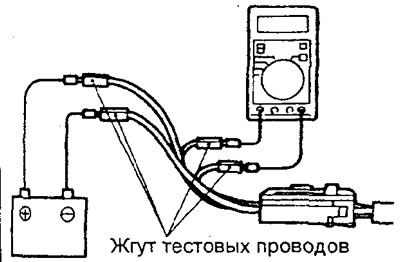
Rear oxygen sensor.
7. Periodically pressing the accelerator pedal, measure the output voltage of the oxygen sensor. When the air-fuel mixture is slightly enriched with an increase in engine speed (acceleration), a serviceable oxygen sensor should output a voltage of 0.6 -1.0 V.
8. If there are any defects, replace the oxygen sensor.
9. Disconnect the test lead harness and connect the connector to the sensor.
Nozzles
1. Checking the sound of the injector operating.
a) Using a phonendoscope, check the operation of the injector (the presence of characteristic creaking sounds) when the engine is idling or when the engine crankshaft is turned by the starter.
b) Check that as the engine crankshaft speed increases, the injector firing frequency also increases.
Note: Please note that even if the injector being tested does not work, sounds from the other injectors will be heard.
Note: If the sound of the injector being tested is not heard, check the injector power supply circuit. If the circuits are normal, check the injector or the electronic engine control unit for a malfunction.
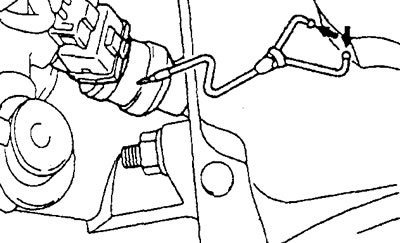
Engine 4G93.
2. Checking the resistance of the injector solenoid valve winding.
a) Disconnect the connector of the injector being tested.
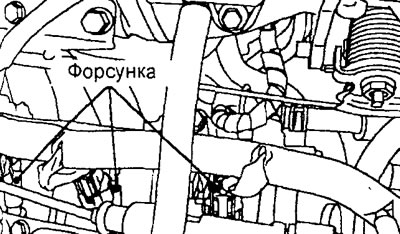
Engine 4G15.
b) Measure the resistance between the terminals of the injector connector.
Nominal value (at 20°C) - 13-16 Ohm
c) Connect the injector connector.
3. Checking the spray pattern and nozzle tightness.
a) Release residual pressure from the high-pressure fuel line to prevent fuel splashing.
b) Remove the injector.
c) Install the special device (injector testing kit), adapter, fuel pressure regulator, special clamps and injector.
d) Connect the tester to the standard diagnostic connector.
d) Turn the ignition key to the "ON" position (do not start the engine).
e) Select sub-item No.07 of the "ACTUATOR TEST" item of the tester and activate the fuel pump.
g) Apply power to the injector and check the quality of fuel atomization. The injector condition is satisfactory if the fuel atomization torch has a uniform structure without visible fuel drops.
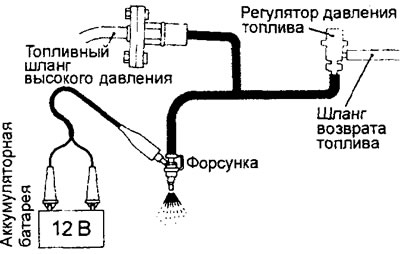
h) Disconnect the power supply from the injector and check the tightness (spray nozzle and shut-off needle) of the injector.
Nominal value is 1 drop or less per minute
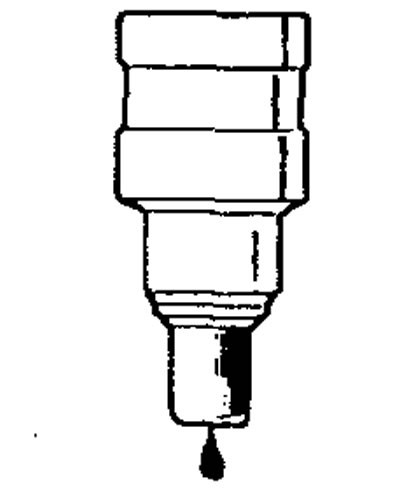
i) Apply power to the injector without turning on the fuel pump. Then, after fuel stops coming out of the injector, disconnect the special tool and reset the injector.
c) Disconnect the tester.
Idle speed control servo
Checking the trigger sound
1. Make sure that the coolant temperature is not higher than 20°C.
Note: It is also permissible to disconnect the coolant temperature sensor connector and connect another coolant temperature sensor with a temperature of 20°C to the connector on the wiring harness side.
2. Check if the sound of the stepper motor running can be heard after turning on the ignition (do not start the engine).
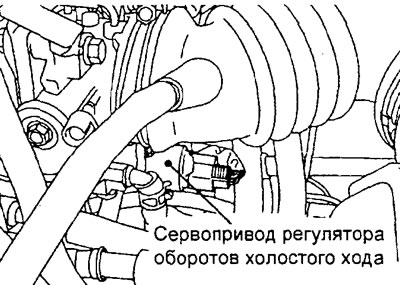
Engine 4G15.
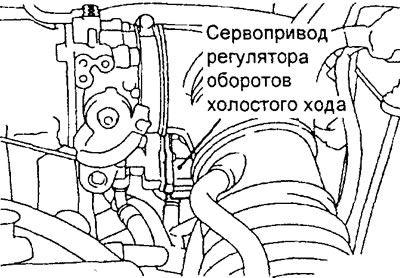
Engine 4G93.
3. If the stepper motor operation sound is not heard, then check the circuits that supply the idle speed control servo drive. If the circuit is normal, then the fault is in the servo drive or the electronic engine control unit.
Checking the resistance of windings
1. Disconnect the idle speed control servo connector.
2. Measure the resistance between terminal "2" and terminal "1" or "3" of the connector on the servo side.
Nominal resistance (at 20°C) - 28 - 33 Ohm
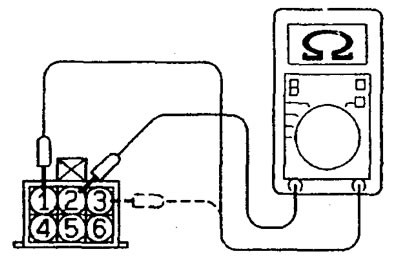
3. Measure the resistance between terminal "5" and terminal "6" and "4".
Nominal resistance (at 20°C) - 28-33 Ohm
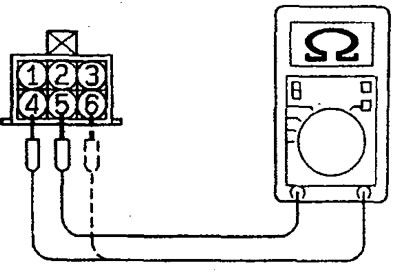
Checking the operation of the servo drive
1. Remove the throttle body.
2. Remove the idle speed control servo.
3. Connect the test lead harness to the servo.
4. Apply approximately 6V to the white "5" and green "2" terminals of the test lead harness.
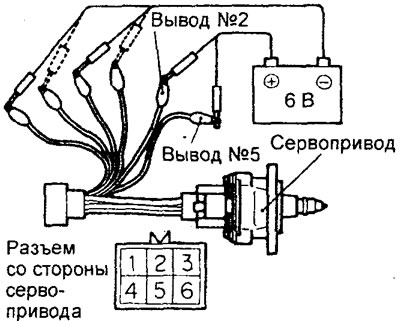
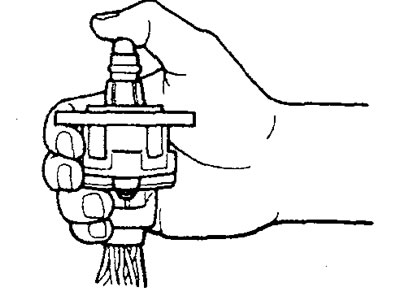
5. Install the servo as shown in the figure and connect the negative wire of the 6V power supply to each of the listed terminals in the order shown below, while checking whether a slight vibration can be felt from the stepper motor when it is running.
a) To the red and black terminals (terminals "1" and "4");
b) To the blue and black terminals (terminals "3" and "4");
c) To the blue and yellow terminals (terminals "3" and "6");
d) To the red and yellow terminals (terminals "1" and "6");
d) To the red and black terminals (terminals "1" and "4");
e) Repeat the check in reverse order from point "d" to point "a".
6. If, as a result of these checks, a slight vibration of the operating servo drive is felt, then it is considered to be in good working order.