



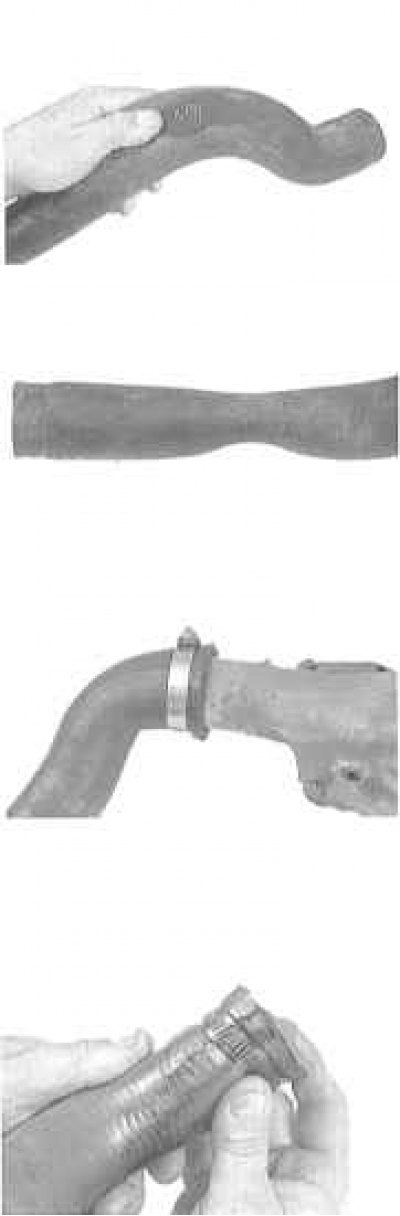
Examples of typical defects of radiator hoses
1 - Check the hoses for frayed areas.
2 - Softening of rubber indicates the beginning of its destruction as a result of aging.
3 - Tightening the clamp too tightly in order to more securely fix it on the nipple/nipple of a hardened hose does not help stop the leak, but only leads to the destruction of the hose material.
4 - Check all hoses for bulges and signs of oil seepage at the ends. Cracks and small breaks in the rubber are easier to detect when squeezing the hose.
1. A wide range of engine failures are associated with a malfunction of the cooling system. On models equipped with AT, this system also provides ATF cooling, thereby maintaining the most favorable conditions for transmission operation.
2. Checking the condition of the cooling system components should be carried out after the power unit has completely cooled down (at least three hours after the engine has stopped).
Caution! Never remove the radiator filler cap when the engine is hot!
3. Remove the cap from the radiator or expansion tank by first turning it to the left until it stops. If you hear a hissing sound, indicating excess pressure in the system, wait until it stops, then press the cap down with your palm and continue turning it to the left until it is completely released. Thoroughly rinse the cap inside and out with clean water. Wipe the radiator filler neck. All traces of corrosion must be completely removed from the surfaces being cleaned. The coolant in the system should be relatively transparent. If the liquid is rust-colored, the system must be flushed and filled with a fresh mixture (see Section Cooling system maintenance). If the fluid level does not reach the top, add a little more of the mixture of the required composition to the radiator/reservoir.
4. Carefully inspect the upper and lower radiator hoses, as well as the smaller diameter cabin heating hoses located between the power unit and the engine compartment bulkhead. Check the hoses along their entire length and replace any defective components if cracks, bulges or signs of material aging are detected. Small cracks are usually easier to see when squeezing the hose. Regardless of their condition, the hoses should be replaced approximately every two years.
5. Check that all hoses are securely fastened to their fittings/pipes. Coolant leaks usually appear as rusty or white streaks on the surfaces surrounding their source. If the hoses are secured to the fittings/pipes with twist-type clamps, it would be wise to replace them with more reliable worm or screw-type clamps.
6. Using compressed air or a soft brush, remove old leaves, insect remains and other debris from the gaps between the radiator heat exchanger plates. Try not to damage the soft heat exchanger plates or cut your fingers on their sharp edges.
7. Every other check, and also at the first signs of a malfunction of the cooling system, perform a pressure test of the radiator cap (see below). If you do not have the appropriate equipment at hand, contact a service station for assistance.
8. After removing the cap from the radiator or expansion tank, use the appropriate adapter to connect a hand pump equipped with a pressure gauge to the system.
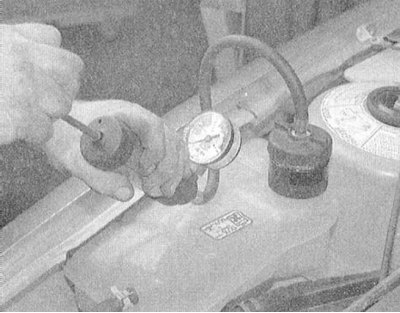
9. Using the pump handle, increase the pressure in the system to the maximum value indicated on the pressure gauge connected to the pump.
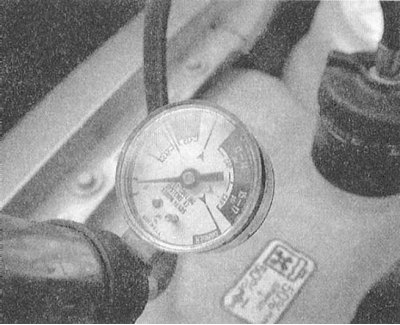
10. Observe the pressure gauge readings for some time - if the pressure in the system drops, then there is a leak. The source of the leak is identified during a repeated thorough inspection of all components of the cooling tract (pump up the pressure again).
11. If the source of the leak cannot be identified during a visual inspection, increase the pressure to the maximum again and leave the system under pressure for some time. After about 30 minutes, check the pressure gauge reading - if it has dropped by less than 20%, the system condition can be considered satisfactory, otherwise you should seek help from car service specialists.
12. Another cause of coolant loss is its internal leaks. Such leaks are usually associated with a breach in the tightness of the cylinder head gaskets or the appearance of cracks in the block body and lead to the coolant entering the engine oil and combustion chambers of the engine. The oil then begins to emulsify, taking on a milky consistency, and the exhaust smoke at the moment of engine start-up turns out to be saturated with water vapor, giving it a thick white color. Another sign of internal coolant leaks is the formation of a greenish or white coating on the spark plug electrodes - by inspecting the spark plugs one by one, you can identify the cylinder that is leaking.
(The article is reprinted from this source mitsubishiman.ru)