
Troubleshooting
Note:
- CVT failures can be caused by improper maintenance, improper adjustment or failure of the CVT electronic control system, mechanical failure, failure of the CVT hydraulic control system, insufficient engine power, or a combination of these failures. Therefore, before starting the test, it is necessary to determine the area of \u200b\u200bthe malfunction (engine, control system or gearbox).
- Troubleshooting should start with the simplest operations and proceed in order of increasing complexity.
1. Check for signs of CVT failure and the conditions under which they occur.
2. Read diagnostic trouble codes. Write down the trouble codes, and clear the codes from the memory of the electronic control unit for the engine and variator.
3. Perform basic checks and adjustments (checking tire pressure, checking the level and condition of the working fluid in the variator, checking the variator control mechanism, etc.), for which the deviation from the norm can be easily determined.
Note: analysis of the results of checking the level of the working fluid:
- If the working fluid level in the variator is lower than normal, the working fluid pump will entrain the working fluid along with air, which will lead to various malfunctions. Air bubbles that have entered the hydraulic system of the variator cause foaming of the working fluid.
- If the hydraulic fluid level is higher than normal, excessive foaming of the fluid will occur, resulting in the same consequences as a low fluid level, and will cause premature deterioration of the fluid.
- In both cases, air bubbles cause overheating, oxidation of the working fluid and varnish deposits that damage valves, couplings and actuators. Foaming also causes fluid to be expelled through the crankcase breather, which is mistaken for leaks.
4. Carry out a road test to determine if further CVT diagnostics are needed.
A) Check for proper gear shifting. If the gear shift is correct, check the electrical part of the control system.
b) Make sure the problem is only with the variator. If noise or vibration is present, possible sources may be the compressor, engine, cardan shaft, etc.
5. Read diagnostic trouble codes (re).
A) If fault codes are displayed when a symptom of a malfunction is present or fault codes have been displayed before (but no fault codes after road test), then see subsection "Troubleshooting by Diagnostic Codes".
b) If there are no fault codes (before and after road test), but there is a symptom of a malfunction, then see subsection "Troubleshooting by their symptoms".
6. If a possible cause is a malfunction in the CVT electronic control system, then use a tester or oscilloscope to check the input and output signals of the CVT electronic control unit.
A) If there are incorrect input and output signals of the CVT electronic control unit, then check the wiring according to the appropriate wiring diagram.
b) If no fault is found when checking the wiring, then check the individual components of the system.
7. If the signals of the electronic control system are normal or if a malfunction in the hydraulic control system of the variator is a possible cause, then check the pressure in the hydraulic control system of the variator. If the condition of the hydraulic system is not normal, carry out the appropriate checks and adjustments (see section "Checking the CVT control system").
8. If the pressure in the CVT control hydraulic system is normal or if a malfunction in the main CVT system is a possible cause (mechanical part), check the engine and torque converter with the vehicle at a complete standstill, identify the faulty part, and make any necessary repairs.
9. After completing the repair, perform a road test to verify that the problem has been corrected.
Reading Diagnostic Trouble Codes
Note: Use the table to identify fault codes "Codes of malfunctions of a control system of a variator".
1. Prepare the vehicle for inspection as follows.
A) Make sure the battery is in good condition, as fault detection is not possible when the battery voltage is low.
b) Turn off all additional equipment.
V) Set the variator selector to position "N".
Attention: do not disconnect the battery until the diagnostic results are completely read, as the fault code will be deleted from the memory of the electronic control unit when the battery or the connector of the electronic control unit is disconnected.
Table. Codes of malfunctions of a control system of a variator.
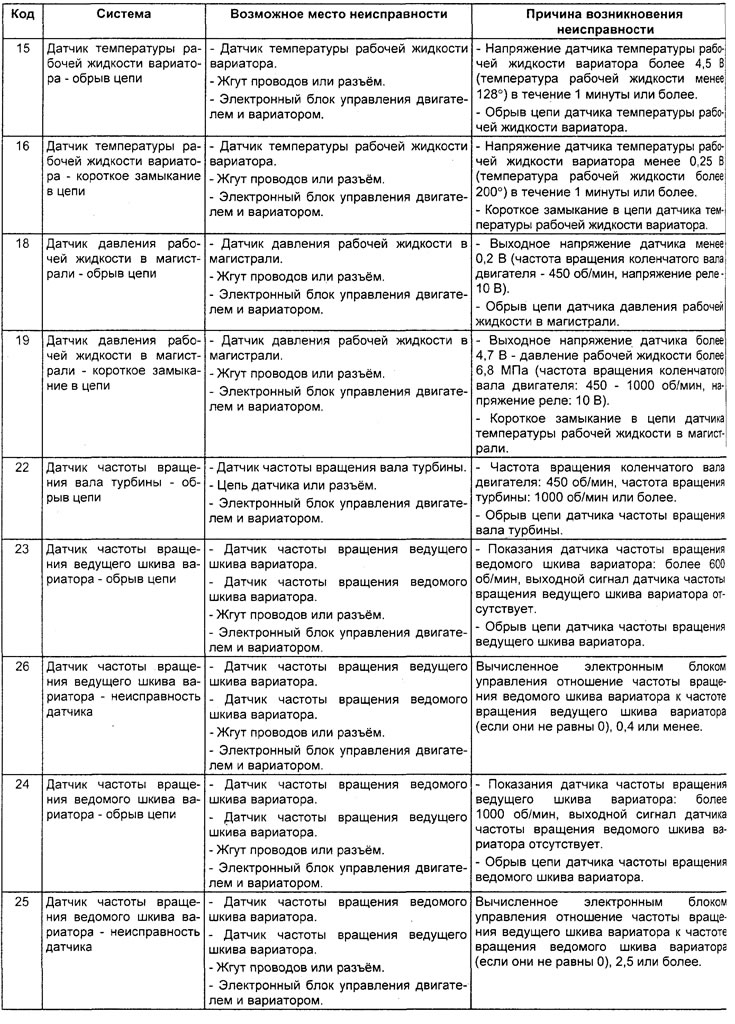
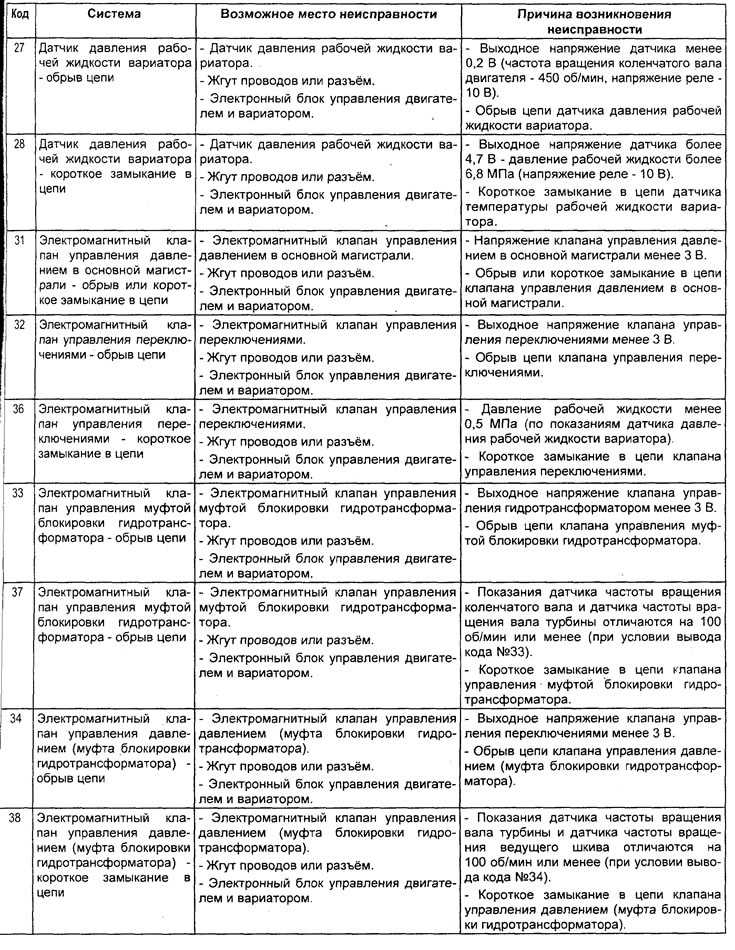
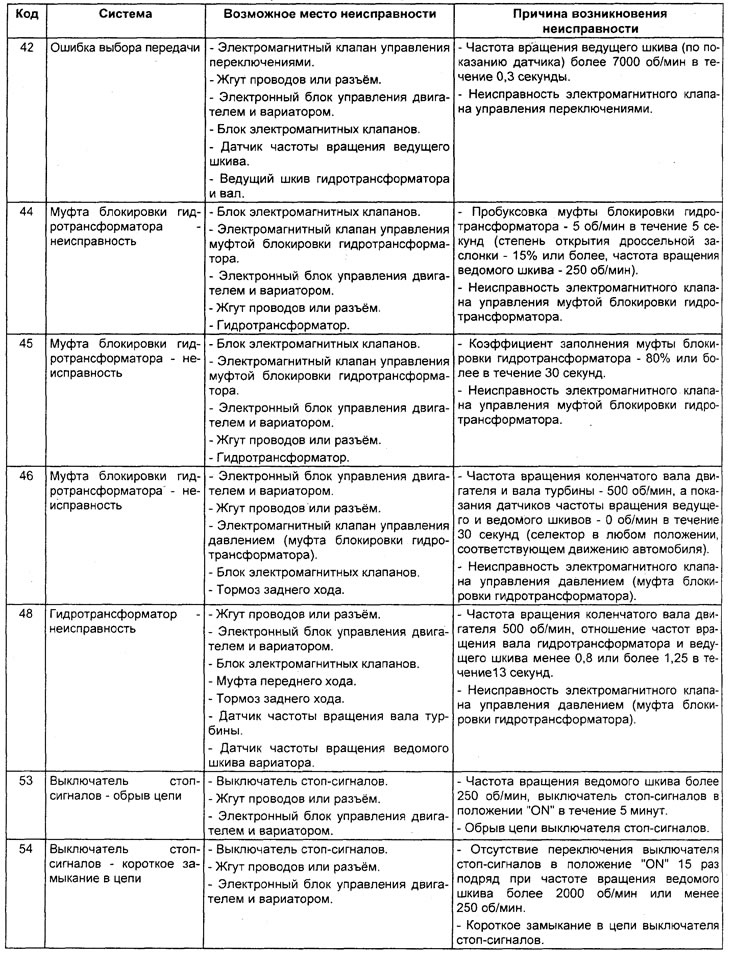
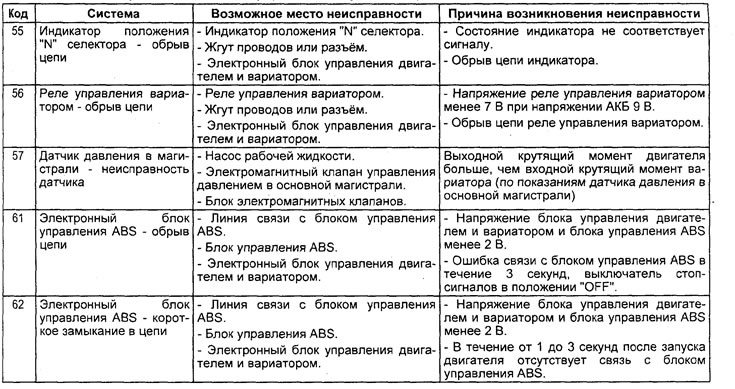
2. Turn the ignition key to the position "OFF" (OFF).
3. When checking with a tester:
A) Connect the tester to the diagnostic connector under the instrument panel.
Attention: when connecting or disconnecting the tester "ignition" should be off (ignition key in position "OFF" (OFF)).
b) Turn on the ignition and select the test mode of the variator control system on the tester.
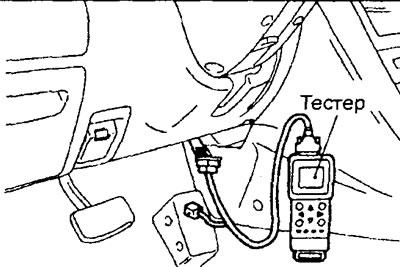
4. Reading codes without using a tester (using the range indicator "N").
A) To connect with "weight" use the special tool.
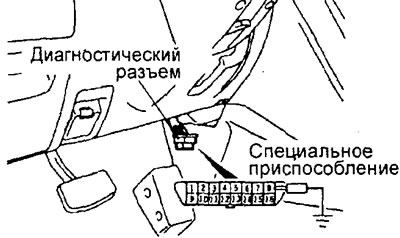
b) Turn the ignition on and read the trouble codes while observing the number of blinks of the range indicator "N" on the instrument cluster.
Note:
- The fault code consists of two digits, the first digit is determined by the initial series of flashes, then after a pause of 2 seconds, a second series of flashes follows, which corresponds to the second digit of the code.
- If there are two or more fault codes, the smallest code will be displayed first, and then the rest in ascending order. There will be a 3 second pause between codes.
- The figure shows an example of the output of codes "13" And "33".
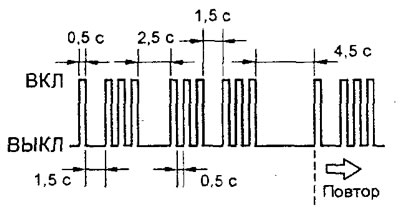
V) If there is no fault, the indicator will flash at intervals of 0.5 seconds (normal state code).
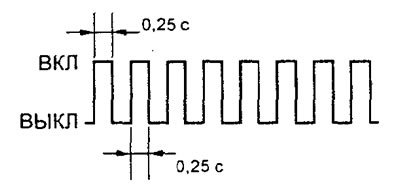
5. After completing the test, turn the ignition key to the position "OFF" (OFF) and then disconnect the tester or special tools from the diagnostic connector.
Clearing Diagnostic Trouble Codes
1. Turn the ignition key to position "OFF" (OFF).
2. If a tester is used, then connect it to the diagnostic socket and erase the codes.
3. If the tester is not being used, disconnect the cable from the negative battery terminal for 10 seconds or more.
Attention: after disconnecting the wire from the negative terminal of the battery, the contents of the memory of electronic control units of other systems will be lost.
4. After the engine has warmed up, let it idle for at least 15 minutes.
Explanations on the operation of the self-diagnosis system
1. CVT status indication with range indicator "N".
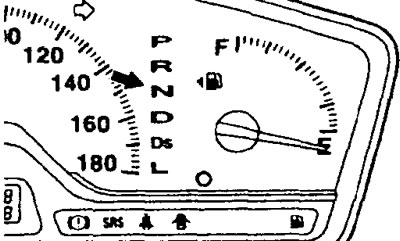
A) If the range indicator "N" (indicated by an arrow) on the instrument cluster flashes at a frequency of 1 time per second (1 Hz), this means that the self-diagnosis system has detected a malfunction of the variator drive pulley speed sensor, the variator driven pulley speed sensor, any solenoid valve, fluid pressure and temperature sensors or relay and the system is operating in emergency mode.
Models without manual shift mode.

Table. Checking the voltage at the terminals of the electronic control unit for the engine and the variator.
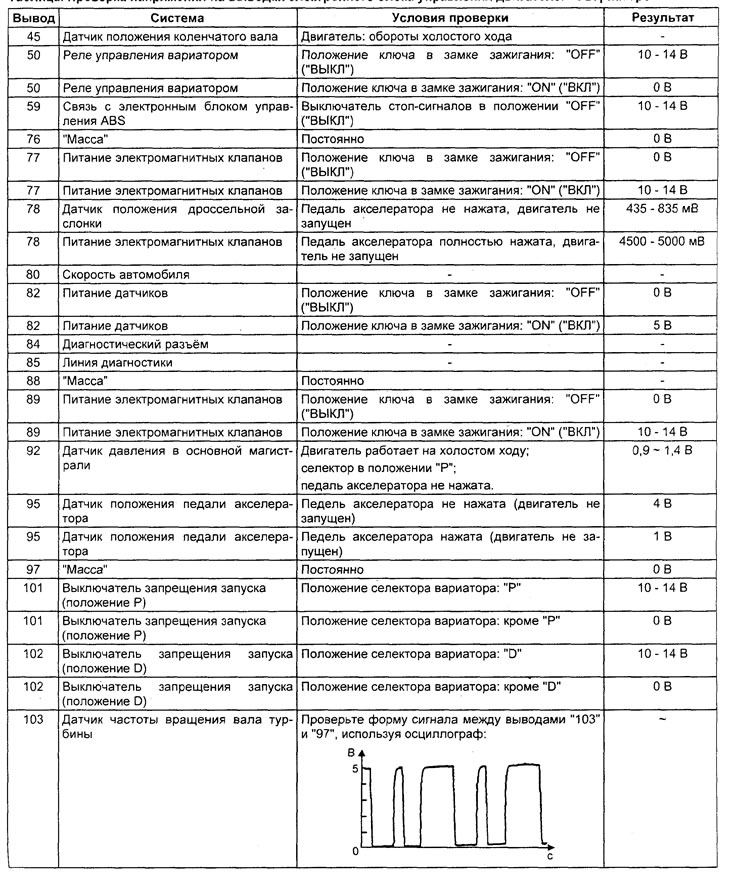
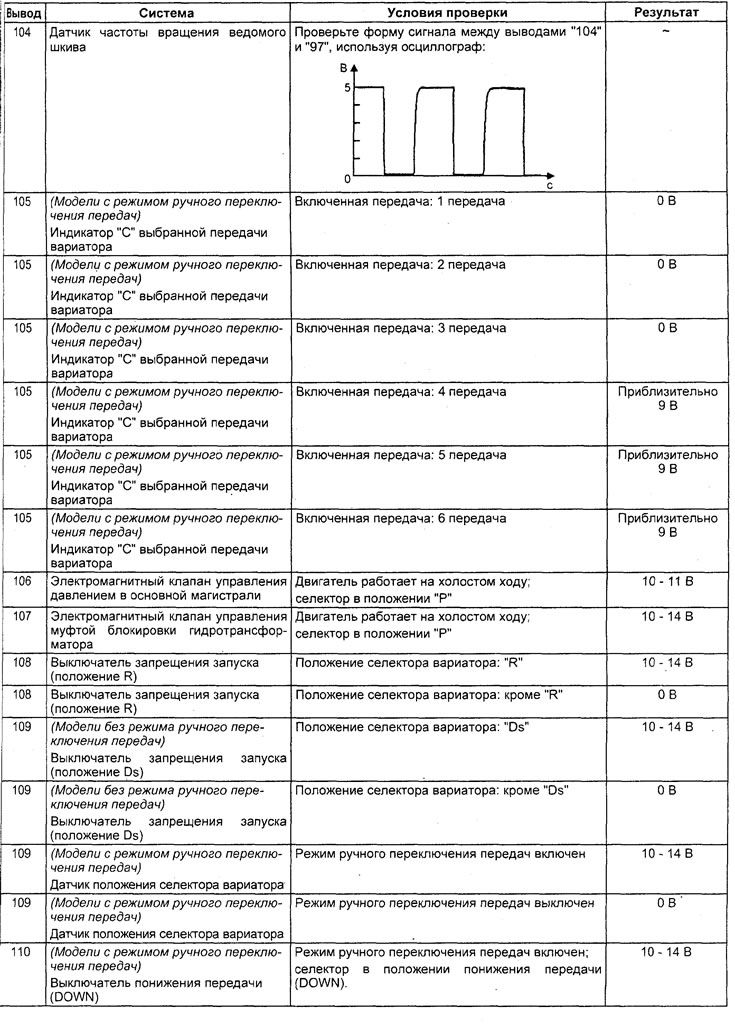
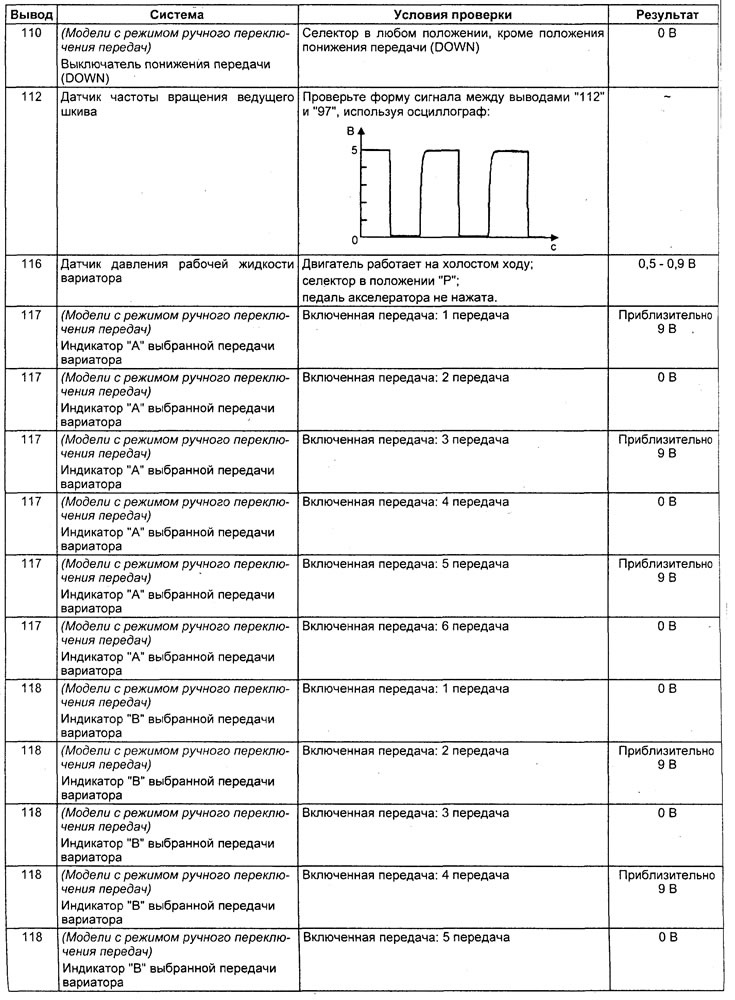
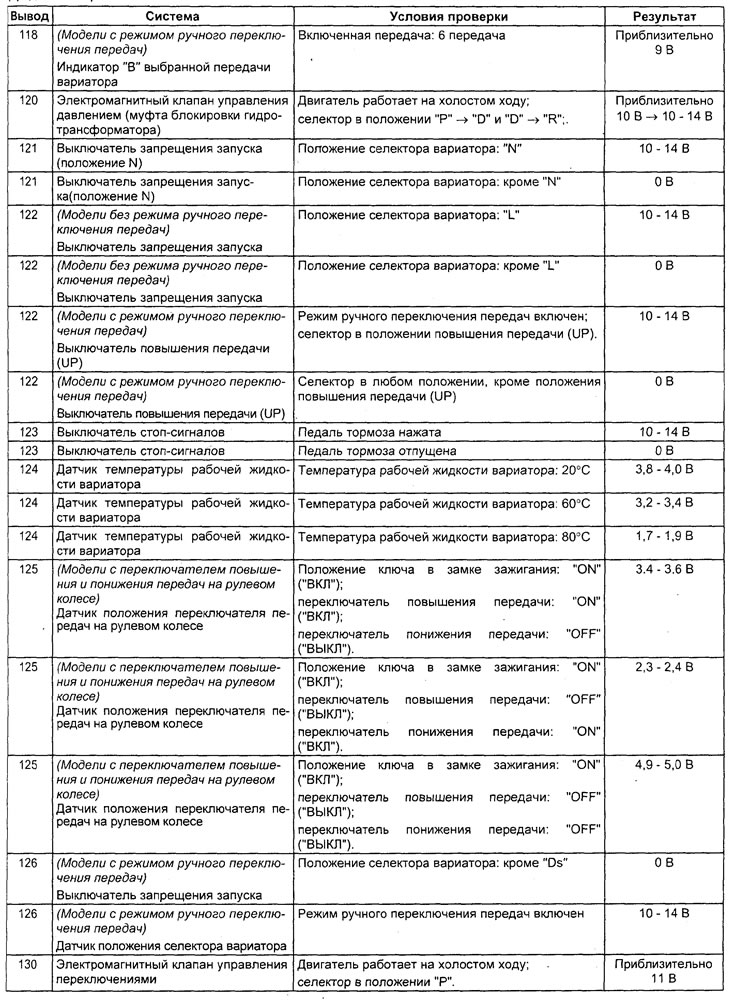
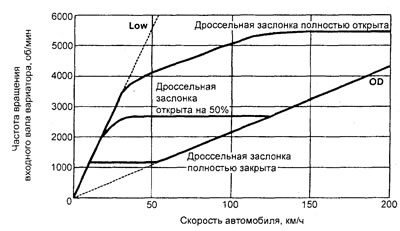
Diagram of the operation of the variator without manual gear shifting.
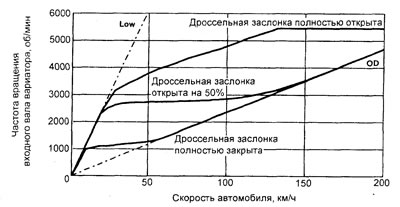
CVT operation diagram without manual shift mode (sedan models from 07.2000 with 4G15 engine).
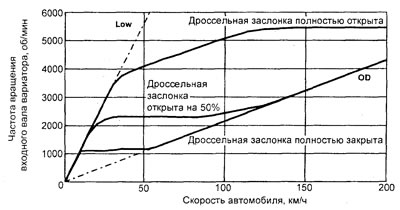
CVT operation diagram without manual shift mode (sedan models from 07.2000 with 4G93 engine).
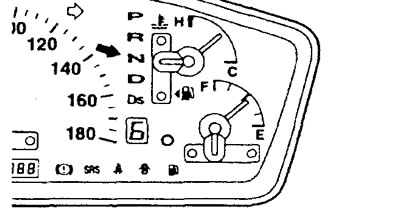
Models with manual shift mode.
b) In this case, you need to check the diagnostic trouble codes.
Attention: if the indicator flashes at a frequency of 2 times per second (2 Hz), then this indicates an increased temperature of the working fluid in the variator, so stop the car in a safe place and let the engine idle until the indicator goes out.
Checks on the connector of the electronic engine control unit and variator
Note:
- If any deviation from the nominal value is found, then check the corresponding sensor, actuator and wires.
- After repairing or replacing an assembly, recheck to ensure that the problem has been corrected.
be guided by the table "Checking the voltage at the terminals of the electronic control unit for the engine and the variator"
1. Disconnect the control box connector and connect the test harness between the connectors, or use a voltmeter needle tester to test at the connector on the harness side.
Attention: probe short circuit "pluses" voltmeter connected to the output of the connector, on "mass" may cause damage to the wiring, sensor, electronic control unit, or all of the above items.
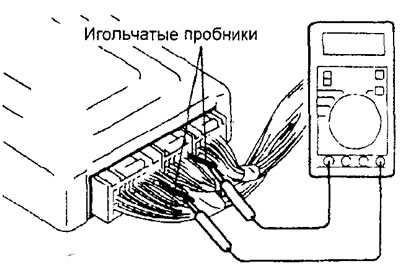
2. With the control unit connector connected, measure the voltage between the terminals "masses" control unit and each corresponding terminal of the unit connector.