



Contents: Checking the components of the CVT…⤓ Table. Checking the switch. ⤓ Table. Nominal values. ⤓ Table. Nominal values. ⤓ Table. Sensor check. ⤓ Table. Nominal values. ⤓ Checking and adjusting the engine…⤓ Table. Checking the switch. ⤓ Checking the operation of the…⤓ Checking and adjusting the ignition…⤓ Checking and adjusting the variator…⤓ Adjusting the variator control cable ⤓
Checking the components of the CVT control system
Note:
- - The procedure for checking the accelerator pedal position sensor is given in the chapter "Fuel injection system".
- - For a detailed procedure for checking the engine start inhibit switch, refer to the section "Checking and adjusting the engine start inhibit switch and the variator control cable".
- The procedure for checking the brake light switch is given in the chapter "Brake system".
1. Checking the start inhibit switch.
Check the start inhibit switch circuit according to the table below.
Table. Checking the switch.
| Selector position | The circuit is closed between the terminals |
| R | 3-8 and 9-10 |
| R | 7-8 |
| N | 4-8 and 9-10 |
| D | 1 -8 |
| Ds | 5-8 |
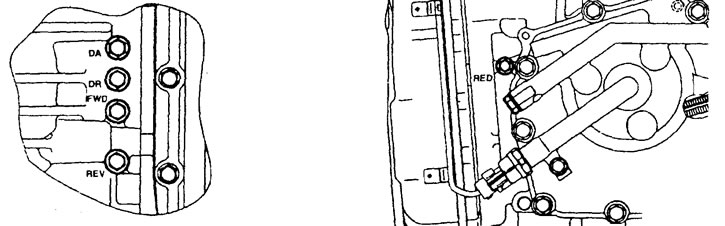
Holes for measuring pressure in the lines of the hydraulic system of the variator control. DA - torque converter input pressure, DR - torque converter output pressure, FWD - forward clutch, REV - reverse brake, RED - RED pressure.
2. Checking the variator control relay.
a) Remove the relay.
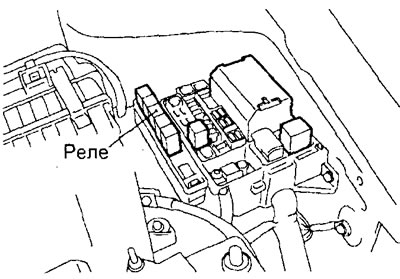
b) Connect the voltmeter and power source as shown in the figure.
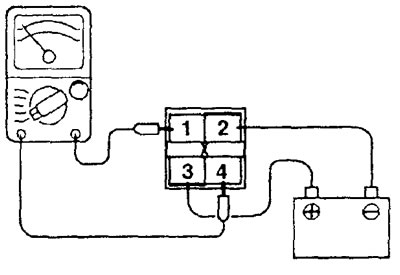
c) When connecting and disconnecting the power source wire, check the conductivity between terminals "1" and "4" of the connector.
| Power supply | Conductivity |
| Connected | Eat |
| Disconnected | No |
d) Replace the relay if necessary.
3. Checking the electromagnetic valves.
a) Disconnect the connector and remove the solenoid valve block cover.
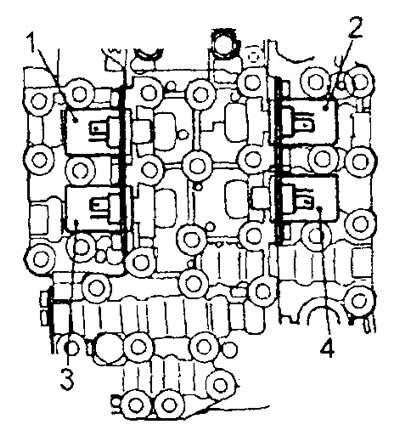
Block of electromagnetic valves. 1 - electromagnetic valve for controlling the torque converter lock-up clutch; 2- electromagnetic valve for controlling pressure of the torque converter clutch;3- switches; 4- electromagnetic valve for controlling pressure in the fuel line
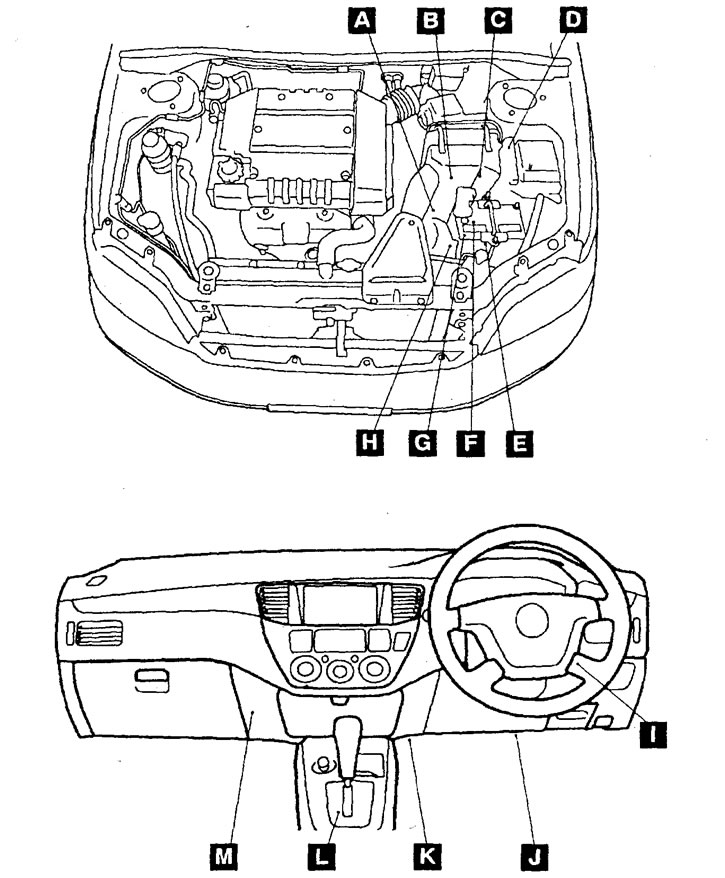
Location of the CVT control system components. A - turbine shaft speed sensor, B - driven pulley speed sensor, C - main line pressure sensor, D - control relay, E - variator working fluid pressure sensor, F - leading pulley speed sensor, G - start inhibit switch, H - working fluid temperature sensor, I - accelerator pedal position sensor, J - brake light switch, K - diagnostic connector, L - selector position sensor (models with manual gear shift mode), M - electronic control unit for the engine and variator.
b) Measure the resistance at the terminals of the connectors of each solenoid valve.
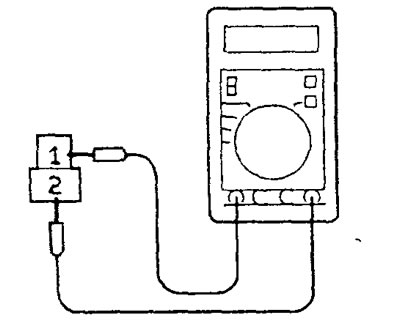
Nominal resistance (at 20°C) — 2.9 - 3.5 Ohm
c) If the measured resistance does not correspond to the nominal value, replace the faulty solenoid valve.
Note: Replace the solenoid valve block assembly if necessary.
4. Checking the CVT fluid temperature sensor.
a) Remove the sensor.
b) Using an ohmmeter, measure the resistance between terminals "1" and "2" of the sensor connector at different temperatures of the working fluid.
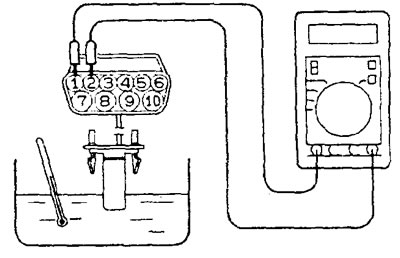
Table. Nominal values.
| Temperature | Resistance |
| 0°C | 16.70- 20.50 kOhm |
| 20°C | 7.30 - 8.90 kOhm |
Table. Nominal values.
| Temperature | Resistance |
| 40°C | 3.40 - 4.20 kOhm |
| 60°C | 1.90-2.20 kOhm |
| 80°C | 1.00-1.20 kOhm |
| 100°C | 0.57 - 0.69 kOhm |
Note: When the working fluid heats up to 125°C, the "N" range indicator will start flashing, but when the temperature drops to 115°C, the flashing will stop.
c) If a malfunction of the working fluid temperature sensor is detected, replace the sensor.
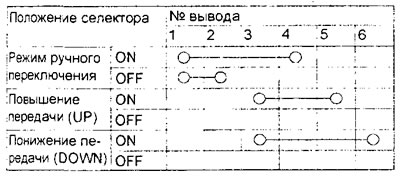
5. Checking the selector position sensor.
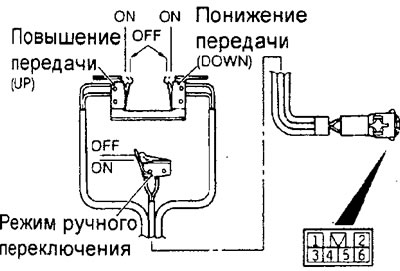
Check the condition of the circuit between the sensor connector terminals at different selector positions according to the table provided.
Table. Sensor check.
6. (Models with upshift/downshift switch on the steering wheel) Check the steering wheel shift position sensor.
a) Remove the lower steering wheel cover.
b) Disconnect the connector from the sensor.
c) Using an ohmmeter, measure the resistance between terminals "1" and "2" of the sensor connector.
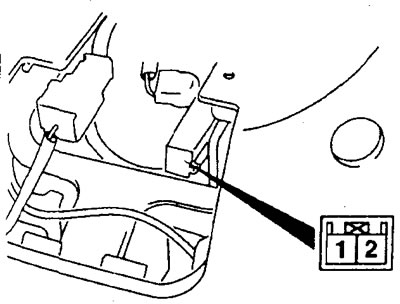
Table. Nominal values.
| Switch position | Resistance |
| Overdrive | 990 - 1010 Ohm |
| Downshift | 388 - 396 Ohm |
Checking and adjusting the engine start inhibit switch and the variator control cable
1. Checking the condition of the circuit at the terminals of the engine start prohibition switch connector.
a) Disconnect the engine start inhibit switch connector.
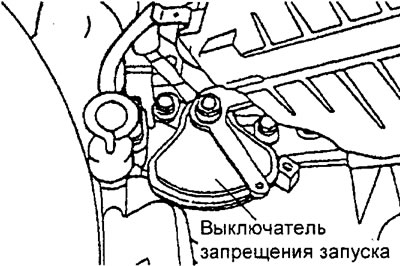
b) Check the condition of the circuit between the connector terminals at different switch positions according to the table provided.
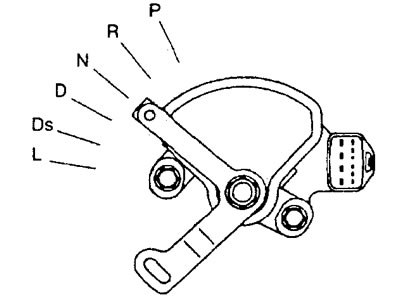
Table. Checking the switch.
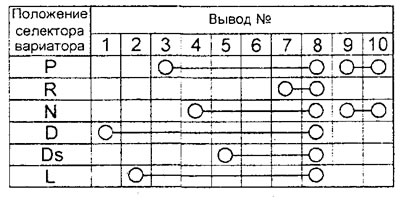
2. Check that the gears engaged correspond to each position of the variator selector and that the variator operates correctly in each range. Adjust if necessary.
3. Set the CVT selector to the "N" position.
4. Loosen the adjusting nut securing the variator control cable to the start inhibit switch lever.
5. Set the manual control lever to neutral position ("N").
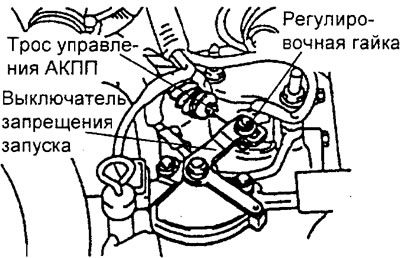
6. Loosen the start inhibit switch mounting bolts and turn it until the holes in the switch and in the start inhibit switch lever are aligned (section "A-A" in the figure).
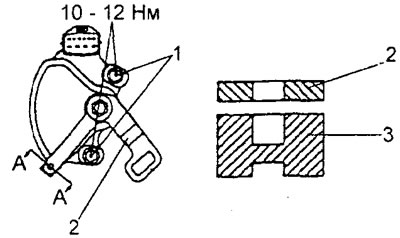
Adjusting the variator control cable and the start inhibit switch. 1 - bolts, 2 - start inhibit switch lever, 3 - start inhibit switch.
7. Without changing the position of the start inhibit switch, tighten the mounting bolts.
Tightening torque: 10 - 12 Nm
8. Slightly pull the variator control cable in the direction shown by the arrow in the figure and tighten the adjusting nut.
Tightening torque: 10 - 14 Nm
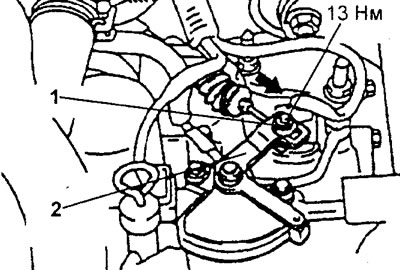
Adjusting the CVT control cable and start inhibit switch (continued). 1 - adjusting nut, 2 - start inhibit switch lever.
9. Make sure that the CVT selector is in the "N" position.
(The material is based on data from the website MITSUBISHIMAN)
10. Check that the gears engaged correspond to each position of the CVT selector and that the gearbox operates correctly in each range.
Checking the operation of the variator selector
1. Raise the parking brake lever.
2. Move the CVT selector from position to each position and check that the selector shifts smoothly and clearly.
3. Check that the engine starts when the selector is in the "P" or "N" position, and that the engine cannot be started when the selector is in other positions.
4. Start the engine, release the parking brake lever and check the operation of the gearbox control mechanism.
(Models without manual shift mode) When the selector lever is moved from the "N" position to "D", "Ds" or "L", the vehicle should move forward, and when the selector lever is moved to the "R" position, the vehicle should move in reverse.
(Models with manual shift mode) When the selector lever is moved from "N" to "D", "Ds" or "1" - "6", the vehicle should move forward, and when the selector lever is moved to "R", the vehicle should move in reverse.
5. Turn off the engine.
6. Turn the ignition switch to the "ON" position, move the CVT selector from the "P" position to the "R" position, and make sure that when the CVT selector is in the "R" position, the reversing lights come on and the buzzer sounds.
Note: the ignition and selector lock systems do not allow the CVT to be switched into unacceptable operating modes if switching may cause a breakdown, therefore, to move the selector from the "P" position to other positions, you need to press the brake pedal and turn the key in the ignition to any position except "LOCK".
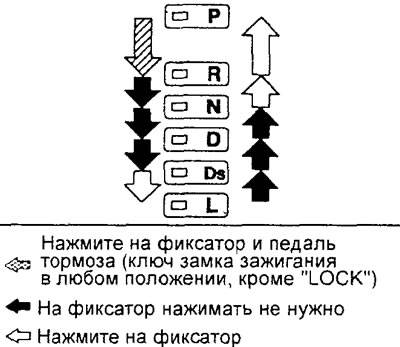
Models without manual shift mode.
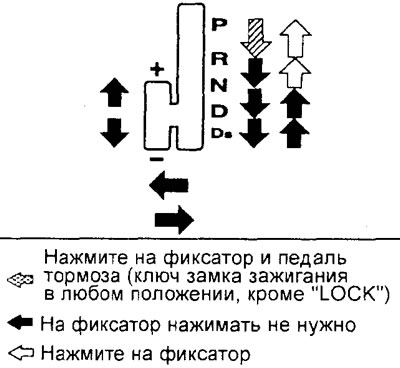
Models with manual switching mode.
Checking and adjusting the ignition lock mechanism
1. Checking the operation of the ignition lock system.
a) Check that if, with the brake pedal depressed, the ignition key is in the "LOCK" position or removed, the selector cannot be moved from the "P" position to any other position without pressing the selector lock.
b) Check that if the ignition key is in any position except "LOCK", the selector can be moved from the "P" position to any other position with the brake pedal depressed and the lock button pressed. Check the smoothness of the selector movement.
c) Check that it is impossible to turn the ignition key to the "LOCK" position with the selector in any position except "P" (brake pedal released). Check that the ignition key can be smoothly turned to the "LOCK" position when the selector is in the "P" position (brake pedal released).
d) If the system operation differs from that specified above, adjust the ignition lock cable.
2. Adjusting the ignition lock cable.
a) Remove the lower part of the center console (see chapter "Body").
b) Set the selector to position "P" and the ignition key to the "LOCK" position.
c) Loosen the ignition lock cable fastening nut.
d) Gently pull the locking cam in the direction "A" indicated by the arrow in the figure and, holding it in this position, tighten the ignition lock cable fastening nut.
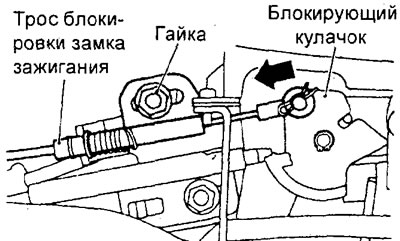
d) Install the lower part of the center console (see chapter "Body").
Checking and adjusting the variator selector locking system
1. Checking the operation of the selector lock system.
a) Check that if, with the brake pedal pressed, the ignition key is in the "ACC" position, the selector cannot be moved from the "P" position to any other position without pressing the selector lock.
b) Check that if, with the brake pedal pressed, the ignition key is in the "ACC" position, the selector can be moved from the "P" position to any other position by pressing the selector lock.
c) Check that if, with the brake pedal released and the lock button pressed, the ignition key is in the "ACC" position, the selector can be moved from the "R" position to the "P" position.
d) If the system operation differs from that specified above, adjust the selector lock cable.
2. Adjusting the variator selector lock cable.
a) Remove the lower part of the center console (see chapter "Body").
b) Set the selector to position "P"
c) Loosen the selector lock cable mounting nut.
d) Adjust the position of the cable so that its edge is located in the middle of the red mark of the locking cam, as shown in the figure.
d) Tighten the cable mounting nut.
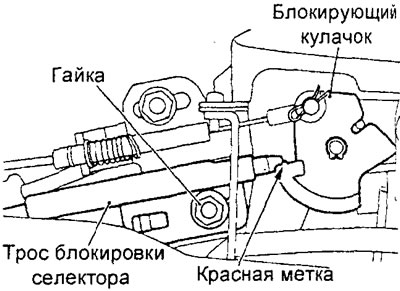
e) Install the lower part of the center console (see chapter "Body").
Adjusting the variator control cable
1. Remove the battery and battery bracket.
2. Move the variator selector lever to the position "N"
3. Loosen the variator control cable mounting nut.
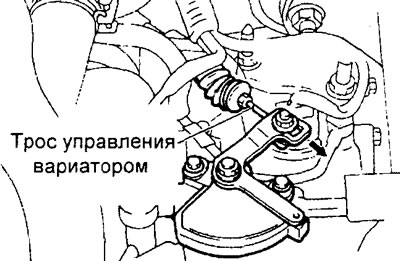
4. Pull the cable slightly in the direction "A" indicated by the arrow in the figure and, holding it in this position, tighten the variator control cable fastening nut.
Tightening torque: 12 ±2 Nm
5. Install the battery bracket and battery.