



Contents: Adjusting the Start Permission…⤓ Adjusting the gear shift cable ⤓ Adjusting the throttle cable (TV…⤓ Adjusting the kickdown servo (F4A20…⤓ Adjusting the pressure in the lines ⤓ Adjusting the reduction pressure…⤓
Adjusting the Start Permission Switch Sensor
See Section Overhaul of manual transmission.
Adjusting the gear shift cable
1. The adjustment is made on the start enable switch (PNP) sensor - find the switch on the transmission housing and make sure that the holes in the lever and the switch housing are aligned. Move the selector to the "N" position, and shift the manual lever on the transmission accordingly.
2. Check the correct alignment of the holes in the lever and the sensor-switch housing; if necessary, make the appropriate adjustments (see below).
3. To adjust, loosen the cable end nut and use your hands to take up the slack until the holes line up. Tighten the nut.
4. Check the proper functioning of the transmission.
Adjusting the throttle cable (TV cable)
1. This adjustment is only available on Mirage models up to 1996.
2. Move the selector lever to the "N" position.
3. Loosen the adjusting nut. Pull the control cable slightly and tighten the nut to 10÷14 N·m.
4. Make sure the selector lever is still in the "N" position.
5. Check the correct functioning of the AT.
Adjusting the kickdown servo (F4A20 series transmissions)
1. Thoroughly clean the area around the kickdown servo switch. Remove the retaining ring. Remove the switch.
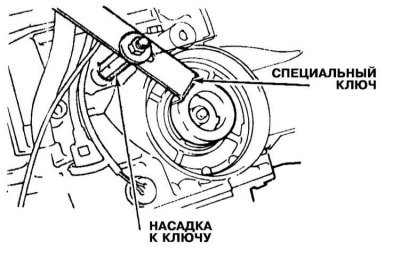
2. Using a special key or attachment, lock the drive piston from turning.
Attention! When putting on the key, the piston should not be pressed down. Tightening of the nozzle is done manually.
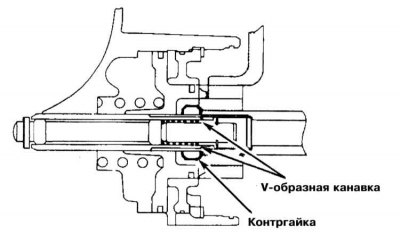
3. Loosen the lock nut until the V-groove in the adjusting rod is reached.
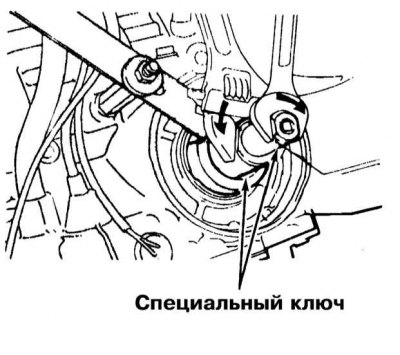
4. Screw the inner nozzle from the MD998916 servo adjustment kit onto the adjusting rod until it stops against the lock nut. Place the outer nozzle on the nut.
5. Use open-end wrenches to tighten both attachments together.
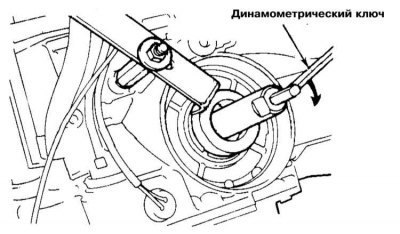
6. Remove the outer socket and tighten the inner socket with a torque wrench to 10 N·m. Release the wrench and repeat the procedure to tighten the socket to the required torque. Lower the wrench again and tighten the socket again, this time to 5 N·m, then release it by 1/4 turn.
7. Unlock the inner nozzle by loosening its pressure against the lock nut, then unscrew the nut manually until it is pressed against the servo piston. Finally, tighten the lock nut to the required force (25÷32 N·m).
Note: Make sure that the rod does not turn while tightening the nut.
Adjusting the pressure in the lines
Note: Since the adjustment is performed with the valve assembly removed, the pressure should be measured first.
Transmission F3A21
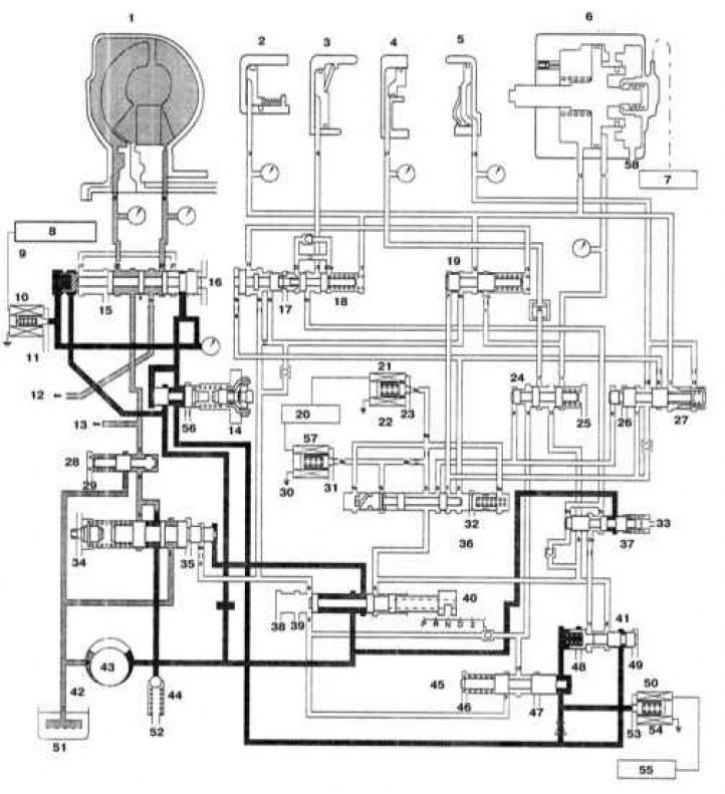
Diagram of pressure distribution in the hydraulic path of 4-stage automatic transmitters in the position "N"
1 - Rotation converter; 2 - Front clutch; 3 - Rear clutch; 4 - Low gear/reverse brake assembly; 5 - Clutch end sleeve; 6 - Kickdown mode servo; 7 - Control module three; 8 - Transmission Control Module; 9 - Damper clutch control valve; 10 - Off; 11 - Damper clutch control solenoid valve; 12 - To the lubrication system (front); 13 - To the lubrication system (rear); 14 - Pressure reducing valve; 15 - Day off.; 16 - Out.; 17 - Day off.; 18 - Rear clutch release valve; 19 - 2/3 and 3/4 gear shift valve; 20 - Transmission Control Module; 21 - Solenoid valve A for switching control; 22 - Off; 23 - Day off.; 24 - Switching valve 1/2; 25 - Day off.; 26 - Day off.; 27 - Clutch end valve; 28 - Rotary converter control valve; 29 - Day off.; 30 - Solenoid valve B switching control; 31 - Exit.; 32 - Exit.; 33 - Exit.; 34 - Regulator valve; 35 - Exit.; 36 - Shift control valve; 37 - N/D Shift Control Valves; 38 - Exit.; 39 - Exit.; 40 - Manual valve; 41 - Pressure control valve; 42 - Oil filter; 43 - Oil pump; 44 - Safety valve; 45 - N/D Shift Control Valve; 46 - Exit.; 47 - Exit.; 48 - Exit.; 49 - Exit.; 50 - Solenoid pressure control valve; 51 - Oil pan; 52 - Exit.; 53 - Exit.; 54 - Off; 55 - Transmission Control Module; 56 - Exit.; 57 - On; 58 - Exit.
1. The diagram of the hydraulic connections of the AT components using the example of the pressure distribution map in the "N" position of the F4A20 series transmissions is shown in the illustration.
2. Remove the valve assembly (see Section Major repairs of AT).
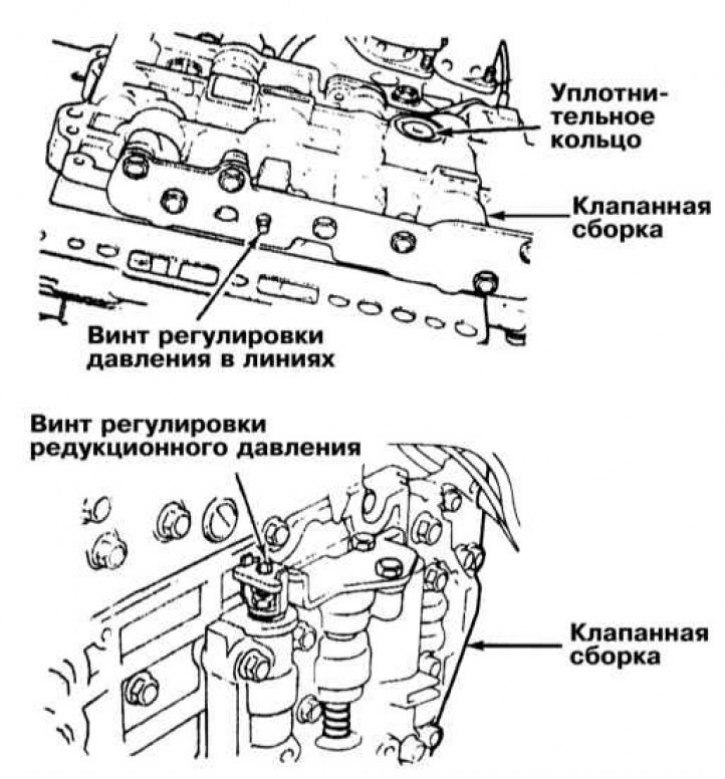
3. Locate the pressure adjustment screw in the lines.
4. Turning the screw on the regulator valve clockwise results in a decrease in pressure in the lines, counterclockwise - in an increase. Turning the screw one full turn results in a pressure change of approximately 26 kPa.
5. Once the adjustment is complete, reinstall the valve assembly. Fill the transmission with fresh ATF (see Chapter Settings and ongoing maintenance) and repeat the pressure check in the lines. The nominal value of the pressure in the lines is 360÷420 kPa at idle speed and 690÷710 kPa at fully open throttle.
Transmissions of the F4A20 series (F4A22 and F4A23/33/51)
The adjustment is carried out in the same way as described above for the F3A20 series transmissions, with the only difference being that in this case, turning the adjusting screw by one full turn results in a pressure change of 38 kPa, and the nominal pressure in the lines is 870÷890 kPa (see Specifications).
Adjusting the reduction pressure (F4A20 series transmissions)
This adjustment is also performed on the valve assembly removed from the transmission.