



Use a charged battery to check.
Disconnect the ground cable from the battery.
Caution: This erases data in the electronic memory, such as the engine fault memory or the radio receiver code. Disconnect the battery only when the ignition is switched off, otherwise the fuel injection device control unit may be damaged. Before disconnecting the battery, read the instructions in the "Radio receiver" and "Removing and installing the battery" sections.
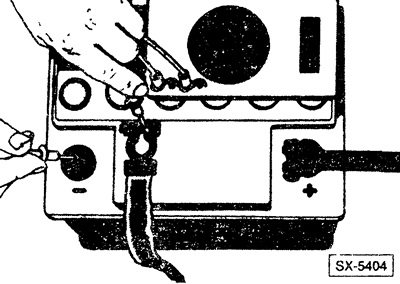
Set the ammeter (with a measurement limit of 0-5 mA to 5 A) to the maximum measurement range. Connect the ammeter between the negative pole of the battery and the ground wire.
Note: The test can also be carried out using a test lamp. However, if the lamp does not light, a test should be carried out using an ammeter.
Turn off all consumers, turn off the clock (and all other constant consumers), close the doors.
Switch measurement ranges up to the milliamp range until a visible indication follows (1-3 mA is acceptable).
Sequentially interrupt various electrical circuits by removing fuses. If the indication goes to zero when one of the circuits is interrupted, the source of the malfunction should be looked for here. Defects may be rusty and dirty contacts, frayed wires, internal short circuits in the units.
If no defect is found in the circuits protected by fuses, the wires should be removed sequentially from the unprotected units. These are: generator, starter, ignition system.
If the readings are reset when one of the units not protected by fuses is disconnected, the corresponding unit must be repaired or replaced. If there is a current leak in the starter or ignition system, also check the ignition switch according to the electrical diagram.
Connect the ground cable to the battery.
If they are available, set the time on the clock and enter the security code into the radio.