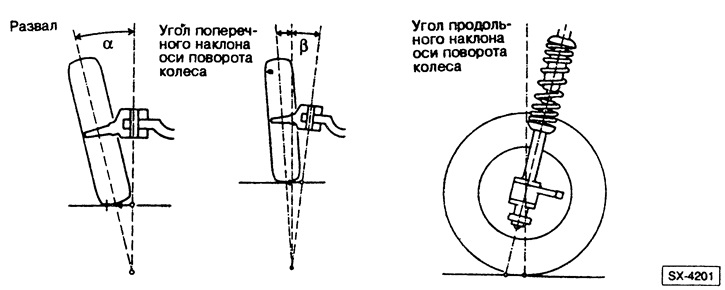
Checking the wheel alignment angles can only be carried out on an appropriate measuring stand.
Therefore, here we will limit ourselves to only a description of the basic concepts.
Convergence / camber / transverse tilt of the steering axis / longitudinal tilt of the steering axis
Toe-in is the difference in the distances between the side surfaces of the front wheels at the front and rear. Positive toe-in means that the wheels are mounted so that they are - when measured at the height of the center of the front wheel - slightly closer together at the front than at the rear. Negative toe-in means that the front wheels - when measured at the height of the center of the wheel - are slightly further apart at the front than at the rear.
Camber and lateral tilt of the steering axis reduce the transmission of shocks from road irregularities and friction when cornering.
Camber is the angle at which the plane of the wheel is tilted from the vertical. The front wheels are installed at an angle, for example, with negative camber the wheels are tilted towards the car.
The transverse tilt angle of the steering axis is the angle between the wheel's rotation axis and the vertical line passing through the tire's contact point; the play does not exceed the permissible values in the transverse plane of the vehicle.
Due to the presence of the distribution and the transverse angle of the wheel rotation, the points of contact of the wheels with the road surface are brought closer to the axis of rotation of the wheel. Thus, the so-called rolling shoulder is maintained at a minimum. The smaller the rolling shoulder, the easier the steering becomes. At the same time, the impact of impacts from unevenness of the road surface on the steering rods is also significantly reduced.
The longitudinal angle of the wheel's turning axis is the angle between the axis and the vertical line passing through the tire's contact point in the longitudinal plane of the vehicle. This angle has a significant effect on maintaining a straight line while driving. Too small an angle contributes to the vehicle's deviation from the direction of travel on uneven roads and in crosswinds and does not sufficiently return the steering control to the center position after cornering.
Article reprinted from the website mitsubishiman
In the COLT/LANCER model, the steering axis tilt and camber angle as well as the steering axis caster angle are not set, but only monitored. If the measured value is outside the tolerance range, the suspension parts are damaged or worn.
Adjustment
To adjust the wheel alignment angles, you must have a pit or a measuring lifting stand. The following conditions must be met during the measurement:
- the tire pressure must comply with the standards.
- the car must be fully fueled.
- before taking measurements, the front of the car should be strongly lowered.
- the steering wheel is set to the straight ahead position.
- in the steering joints, the play does not exceed the permissible values (maximum play of the steering wheel along the outer diameter is 30 mm).
- the play in the suspension does not exceed the permissible values, the play in the wheel bearings is within the tolerance.
- the radial and lateral runout of the wheel rims must not exceed 2.0 mm (the runout of the rims must be compensated for using a measuring device).