



Contents: Convergence ⤓ Longitudinal angle of inclination of…⤓ Wheel alignment ⤓ Tilt of the pivot axis ⤓ Recommendations for checking wheel…⤓
Convergence
Toe-in is the position of the middle wheels when the distance between the side surfaces of the tires at the front is less than at the rear; while reverse toe-in occurs when the distance at the rear is less than the distance at the front. The purpose of adjusting toe-in is to ensure that the wheels rotate parallel.
Wheel alignment is used to compensate for small deviations that may occur in the wheel suspension system as the vehicle moves forward. The set wheel toe angle is a preliminary adjustment that allows the toe value to be zero when the vehicle is in motion. Incorrect forward or reverse wheel toe adjustments will cause premature tire wear and will not provide maximum fuel economy. As individual components of the steering mechanism and suspension system wear over the course of the vehicle's mileage, additional wheel alignment may be required to compensate. Toe should always be the last adjustment made to the wheel alignment.
Adjusting the toe-in value
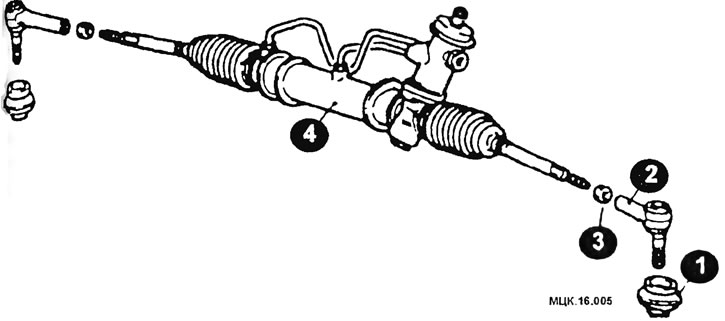
Steering gear tips
1 - case; 2 - steering rod ends; 3 - lock nut; 4 - steering mechanism.
The wheel toe-in is adjusted by changing the length of the steering rods. Loosen the nuts (3) of the right and left rods, then turn the steering rod ends to change the length of the steering rods to meet the specifications. With this adjustment, the right and left steering rods must be the same length. The required wheel toe-in value is 0°00'±09'.
Longitudinal angle of inclination of wheels
Lean is the forward or backward deviation from the vertical line when viewed from the side of the vehicle. Lean back is called positive (+), lean forward is negative (-). Lean affects road holding, but does not affect tire wear. Weak springs and vehicle overload can affect the amount of lean.
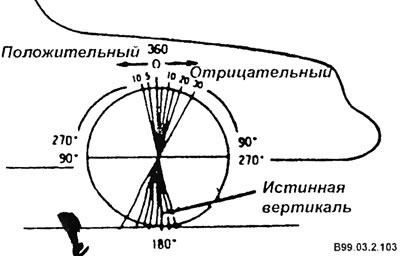
If one wheel has more positive lean than the other wheel, this will cause that wheel to "pull" toward the center of the car. As a result, the car will pull toward the wheel with less positive lean.
The tilt angle of the steering axis is measured in degrees and is not adjustable. The required value of the longitudinal tilt angle of the wheels: 2°51'±30' (deviation right to left - 30' max).
Wheel alignment
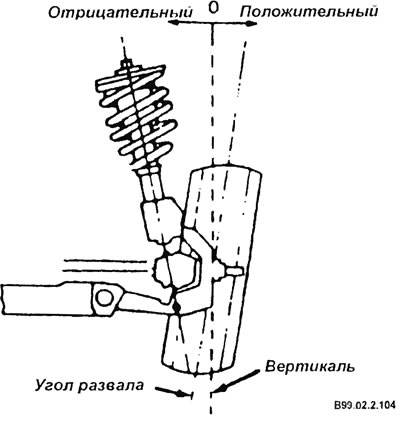
Camber is the deviation of the top of the tire from the vertical when viewed from the side of the vehicle. When the top of the tire is tilted outward from the vertical, it is called positive camber (+). When the tire is tilted inward, it is called negative camber (-). Camber is measured in degrees of deviation from the vertical and is characterized by the camber angle. The camber angle affects both the road holding characteristics and the wear of the tire. If a vehicle has too much positive camber, the outer shoulder of the tire will wear. Likewise, if the vehicle has too much negative camber, the inner shoulder of the tire will wear.
Camber is measured in degrees and is not adjustable.
Required wheel alignment: 0°00'±30' (right/left deviation — 30' max).
Tilt of the pivot axis
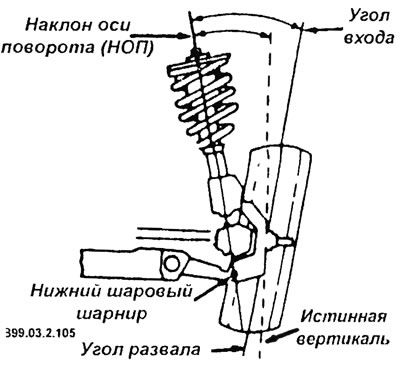
Steering axis inclination (SAI) is the deviation (at the top) of the steering knuckle from vertical. SAI is measured between the true vertical and a line through the center of the strut and the lower ball joint when looking at the vehicle from the side. Steering axis inclination helps the vehicle maintain straight-line motion and helps return the wheel to the straight-ahead position. SAI should be negative for front-wheel drive vehicles.
The tilt angle of the pivot axis is not adjustable.
The required tilt value of the rotation axis is 12°52'.
Recommendations for checking wheel alignment angles
Complaints about steering problems and vibration are not always the result of improper wheel installation. They can also be caused by wheel or tire imbalance. Another point that needs to be checked is that the tire may "pull" due to a defect or severe wear. "Pull" is a deviation from straight-line movement on a level section of the road when there is no hand pressure on the steering wheel. For correct wheel installation, before proceeding to measure the wheel alignment angles, it is necessary to check:
- air pressure in all tires (must be within the norm);
- tread wear;
- clearance in wheel hub bearings;
- condition of ball joints (absence of play in them);
- steering rod ends (correct any detected deviations before adjusting the wheel angles);
- tire and wheel beating;
- condition of the rack and pinion in the steering system,
- proper functioning of the racks;
- condition of front suspension arms;
- possible excessive loading of the vehicle if this excessive load is carried by the vehicle, constantly check the installation angles under this load;
- reliability of the equipment used for checking and setting angles. Follow the equipment manufacturer's instructions carefully;
- regardless of the type of equipment used, the vehicle must be installed on a site that is level both longitudinally and transversely.
CAUTION: Satisfactory vehicle operation can be achieved over a wide range of adjustments to the front suspension.
If the requirements cannot be met and the estimated technical characteristics cannot be obtained, check the vehicle for faulty suspension components. Make the necessary repairs or replacements. If the adjustment fails to achieve the toe-in value within the established limits, the adjustment should be repeated.
To obtain the correct values of the installation angles for the front wheels, the following conditions must be met:
- the tread pattern on all tires should be uniform and the tires themselves should be in good condition;
- the air pressure in the tires must be correct;
- all rims must be checked and in satisfactory condition;
- each of the front seats must be loaded with 70 kg;
- the fuel tank should be half full;
- bounce the car a few times to stabilize the springs (also stabilize the springs if the car was previously lifted);
- when using installation equipment whose turntable does not capture lateral forces, the vehicle must first be rolled back one meter and then returned to its original position.
Wheel alignment methods vary depending on the equipment used. The equipment manufacturer's instructions must be followed.