



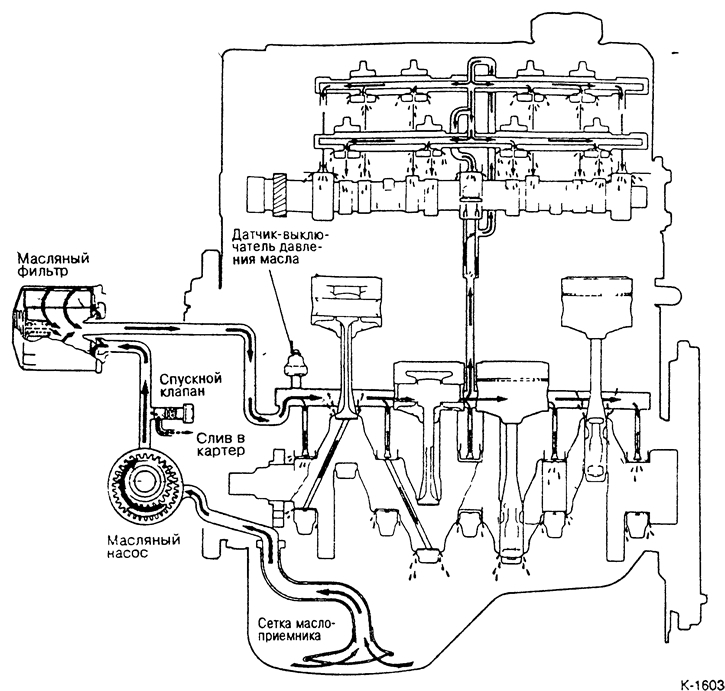
All MITSUBISHI COLT/LAN-CER engines are equipped with a so-called pressure lubrication system. The oil pump draws oil from the oil pan through the oil receiver screen and pushes it through the oil filter into the main oil circuit. There is a drain valve (oil pressure regulating valve) at the outlet of the oil pump. When the oil pressure rises above 5.6 bar, the valve opens and some of the oil flows back into the oil pan.
The oil enters the main circuit via the central axis of the filter cartridge. There is also an oil pressure switch sensor, which signals the driver that the oil pressure is too low by lighting up a control lamp on the instrument panel. The oil pressure control lamp lights up when the oil pressure drops below 0.3 bar. When the oil filter is clogged, the bypass valve opens, allowing unfiltered oil to pass into the main channel.
The main channel branches off into the crankshaft bearing lubrication channels. Oil is supplied to the connecting rod bearings through inclined holes.
At the same time, the oil rises along the inclined channel into the cylinder head and lubricates the camshaft bearings, rocker arms and valve stems there.
The oil pump on the petrol engine is mounted in one housing together with the crankshaft seal on the toothed belt side of the engine. The inner rotor of the oil pump is connected to the crankshaft. Structurally, the oil pump was manufactured until July 1988 as a pump with a gear with internal teeth, and since August 1988 as a rotary pump. In the diesel engine, the oil pump with a gear is located at the front of the engine.
Some COLT/LANCER models are additionally equipped with an oil radiator (side-circuit radiator). In this case, part of the oil flow after the oil pump is diverted to the oil radiator located in the front of the car. It serves to better cool the oil and thus the engine.