



1. Using a wire brush, clean the battery terminals and wire terminals. If necessary, wash the terminals with a solution of baking soda and warm water. Be careful not to let the baking soda solution get into the battery jars.
2. Before connecting the battery clamps, lubricate the terminals with acid-free petroleum jelly and anti-corrosion compound.
3. Periodically (once a quarter) check the state of charge of the battery by measuring the density of the electrolyte in the battery cells.
Checking the level and density of electrolyte
The electrolyte level should be between the "UPPER LEVEL" and "LOWER LEVEL" marks on the battery case.
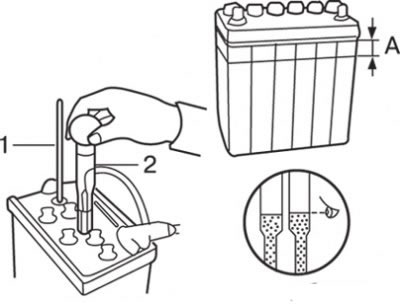
Fig. 19.1. Checking the density of electrolyte in the battery: A – optimal electrolyte level; 1 – thermometer; 2 – hydrometer
Using a hydrometer and a thermometer, measure the density and temperature of the electrolyte (Fig. 19.1).
The density of the electrolyte depends on the temperature, so to convert the measured value to the density at 20°C use the following formula:
D20 = Dt + 0.0007(t – 20), where
D20 – density of electrolyte reduced to a temperature of 20°C;
Dt – the result of the actual density measurement;
t – actual temperature of the electrolyte.
Charging the battery
When charging a battery installed in a vehicle, disconnect the negative cable from its terminals first, then the positive cable, to avoid damage to electrical components.
The charging current is usually 1/10 of the battery capacity.
In case of fast charging due to time constraints etc., the charging current should never exceed the battery capacity indicated in amperes.
The battery is fully charged in the following cases:
- the reduced density of the electrolyte became equal to 1.250–1.290 and remains constant for an hour;
- the voltage of each battery cell is 2.5–2.8 V and remains constant for an hour.
Caution: Be careful and monitor the electrolyte level, which may increase during charging.
Warning! Do not charge the battery near fire sources due to the risk of explosion.
Caution! Do not perform any work that may cause sparks while the battery is charging.
Attention! After finishing charging the battery, close the lids of the cans, rinse the battery from the outside with clean water to remove any remaining acid, and wipe dry.