



Removal
Note. In order to gain access to the clutch assembly, the gearbox is usually removed, leaving the engine in the vehicle. If the engine has already been removed for general or major repairs, the condition of the clutch components must be checked without fail. Considering the relatively low cost of the parts and the fairly large amount of mechanical work required to gain access to the clutch assembly, it makes sense to replace the latter regardless of the condition of its components. Below is a description of the procedure for removing the clutch without removing the engine from the vehicle.
1. Disconnect the negative cable from the battery.
If your car stereo system is equipped with a security code, make sure you have the correct combination to activate the audio system before disconnecting the battery!
2. Jack up the car and place it on supports.
3. Remove the transmission assembly (see Chapter Manual gearbox).
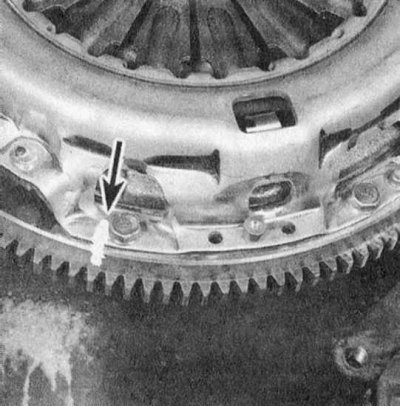
4. Carefully inspect the flywheel and clutch basket assembly surfaces for markings (usually in the form of white letters X or O). If you cannot find the markings, apply them yourself, clearly marking the position of the basket relative to the flywheel.
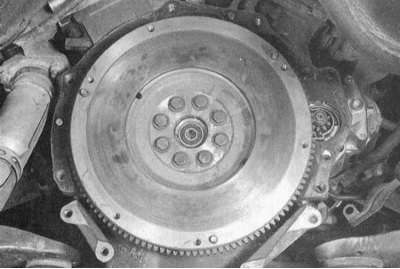
5. Working diagonally, in several steps (1/4 turn per approach), evenly loosen the clutch basket to flywheel mounting bolts, completely releasing the diaphragm spring. While securely supporting the assembly, finally unscrew the bolts, then separate the basket from the flywheel and remove the unit from the vehicle.
 |  |
6. Release the retainer and remove the release bearing assembly.
Do not use solvent to clean the release bearing!
7. Assess the condition of the clutch release fork and its bearing surfaces. If necessary, remove the fork and unscrew its spherical bearing from the gearbox housing.
8. Carefully check the condition of all removed components (see below), replace worn and damaged components.
Examination
1. Most often, a malfunction of the clutch is associated with wear of the friction linings of the driven disk. However, it is also necessary to carefully examine the condition of all other components of the assembly.
Note: If there are traces of oil on the surface of the assembly components (areas polished to a shine), the cause of the leak should be identified and eliminated - check the condition of the rear crankshaft oil seal and the gearbox primary shaft oil seal, replace defective components if necessary.
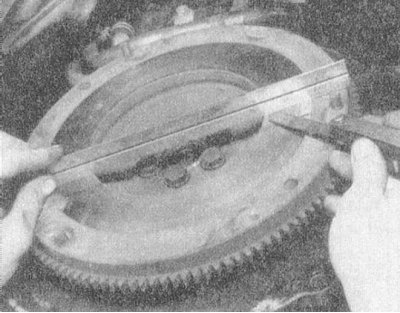
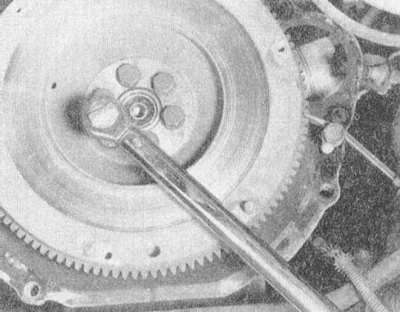
2. Inspect the flywheel working surface for signs of deformation, cracks, traces of overheating, grooves and other damage. Minor defects can be eliminated by turning in a car service workshop (turning is recommended regardless of the surface condition). A description of the flywheel removal and installation procedures is given in Section Removal and installation the flywheel/drive disc.
 |  |
3. Check the condition of the guide bearing (see Section Checking the condition and replacing the guide bearing).
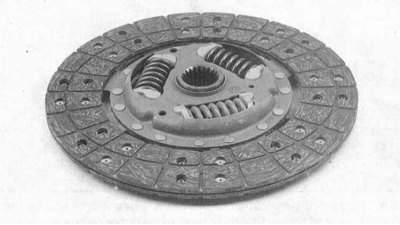
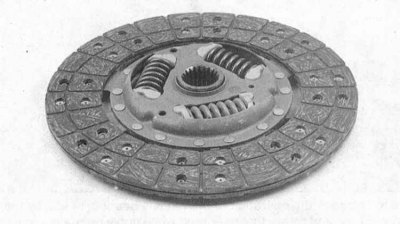
4. Assess the degree of wear of the friction linings of the driven clutch disc. The surface of the linings should rise above the rivet heads by at least 0.8 mm. Make sure that all rivets are tightly seated, check the torsion springs/dampers for cracks, signs of deformation and other mechanical damage. As mentioned above, it is reasonable to replace the clutch components every time the assembly is dismantled, so pay attention to the slightest errors.
5. The release bearing is always replaced together with the driven disk.
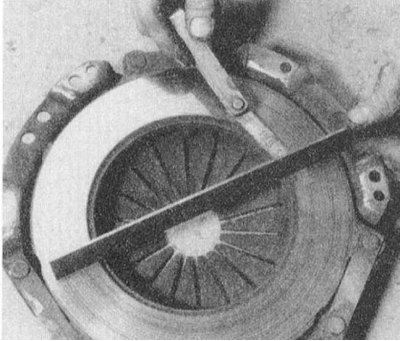
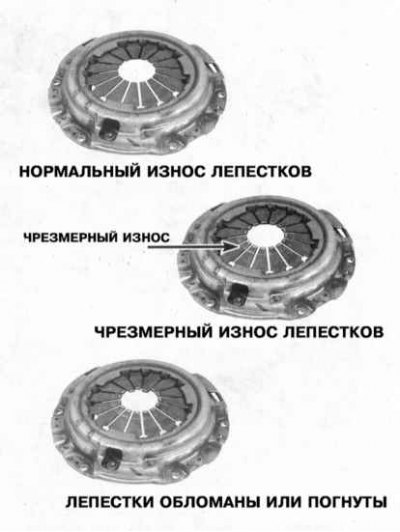
6. Assess the condition of the machined surfaces of the pressure plate and diaphragm spring petals. If defects are found, replace the basket assembly. Traces of light polishing can be removed using fine-grained sandpaper. A restored clutch assembly can always be purchased on an exchange basis through Mitsubishi branded service stations.
 |  |
Installation
1. Install the standard spherical bearing of the clutch release fork onto your vehicle and tighten it to the required torque (35 Nm).
Information copied from the website [www.mitsubishiman.ru]
2. Install the clutch release fork.
3. Lubricate the bearing and contact surfaces of the fork with universal grease.
4. If equipped with the appropriate equipment, lubricate the clutch slave cylinder pusher and its receiving socket in the release fork with the same grease.
5. Pack high-melting grease into the inner groove of the release bearing, - try not to let the grease get on the non-metallic elements of the assembly.
6. Install the bearing in its original place and secure it with a retainer.
7. Before installation, wipe the machined surfaces of the flywheel and pressure plate with a rag soaked in acetone. It is extremely important to achieve complete degreasing of the working surfaces of the components, as well as the friction linings of the driven disk. Touch the components only with clean hands.
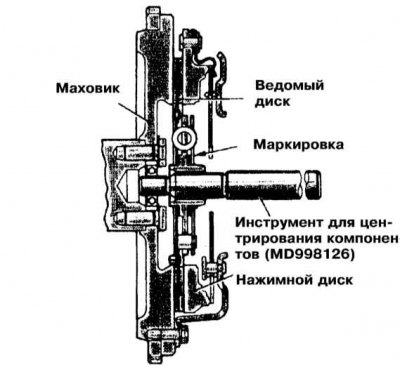
8. Press the clutch basket assembly (with the driven disc alignment tool inserted and secured) onto the flywheel. Make sure that the side of the clutch disc marked with the appropriate marking (like "Flywheel side") faces the flywheel. If there is no marking, remember that the driven disc is always mounted with torsion springs/dampers to the gearbox.
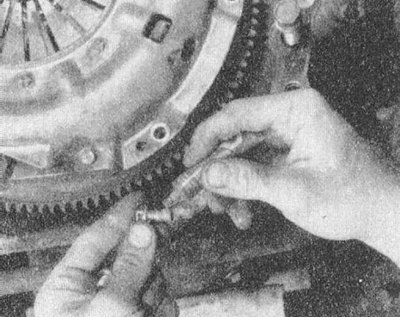
9. Tighten the bolts securing the assembly to the flywheel by hand. Before screwing in, lubricate the threaded portion of the fastener with a locking sealant.
10. Center the clutch assembly components. The special tool is passed through the driven disk hub and inserted into the guide bearing at the end of the crankshaft journal. To align the components, move the tool in different directions in the vertical and horizontal planes.
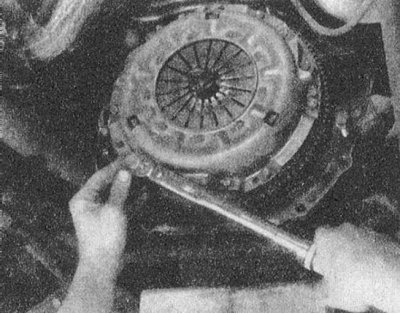
11. Tighten the assembly mounting bolts diagonally in several stages, then tighten them to the specified torque (19 Nm: Galant models 1994–1998 and 22 Nm: other models). Remove the clutch alignment tool.
12. Install the transmission and all components removed for access. Ensure that all fasteners are tightened to the required torque.
13. Check the proper functioning of the clutch.