
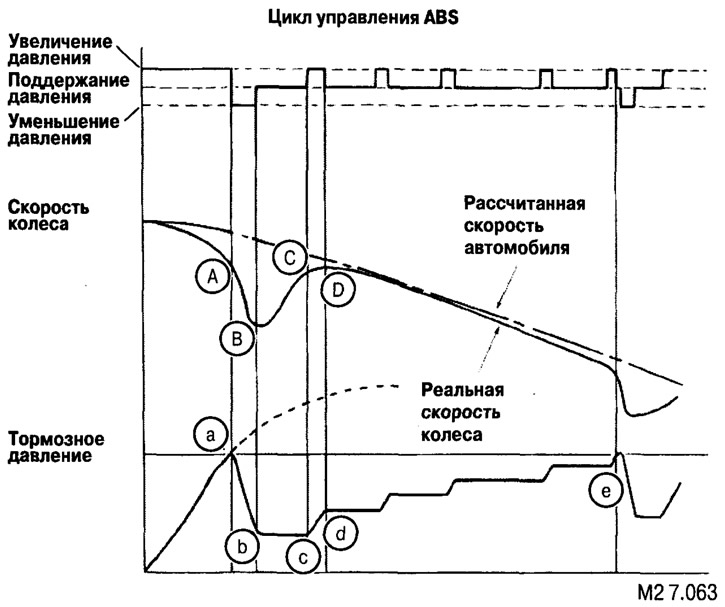
The ABS-ECU receives signals from the four wheel speed sensors, determines the speed and acceleration of each wheel, and calculates the vehicle speed.
If you depress the brake pedal, the TJ pressure in the brake cylinders increases and the speed of rotation of the wheels decreases. If the difference between the wheel speed and vehicle speed increases and the deceleration speed of the wheel reaches a certain point (A), the ECU determines that the wheel may be locked up and reduces the TJ pressure by sending a signal to the solenoid valves (between a and b).
Then, when the wheel deceleration speed is restored and the rotation speed reaches point B, the ECU gives a signal to maintain pressure (between b and c).
When the wheel deceleration rate passes point C, the ECU determines that the possibility of wheel lockup has been eliminated and issues an increase in TF pressure signal (between c and d).
Further, the pressure of the TJ is controlled by alternately increasing and maintaining the pressure (between d and e).
When the wheel deceleration speed reaches a certain value again, the cycle repeats from the beginning.
The ABS system is activated at a speed of at least 10 km/h.
The ABS system has four sensors that control the front left and right wheels independently and the rear wheels together.
Brake fluid pressure is controlled independently for all four wheels.